Discussion Overview
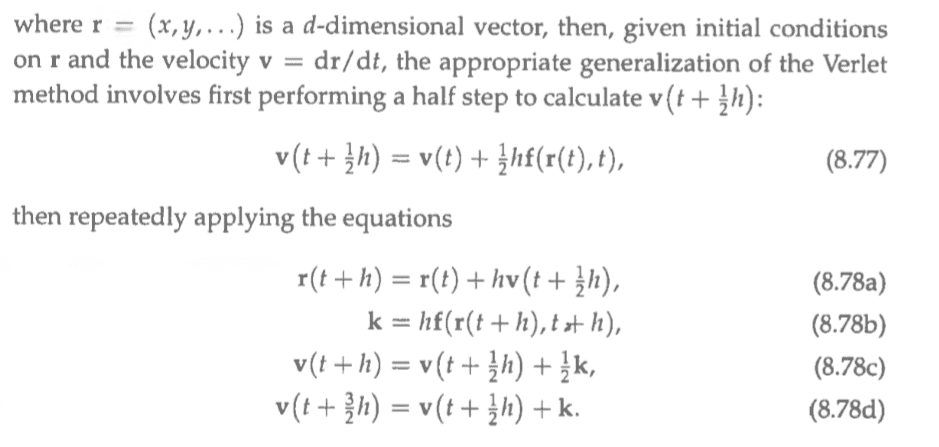
The discussion centers on the Verlet algorithm and its comparison to Runge-Kutta (R-K) methods in the context of energy conservation in simulations of gravitational systems. Participants explore the steps involved in the Verlet algorithm, express confusion over specific equations, and discuss the implications of energy calculations in their simulations.
Discussion Character
- Exploratory
- Technical explanation
- Debate/contested
- Mathematical reasoning
Main Points Raised
- Some participants express confusion about the steps in the Verlet algorithm, particularly regarding the calculation of velocities at different time increments.
- There is a discussion about the absence of a step labeled 8.78 and the clarification that subsequent steps should be performed in succession rather than as a loop.
- One participant notes that the Verlet algorithm may not be very accurate and mentions their initial attempts to solve a one-body problem using the R-K method, which they found unproductive.
- Participants discuss the formulation of Newton's law of universal gravitation and the necessity of considering two masses in gravitational interactions.
- One participant shares their findings on energy values from their simulation, noting that they are close to expected values and considering the effect of time step size on accuracy.
- There is a suggestion that the total energy should remain constant at each step, and that the velocity Verlet method may be better at conserving energy compared to R-K methods.
- Some participants debate the utility of averaging kinetic and potential energy values, with differing opinions on its relevance depending on the type of system being simulated.
Areas of Agreement / Disagreement
Participants generally express confusion and uncertainty regarding the steps of the Verlet algorithm and the implications for energy conservation. There are competing views on the effectiveness of the Verlet algorithm compared to R-K methods, particularly regarding energy conservation, and the discussion remains unresolved.
Contextual Notes
Participants highlight limitations in their understanding of the Verlet algorithm and its application, as well as potential inaccuracies in energy calculations due to numerical methods and time step sizes.