How Far Should a Helicopter Drop a Food Packet for Flood Victims?

Click For Summary

Homework Help Overview

The discussion revolves around a helicopter's operation in a flood relief scenario, specifically focusing on the mechanics of dropping a food packet for victims on the ground. The problem involves understanding the trajectory of the packet when released from a moving helicopter at a certain altitude.

Discussion Character

  • Exploratory, Assumption checking, Problem interpretation

Approaches and Questions Raised

  • Participants explore the implications of the helicopter's horizontal movement and its effect on the packet's trajectory. Questions arise regarding the initial velocity of the packet and the positioning of the victims relative to the helicopter during the drop.

Discussion Status

There is an ongoing examination of the assumptions surrounding the problem, particularly concerning the helicopter's position relative to the victims and the nature of projectile motion. Some participants suggest using a specific diagram from the textbook to clarify the situation, while others express confusion about the mechanics involved.

Contextual Notes

Participants note that the problem statement indicates the helicopter is flying horizontally, which complicates the drop scenario. There is also mention of differing interpretations of the diagrams provided in the textbook, leading to confusion about the correct approach to the problem.

gracy
Messages
2,486
Reaction score
83
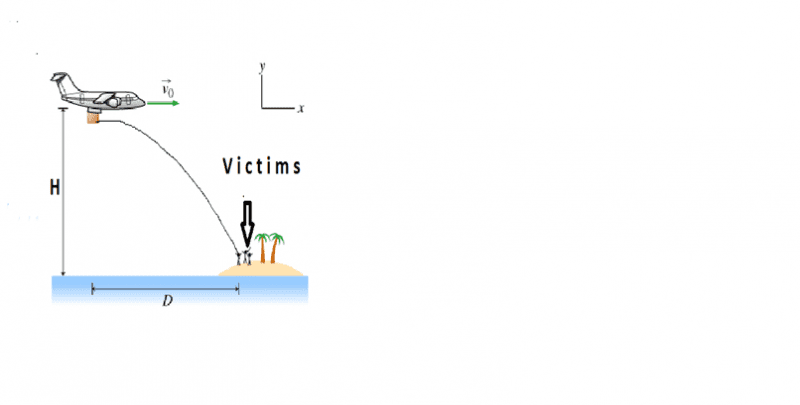
A helicopter on a flood relief mission flying horizontally with a speed vo at an altitude H, has to drop a food packet for victims standing on the ground. At what 'distance from the victims should the food packet be dropped'?the victims are standing in the vertical plane of the helicopter.
In my textbook diagram for this problem is given
(a)
upload_2014-11-21_19-49-29.png

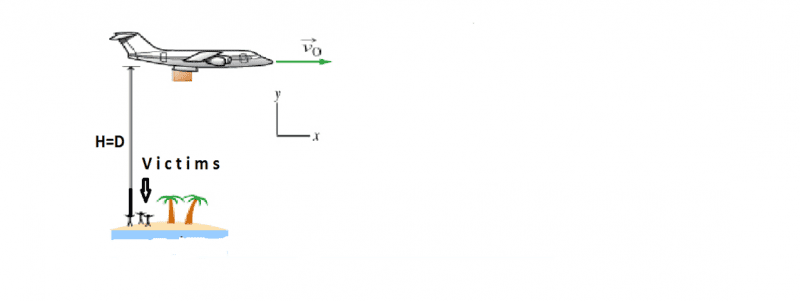
but what i am confused about is why victims are standing there, can't they stand just beneath the helicopter like this (b)
upload_2014-11-21_20-33-41.png
after all ,victims are standing in the vertical plane of the helicopter in this picture also .So 'distance from the victims should the food packet be dropped 'is equal to height H .That's what i thought and chose the option H as answer for this MCQ.But in my textbook 'distance from the victims should the food packet be dropped' i.e D is taken as in Picture (a) and hence solved this problem in totally different way.So what is wrong in picture b ,victims are still in the vertical plane of the helicopter as mentioned in the question.please do reply.
Thanks.
 

Attachments

  • upload_2014-11-21_19-23-51.png
    upload_2014-11-21_19-23-51.png
    55.3 KB · Views: 1,053
  • upload_2014-11-21_19-35-27.png
    upload_2014-11-21_19-35-27.png
    25.4 KB · Views: 828
  • upload_2014-11-21_20-30-21.png
    upload_2014-11-21_20-30-21.png
    36 KB · Views: 1,187
Last edited:
Physics news on Phys.org
When dropped from a moving helicopter (looks like a plane to me), do the packets fall straight down?
 
  • Like
Likes   Reactions: gracy
Doc Al said:
When dropped from a moving helicopter (looks like a plane to me), do the packets fall straight down?
assume it as helicopter.
 
Doc Al said:
do the packets fall straight down?
I didn't understand what you are trying to ask.please clear your question
 
gracy said:
I didn't understand what you are trying to ask.please clear your question
I'll ask in a different way: When the packets first leave the helicopter, what velocity do they have?
 
Doc Al said:
I'll ask in a different way: When the packets first leave the helicopter, what velocity do they have?
it is not given.i am just concerned and confused about position of victims.please review my full question.
 
I think you are confused by the fact that a helicopter is mentioned. It seems like since the problem statement mentions a helicopter and you don't see a helicopter in the figure, you are ignoring other parts of the figure (such as the fact that the vehicle in question is not hovering over the survivors). I think it'd be reasonable for you to assume that the helicopter/plane is not hovering over the survivors. Then this becomes a non-trivial (in that you have to use at least one equation) projectile motion problem.

I recommend you use figure a. Assume the vehicle is some lateral distance away from the survivors when it drops the package.
 
gracy said:
it is not given.
Actually, it is given.

gracy said:
i am just concerned and confused about position of victims.please review my full question.
I understand your question. Please answer my questions, as they are meant to clear up yours.

(And read DocZaius's post above.)
 
DocZaius said:
I think you are confused by the fact that a helicopter is mentioned. It seems like since the problem statement mentions a helicopter and you don't see a helicopter in the figure, you are ignoring other parts of the figure (such as the fact that the vehicle in question is not hovering over the survivors). I think it'd be reasonable for you to assume that the helicopter/plane is not hovering over the survivors. Then this becomes a non-trivial (in that you have to use at least one equation) projectile motion problem.

I recommend you use figure a. Assume the vehicle is some lateral distance away from the survivors when it drops the package.
i think there is some misunderstanding.picture (a)is given in my textbook but not in question but as a solution.
 
  • #10
Doc Al said:
Actually, it is given.
how?initial velocity of packet is same as that of helicopter i.e vo,right?
 
  • #11
gracy said:
how?initial velocity of packet is same as that of helicopter i.e vo,right?
yes
 
  • #12
gracy said:
how?initial velocity of packet is same as that of helicopter i.e vo,right?
which is a velocity, represented as an arbitrary unknown rather than a specific number.
 
  • #13
gracy said:
i think there is some misunderstanding.picture (a)is given in my textbook but not in question but as a solution

Ah ok. In that case I understand your confusion more. However the problem statement does say the helicopter is flying horizontally. This means that the package will be moving both horizontally and vertically upon being dropped. So the helicopter cannot be directly above the survivors at the moment it drops the package. In your (second) diagram, the package would miss the survivors since it would move horizontally at the speed of the vehicle. The vehicle needs to be located laterally "before" the survivors. Find that distance.
 
  • #14
gracy said:
i think there is some misunderstanding.picture (a)is given in my textbook but not in question but as a solution.
The picture fits the question (except they show a plane, not a helicopter).

gracy said:
how?initial velocity of packet is same as that of helicopter i.e vo,right?
Right. So what sort of trajectory would you expect it have as it fell? Would you expect it to fall straight down?
 
  • #15
DocZaius said:
This means that the package will be moving both horizontally and vertically upon being dropped.
why?can you please make me understand this point.
 
  • #16
gracy said:
why?can you please make me understand this point.
Drop a ball. How does it fall to the ground?

Throw a ball horizontally. How does it fall to the ground?
 
  • #17
Doc Al said:
Drop a ball. How does it fall to the ground?

Throw a ball horizontally. How does it fall to the ground?
in first case vertically and in second case it's path would be projectile.
 
  • #18
gracy said:
in first case vertically and in second case it's path would be projectile.
Right. The second case would take a parabolic trajectory. (Both cases are projectile motion.)

The second case is exactly like the one in your problem. Since the packet has an initial horizontal velocity, it is just as if it were thrown at that speed.
 
  • #19
how first case is an example of projectile motion?
 
  • #20
better example than throwning a ball. Drop the ball. Have your friend get in a car and drive past your house and then drop the ball. The second case is identical to the situation, except it's a helicoptor (plane?), not a car.
 
  • #21
gracy said:
how first case is an example of projectile motion?
The projectile is being "projected" directly downwards. It doesn't have to be shot sideways out of a cannon to be a projectile.
 
  • #22
BiGyElLoWhAt said:
The projectile is being "projected" directly downwards. It doesn't have to be shot sideways out of a cannon to be a projectile.
actually i have tried this at home.ball fall vertically downward not followed parabolic path as in projectile motion.
 
  • #23
Doc Al said:
Drop a ball.
actually i have tried this at home.ball fall vertically downward not followed parabolic path as in projectile motion.
 
  • #24
gracy said:
actually i have tried this at home.ball fall vertically downward not followed parabolic path as in projectile motion.

I'm guessing you weren't moving when you dropped the ball then. Now drop the ball while walking. Does it still fall vertically?

EDIT: Also, as BiGyElLoWhAt points out below, it's still following a path that is described as "projectile motion". A vertical free-fall is a special case of projectile motion with no sideways velocity.
 
  • #25
It doesn't have to be parabolic to be projectile. It's a projectile with zero x component in the velocity.
 
  • #26
cjl said:
I'm guessing you weren't moving when you dropped the ball then. Now drop the ball while walking. Does it still fall vertically?
You won't notice it walking. Get on a bike or a skateboard or have a friend drive a car and just watch the ball. Maybe pull out your phone and record it, but make sure to keep the phone stationary when you do. Watch the ball leave your friends hand and shoot across the screen out of view of the camera.
 
  • #27
cjl said:
. A vertical free-fall is a special case of projectile motion with no sideways velocity.
you mean straight vertical path is also a projectile?i have never been told this in class.
 
  • #28
Yes it is - it follows the exact same equations of motion. Try it - if you use whatever equations you were given in class, and plug in zero for the initial horizontal velocity, what do you get?
 
  • #29
cjl said:
- it follows the exact same equations of motion.
equations of motions?suvat equations,right?we will not take projectile specific equations such as for maximum height,range,time of flight in this type of vertical free fall projectile motion?
 
  • #30
All of those equations work just as well for vertical projectile motion as they do for angled projectile motion. As I said - try using them with some arbitrary initial conditions (with zero initial horizontal velocity) and see what they tell you.
 
  • Like
Likes   Reactions: BiGyElLoWhAt

Similar threads

Replies
9
Views
8K
  • · Replies 2 ·
Replies
2
Views
2K
  • · Replies 6 ·
Replies
6
Views
2K
Replies
1
Views
7K
  • · Replies 16 ·
Replies
16
Views
9K
  • · Replies 1 ·
Replies
1
Views
2K
Replies
6
Views
3K
  • · Replies 6 ·
Replies
6
Views
5K
  • · Replies 1 ·
Replies
1
Views
2K
  • · Replies 7 ·
Replies
7
Views
3K