How forces act on a shape and its centre of Mass

Click For Summary
SUMMARY

This discussion centers on the application of uniformly distributed forces on oddly shaped objects and their relationship to the center of mass and centroid. The participants clarify that a uniformly distributed force, such as 100N over an area of 1200m², results in a pressure of 100/1200 N/m². The equivalent point force acts at the centroid of the area, not necessarily at the center of mass, which can lead to rotational effects if the two points do not coincide. Understanding these concepts is crucial for accurately analyzing forces in engineering and physics applications.

PREREQUISITES
  • Understanding of Centroids and Centre of Mass
  • Knowledge of pressure and force relationships
  • Familiarity with distributed loads in structural analysis
  • Basic principles of mechanics and equilibrium
NEXT STEPS
  • Study the relationship between pressure and force in mechanics
  • Learn about the calculation of centroids for various shapes
  • Explore the effects of force distribution on structural stability
  • Investigate the differences between center of mass and centroid in non-uniform objects
USEFUL FOR

Students and professionals in engineering, physics, and mechanics who are analyzing forces on structures and need to understand the implications of force distribution on stability and motion.

tomtomtom1
Messages
160
Reaction score
8
Homework Statement
I am now trying to understand how a uniformally distributed force and a non uniformally distributed force acts on a shape.
Relevant Equations
I am now trying to understand how a uniformally distributed force and a non uniformally distributed force acts on a shape.
Hello all

After a lot of support from people like [U]Dr.D[/U], [U]mfig[/U] and [U]collinsmark[/U] I have finally understood the concept of Centriods and Centre of Mass.

I am now trying to understand how a uniformally distributed force and a non uniformally distributed force acts on a shape.

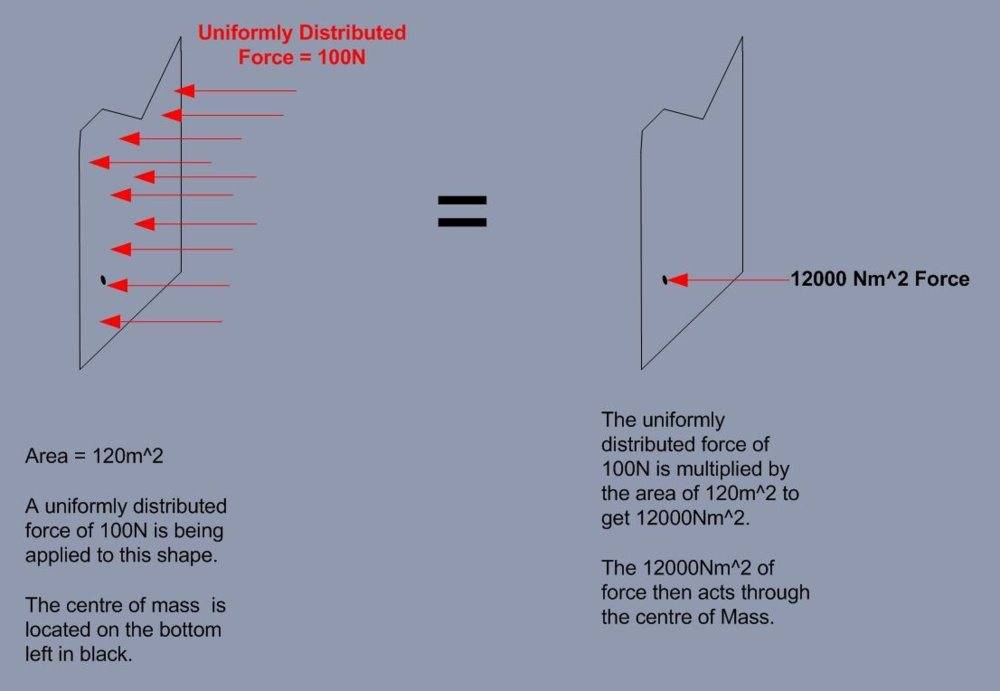
If I had an oddly shaped object for which I found the centre of mass and its surface area.

I then applied a uniformly distributed force of 100N on that object's surface, then would I be correct in saying that the uniformly distributed force of 100N is converted to an equivalent point force by multiplying the area by the force. The equivalent point force then acts through the objects centre of mass.

Below is a picture of what I am trying to understand:-
eplpplp.JPG


Would this illustration be correct?

Thank you.
 
  • Like
Likes   Reactions: Stephen Tashi and Delta2
Physics news on Phys.org
tomtomtom1 said:
Homework Statement: I am now trying to understand how a uniformally distributed force and a non uniformally distributed force acts on a shape.
Homework Equations: I am now trying to understand how a uniformally distributed force and a non uniformally distributed force acts on a shape.

Hello all

After a lot of support from people like [U]Dr.D[/U], [U]mfig[/U] and [U]collinsmark[/U] I have finally understood the concept of Centriods and Centre of Mass.

I am now trying to understand how a uniformally distributed force and a non uniformally distributed force acts on a shape.

If I had an oddly shaped object for which I found the centre of mass and its surface area.

I then applied a uniformly distributed force of 100N on that object's surface, then would I be correct in saying that the uniformly distributed force of 100N is converted to an equivalent point force by multiplying the area by the force. The equivalent point force then acts through the objects centre of mass.

Below is a picture of what I am trying to understand:-

View attachment 253432

Would this illustration be correct?

Thank you.
Nearly right, but if a 100N force is uniformly distributed over an area then that gives a pressure: force per unit area. 100/1200 N/m2 in this case. So equating that to a point force by multiplying back again by the area gives you 100N again, as is required for it be a force, not Nm2.
 
  • Like
Likes   Reactions: poseidon721 and Delta2
Haruspex

Thank you for the response.

Ignoring the units for now, then everything else is correct then?

A uniformally distributed force is concentrated to a point force by multiplying the force by the area, and this point force acts through the centre of mass of the object.

I just need to get the units correct.
 
tomtomtom1 said:
Haruspex

Thank you for the response.

Ignoring the units for now, then everything else is correct then?

A uniformally distributed force is concentrated to a point force by multiplying the force by the area, and this point force acts through the centre of mass of the object.

I just need to get the units correct.
No, you are missing the main point of my post.
You started with a force, 100N. You said this was uniformly distributed over an area of 1200m2. That means you have a pressure of 100/1200 N/m2.
You can multiply the pressure by the area to get back to 100N to find the equivalent point force, but it makes no sense to multiply a force by an area, and it certainly does not give a force as an answer.

Edit: following @Cutter Ketch 's post below, I realize I misread your original post. I thought you had stated the plate was uniform. All my preceding comments are on that basis.
If the plate is not uniform then there is no relationship between the centre of mass and the effective location of the force. How could there be? The force does not "know" how the mass is distributed, only how the force itself is distributed.
 
Last edited:
  • Like
Likes   Reactions: Delta2
If the force is uniformly distributed over an area, the equivalent point force would be at the geometric center of the area. This does not necessarily correspond to the center of mass of the object.
Say a lightweight circular trampoline is falling straight down through the air. At the moment the trampoline happens to be horizontal. The nearly uniform pressure of the relative wind acts at the center of the trampoline. If a person is at the center so that the center of mass is at the center the trampoline will not tend to tip. (Well, real world, turbulence, flow around the edges, yada yada yada, but at least it won’t have a strong tendency to flip over immediately). If, on the other hand the person is near the edge so that the center of mass is well away from the center of the trampoline, the wind force acting at the center is a large torque about the CM and the trampoline will flip immediately.
 
  • Like
Likes   Reactions: BvU and Delta2
haruspex said:
No, you are missing the main point of my post.
You started with a force, 100N. You said this was uniformly distributed over an area of 1200m2. That means you have a pressure of 100/1200 N/m2.
You can multiply the pressure by the area to get back to 100N to find the equivalent point force, but it makes no sense to multiply a force by an area, and it certainly does not give a force as an answer.

Edit: following @Cutter Ketch 's post below, I realize I misread your original post. I thought you had stated the plate was uniform. All my preceding comments are on that basis.
If the plate is not uniform then there is no relationship between the centre of mass and the effective location of the force. How could there be? The force does not "know" how the mass is distributed, only how the force itself is distributed.

Hi Haruspex

I think I'm more confused then I was to start with, I have made things more confusing myself so my apologies.

If I can step back a moment; I am trying to determine the method to convert a uniformly distributed force being applied over a shapes surface area into an equivalent point force that acts through the centre of mass and the centroid (where centre of mass and centroid are the same point).

I have amended my diagram to look like:-

UDL.JPG


Is there a method of converting a uniformly distributed force of 100N being applied to a surface area 0f 120m^2 into an equivalent point force that acts through the centre of mass and the centroid?

This is what I am trying to determine.
 
tomtomtom1 said:
where centre of mass and centroid are the same point)
If they are the same point then that sets aside @Cutter Ketch's objection.
But I feel greater understanding is to be had by treating it more generally.

A uniformly applied force will be equivalent to a single force applied at the plate's centroid, regardless of where the mass centre is.
If the total distributed force is 100N then the equivalent point force is 100N. There is nothing to be gained by first dividing by the plate's area to obtain a pressure then multiplying by it again to obtain the magnitude of the point force.

In your original post you confused force with pressure. Because the force is spread uniformly you reasonably thought of it as being a pressure, but failed to realize that to evaluate the pressure you need to divide the total force by the area.

Similarly, if the plate has a uniform mass distribution then its mass centre will be at the plate's centroid regardless of how the force is distributed. The force distribution will have its own centroid.
 
haruspex said:
If they are the same point then that sets aside @Cutter Ketch's objection.
But I feel greater understanding is to be had by treating it more generally.

A uniformly applied force will be equivalent to a single force applied at the plate's centroid, regardless of where the mass centre is.
If the total distributed force is 100N then the equivalent point force is 100N. There is nothing to be gained by first dividing by the plate's area to obtain a pressure then multiplying by it again to obtain the magnitude of the point force.

In your original post you confused force with pressure. Because the force is spread uniformly you reasonably thought of it as being a pressure, but failed to realize that to evaluate the pressure you need to divide the total force by the area.

Similarly, if the plate has a uniform mass distribution then its mass centre will be at the plate's centroid regardless of how the force is distributed. The force distribution will have its own centroid.
Hi Haruspex

Firstly thank you for all your input, I really do appreciate it and I know this very difficult because I am struggling to understand it but I need to be able to intimately understand this otherwise there is no point in learning it - but I know I will get there.

A uniformly applied force will be equivalent to a single force applied at the plate's centroid, regardless of where the mass centre is. - Is this a physics fact in that a “uniformly applied force will be equivalent to a single force applied at the plate's centroid” will it ALWAYS be applied to the centroid? - the reason I ask is because I thought that the equivalent single force would be applied to the centre of mass not the centroid.

Also If the equivalent single force is always applied to the centroid, then if the Centroid and the centre of mass were located at different points then this would cause a rotation about the centre of mass.

If the total distributed force is 100N then the equivalent point force is 100N. – The reason why I multiplied it by the surface area is because when working out reaction forces for beams; to convert a uniformly distributed load for a simply supported beam I must multiply the distributed load by the area or span the load covers for example: -

ffffff.png


As you can see I have multiplied the load of 20kN/m by 5m to get 100kN, and this point load acts at the beams ½ way point which I thought was always the centre of mass but now I know that the point load actually acts on the centroid. I was trying to take the above example and apply it to a surface area. So why in this case would you multiply the load by the span but in my plate example you would not multiply the distributed load by the area?

Finally where you have stated “The force distribution will have its own centroid” - not sure what this means can you elaborate.

Thank you once again.
 
tomtomtom1 said:
A uniformly applied force will be equivalent to a single force applied at the plate's centroid, regardless of where the mass centre is. - Is this a physics fact in that a “uniformly applied force will be equivalent to a single force applied at the plate's centroid” will it ALWAYS be applied to the centroid? - the reason I ask is because I thought that the equivalent single force would be applied to the centre of mass not the centroid.
Uniform distribution of the force is a relationship between the force and the region over which it is distributed. It is independent of the mass distribution over the region.
For each (force and mass) independently, if the distribution is uniform then average location is at the centroid of the region.
A continuously distributed force can be described as exerting a pressure which is a function of position, ##P(\vec x)## at point ##\vec x##, say. The total force is the integral over the area, ∫P.dA, where dA is an element of area. (dA is also a vector, but I don't want to complicate matters.)
If the force is uniform then P is constant and can be factored out: ##F=P\int.dA##. But ∫.dA is just the total area, A.
To find the effective location of the force, ##\bar x## (its average position) we write ##F.\bar x=\int P(\vec x).\vec x.dA##. (This is a "balance of moments" equation.). Again, with P constant we factor it out to produce ##F.\bar x=P\int \vec x.dA##.
By definition, ##\frac{\int \vec x.dA}{\int .dA}## is the location of the centroid of the area, so we deduce ##\bar x## is the centroid.
We can perform exactly the same calculation in respect of a uniform mass distribution.
tomtomtom1 said:
Also If the equivalent single force is always applied to the centroid, then if the Centroid and the centre of mass were located at different points then this would cause a rotation about the centre of mass.
Yes.
tomtomtom1 said:
when working out reaction forces for beams; to convert a uniformly distributed load for a simply supported beam I must multiply the distributed load by the area or span the load covers
Yes, but note that the load is specified as a force per unit length (kN/m), not as a force. So to find the total force you needed to multiply by the length.
If the force is over an area then it may be specified as a force per unit area, i.e. a pressure, maybe kN/m2. So in your post #1 you would have it as (100/1200)N/m2. Again, to find the total force you would multiply that by the area; but since you stated the total force there was no need to do the division and multiplication; that would be wasted efffort.
 
  • Like
Likes   Reactions: tomtomtom1
  • #10
haruspex said:
Uniform distribution of the force is a relationship between the force and the region over which it is distributed. It is independent of the mass distribution over the region.
For each (force and mass) independently, if the distribution is uniform then average location is at the centroid of the region.
A continuously distributed force can be described as exerting a pressure which is a function of position, ##P(\vec x)## at point ##\vec x##, say. The total force is the integral over the area, ∫P.dA, where dA is an element of area. (dA is also a vector, but I don't want to complicate matters.)
If the force is uniform then P is constant and can be factored out: ##F=P\int.dA##. But ∫.dA is just the total area, A.
To find the effective location of the force, ##\bar x## (its average position) we write ##F.\bar x=\int P(\vec x).\vec x.dA##. (This is a "balance of moments" equation.). Again, with P constant we factor it out to produce ##F.\bar x=P\int \vec x.dA##.
By definition, ##\frac{\int \vec x.dA}{\int .dA}## is the location of the centroid of the area, so we deduce ##\bar x## is the centroid.
We can perform exactly the same calculation in respect of a uniform mass distribution.

Yes.

Yes, but note that the load is specified as a force per unit length (kN/m), not as a force. So to find the total force you needed to multiply by the length.
If the force is over an area then it may be specified as a force per unit area, i.e. a pressure, maybe kN/m2. So in your post #1 you would have it as (100/1200)N/m2. Again, to find the total force you would multiply that by the area; but since you stated the total force there was no need to do the division and multiplication; that would be wasted efffort.

Haruspex

Based on what you have told me I can say the following:-

For any object the Centre of Mass and Centroid can be:-
  • At the same location for materials with uniform density.
  • Different locations for materials with non-uniform density.
For any object that is subjected to a uniformly distributed load which is converted to an equivalent point load, always acts at the objects Centriod regardless of the where the centre of mass is located, therefore it can be stated that:-
  • If the COM and Centriod are located at the same point, then the object will move as a particle with no rotation.
  • If the COM and Centriod is located at different points, then the object will rotate about the centre of mass.

What I have summarized makes sense to me and I understand it thanks to you. Just based on these points would you agree?

Once again I thank you for your time, effort and knowledge.

Tom
 
Last edited:
  • #11
Yes, that's all good, but be careful with this statement:
tomtomtom1 said:
If the COM and Centriod is located at different points, then the object will rotate about the centre of mass.
That could be read as meaning the mass centre stays fixed and the object rotates around it.
If the object has mass m and the force applied is F then the acceleration of the object will be F/m. This is true regardless of the distributions of mass and force.
The rotation of the object about its mass centre will be additional to this linear motion.
 
  • #12
haruspex said:
Yes, that's all good, but be careful with this statement:

That could be read as meaning the mass centre stays fixed and the object rotates around it.
If the object has mass m and the force applied is F then the acceleration of the object will be F/m. This is true regardless of the distributions of mass and force.
The rotation of the object about its mass centre will be additional to this linear motion.

Hi Haruspex

Something has hit home regarding your comment about the centriod of a force distribution.

After some head scratching I was hoping I could get your opinion on the following:-

fd.JPG
In Diagram A have a non uniform force that is being applied to my shape.
The centre of mass & centroid are the same location as the density of the material is uniform.

In Diagram B I have calculated the X,Y,Z position of the force distribution shown in blue.
I now have 2 x centroids, one for my shape and one for my force distribution.

In Diagram C I have projected the centroid of my force distribution onto my shape shown in yellow.
If I converted my non uniform distributed load into an equivalent point load then would it be correct to say that the point force would act at the projected centroid (yellow) and not the centroid of my shape.

Is this correct?
 
Last edited:
  • #13
tomtomtom1 said:
Hi Haruspex

Something has hit home regarding your comment about the centriod of a force distribution.

After some head scratching I was hoping I could get your opinion on the following:-

View attachment 253522In Diagram A have a non uniform force that is being applied to my shape.
The centre of mass & centroid are the same location as the density of the material is uniform.

In Diagram B I have calculated the X,Y,Z position of the force distribution shown in blue.
I now have 2 x centroids, one for my shape and one for my force distribution.

In Diagram C I have projected the centroid of my force distribution onto my shape shown in yellow.
If I converted my non uniform distributed load into an equivalent point load then would it be correct to say that the point force would act at the projected centroid (yellow) and not the centroid of my shape.

Is this correct?
you've got it!
 
  • Like
Likes   Reactions: tomtomtom1
  • #14
haruspex said:
you've got it!
Thanks hatuspex
 

Similar threads

Replies
16
Views
2K
Replies
1
Views
1K
Replies
5
Views
576
  • · Replies 4 ·
Replies
4
Views
2K
  • · Replies 4 ·
Replies
4
Views
2K
  • · Replies 13 ·
Replies
13
Views
3K
  • · Replies 7 ·
Replies
7
Views
3K
Replies
5
Views
3K
  • · Replies 6 ·
Replies
6
Views
889