How Is Fluid Pressure Calculated in a U-Tube Experiment?

Click For Summary
SUMMARY

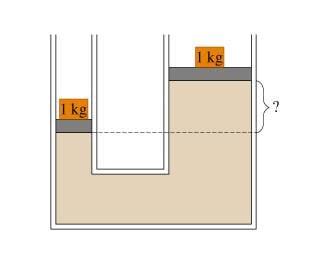
The calculation of fluid pressure in a U-tube experiment involves understanding the equilibrium of forces acting on the liquid columns. The pressure at the dashed line in the left arm is calculated as 1 kg / πr², while the pressure at the top of the right tube is 1 kg / 4πr². By applying the formula p - p₀ + ρg*d and using the density of water (ρ = 1000 kg/m³), the derived mass of water in the right arm is found to be incorrect due to miscalculations in force equilibrium. The correct approach requires equating the upward force from the left arm to the weight of the liquid on the right side.

PREREQUISITES
  • Understanding of fluid mechanics principles
  • Familiarity with pressure calculations in fluids
  • Knowledge of the U-tube experiment setup
  • Basic algebra for solving equations
NEXT STEPS
  • Study the derivation of fluid pressure equations in static fluids
  • Learn about the U-tube experiment and its applications in measuring pressure differences
  • Explore the concept of hydrostatic pressure and its calculations
  • Investigate the effects of varying densities on fluid pressure in different scenarios
USEFUL FOR

Students and educators in physics, engineers working with fluid dynamics, and researchers conducting experiments involving fluid pressure measurements.

Linus Pauling
Messages
187
Reaction score
0
1.
1013534D.jpg


The locations of the two caps at equilibrium are now as given in this figure. (Part D figure) The dashed line represents the level of the water in the left arm.
What is the mass of the water located in the right arm between the dashed line and the right cap?


3. p - p_0 +rho*g*d

The pressure at the dashed line is 1kg / pi*r^2. I take r to be 1, so p = 1/pi
p_0, the pressure at the top of the right tube is 1kg / pi*(2r)^2 = 1/4pi

With these two values, and rho = density of water = 1000 kg/m^3, I solve for d and obtain:

d = 2.44*10^-5

I multiply that by A on the right tube to get volume = 4pi(2.44*10^-5) = 3.07*10^-4

Multiply by denisty to obtain mass, m = 0.307 which is incorrect.
 
Physics news on Phys.org
The pressure due to the mass on the left at the dashed line is
P = F/A = mg/A = 1*g/A
so it pushes upward on the right side (at the dashed line) with force
F = PA = 1*g.
This upward force must equal the weight of the mass and extra liquid on the right. It results in an answer about 10 times as large as you have.
 

Similar threads

  • · Replies 17 ·
Replies
17
Views
2K
  • · Replies 22 ·
Replies
22
Views
1K
  • · Replies 15 ·
Replies
15
Views
3K
  • · Replies 2 ·
Replies
2
Views
7K
  • · Replies 2 ·
Replies
2
Views
5K
Replies
3
Views
2K
  • · Replies 5 ·
Replies
5
Views
4K
  • · Replies 1 ·
Replies
1
Views
2K
  • · Replies 3 ·
Replies
3
Views
16K
Replies
1
Views
2K