How is mass flow an inexact differential

Click For Summary
Mass flow rate within an annular region of a pipe is considered an inexact differential due to its path-dependent nature, similar to heat and momentum flux. The distinction arises because mass flow is typically analyzed in terms of gradients, such as velocity and concentration, rather than as a simple difference between two states. This leads to confusion, as it seems counterintuitive that mass flow through the annulus does not equal the difference between mass flows at two radii. The discussion highlights the difficulty in understanding this concept, especially when compared to more straightforward examples like heat and work. Overall, the text's explanation is deemed inadequate by some participants in the discussion.
granzer
Messages
15
Reaction score
1
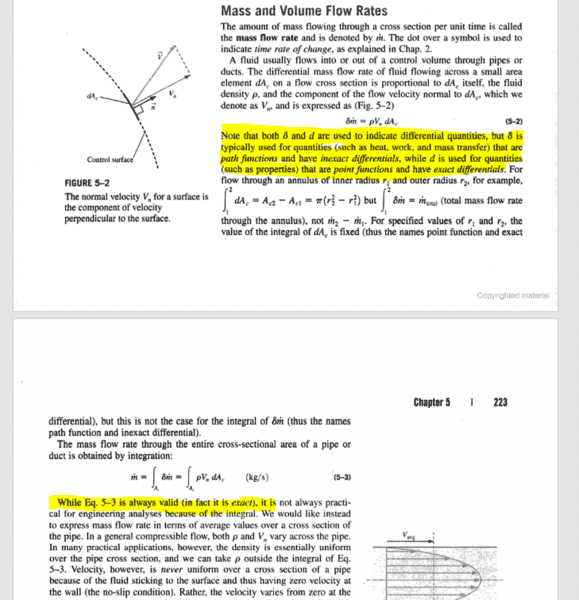
How is mass flow rate within an annular region of a pipe taken to be an inexact differential?

I read it in Fluid Mechanics textbook by Yunus A. Cengel and John M. Cimbala.
4.PNG

The mass flow rate through the annulus is given to be inexact differential. Why is mass flow through the annulus not equal to
(m2)-(m1)
Given any 2 radius r2 and r1?
Won't the mass flow rate in the annulus be equal to (mass flow through the area with radius r2)-(mass flow through the area with radius r1) ie m2-m1?
Also later it goes on to say that the mass flow rate is exact.
Thank you.
 

Attachments

  • 4.PNG
    4.PNG
    56.9 KB · Views: 1,659
Engineering news on Phys.org
I have no idea why they are making this distinction. Just keep moving on and see if it makes any kind of sense later.
 
Chestermiller said:
I have no idea why they are making this distinction. Just keep moving on and see if it makes any kind of sense later.
@Chestermiller Yes sir, that's what I have been doing. Heat and work are easy to be understood as inexact. But this particular example is difficult to grasp.
 
granzer said:
@Chestermiller Yes sir, that's what I have been doing. Heat and work are easy to be understood as inexact. But this particular example is difficult to grasp.
They are trying to say that the three transport quantities heat flux, momentum flux, and mass flux are path-dependent. But, in the case of mass flux, it is usually thought of in terms of diffusion. Heat flux (conductive) is proportional to the temperature gradient, mass flux is proportional to the velocity gradient, and mass flux (diffusion) is proportional to the concentration gradient. This is the analogy they are trying to establish.

Their description here does not work for me either.
 
I can't stand that text. This is a good example of why.
 
What mathematics software should engineering students use? Is it correct that much of the engineering industry relies on MATLAB, making it the tool many graduates will encounter in professional settings? How does SageMath compare? It is a free package that supports both numerical and symbolic computation and can be installed on various platforms. Could it become more widely used because it is freely available? I am an academic who has taught engineering mathematics, and taught the...

Similar threads

Replies
0
Views
2K
  • · Replies 1 ·
Replies
1
Views
2K
Replies
1
Views
2K
  • · Replies 5 ·
Replies
5
Views
5K
  • · Replies 4 ·
Replies
4
Views
2K
Replies
1
Views
2K
  • · Replies 12 ·
Replies
12
Views
3K
  • · Replies 35 ·
2
Replies
35
Views
4K
Replies
3
Views
8K
Replies
3
Views
2K