How is x-vt a rightward moving wave?

  • Thread starter Thread starter Jaccobtw
  • Start date Start date
Jaccobtw
Messages
167
Reaction score
32
Homework Statement
How is x-vt a rightward moving wave?
Relevant Equations
f(x-vt) = disturbance
The only way I can see x-vt being a rightward moving wave is if x-vt = some position the wave had initially. As t increases, x-vt gets smaller, despite the fact that it is a rightward moving wave. For example, if x = 10 m and v = 1 m/s, as t increases, x-vt describes a position the wave had in the past. Is this correct intuition?
 
Physics news on Phys.org
It's a rightward moving wave for ##v > 0##. At ##t =0##, the wave takes the form of ##y = f(x)##. Choose a function ##f##. Something simple. For example ##f(x) = x##. Draw that initial state of the wave on a graph.

Then, for ##t = 1##, say, the wave takes the form ##y = f(x -v) = x -v##. Draw that state of the wave on a graph. Take ##v = 1## as well, so that ##y = x - 1##.

Has the wave moved left or right?
 
Another way of looking at this is from the standpoint of the wave.

For positive ##x## at a particular instant in time ##t## and at position ##x##, the function ##f(x-vt)## return a specific value, say ##3## units. Time always increases. At a later time ##t'>t## must ##x## increase, decrease or stay the same for the function to return the same value of ##3## units?
 
PeroK said:
It's a rightward moving wave for ##v > 0##. At ##t =0##, the wave takes the form of ##y = f(x)##. Choose a function ##f##. Something simple. For example ##f(x) = x##. Draw that initial state of the wave on a graph.

Then, for ##t = 1##, say, the wave takes the form ##y = f(x -v) = x -v##. Draw that state of the wave on a graph. Take ##v = 1## as well, so that ##y = x - 1##.

Has the wave moved left or right?
f(x) = 10 for t = 0

For t = 1, and v = 1

10-(1)(1) =9

We began at 10 and now we’re at 9, so hasn’t the wave moved to the left?
 
Jaccobtw said:
f(x) = 10 for t = 0

For t = 1, and v = 1

10-(1)(1) =9

We began at 10 and now we’re at 9, so hasn’t the wave moved to the left?
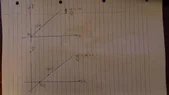
That's not two graphs! This is what the graphs of ##y = x## and ##y = x-1## look like.
 

Attachments

  • Graphs.webp
    Graphs.webp
    18.3 KB · Views: 1
  • Like
Likes   Reactions: Jaccobtw
PS I've shown two points on the wave (P and Q) at times 0 and 1.
 
Another example: consider the function ##f(x)=x^2##, whose graph is a parabola opening upwards, with its vertex at ##(x,y)=(0,0)##.

For ##v=+1##, ##f(x-vt)=(x-t)^2##.

At ##t=0## we have the original function.

At ##t=1##, ##f(x-vt)=(x-1)^2##. It's still a parabola. Where is the vertex?

At ##t=2##, ##f(x-vt)=(x-2)^2##. It's still a parabola. Where is the vertex?
 
  • Like
Likes   Reactions: PeroK
Note that, in general, if ##a > 0## and ##g(x) = f(x-a)##, then ##g(x)## is ##f(x)## translated to the right. One way to see this is to consider a point ##x_0## where ##f(x_0) = 0##. The corresponding zero for the function ##g(x)## is at ##x_1 = x_0 + a##. As ##g(x_1) = f(x_1 - a) = f(x_0 + a - a) = f(x_0) = 0##.

From this, we can see that the zeroes of the function ##g(x)## are the zeroes of the function ##f(x)## translated to the right by ##a##. And, everything else is translated to the right as well,
 
PeroK said:
PS I've shown two points on the wave (P and Q) at times 0 and 1.
PeroK said:
That's not two graphs! This is what the graphs of ##y = x## and ##y = x-1## look like.
Thank you, I think I’ve got it down. (x, f(x)) is where we want to find the disturbance. x-vt is the coordinate in the moving reference frame. It says, what is the disturbance at (x, f(x)) when the wave has moved a distance vt.
 
  • #10
Jaccobtw said:
Thank you, I think I’ve got it down. (x, f(x)) is where we want to find the disturbance. x-vt is the coordinate in the moving reference frame. It says, what is the disturbance at (x, f(x)) when the wave has moved a distance vt.
Perhaps, but ##y = f(x - vt)## is a function of two variables. You need either an animation, or to have an additional ##t## axis. Perhaps with ##t## going into the page. It's not enough, IMO, to try to think of a wave as a static function in 2D.
 
  • #11
I’ll try to offer yet another perspective. The function ##f## describes the shape of the wave. We can consider a point on the wave with a particular constant value of ##f##, call it ##f_0##. Now consider how the point (or more generally, points) with this value are moving with time. We have ##f(x-vt) = f_0## so - assuming ##f## is locally invertible - we must have ##x-vt = c_0## for some constant ##c_0## such that ##f(c_0) = f_0##. Solving for ##x## we find $$x= vt + c_0.$$
Therefore, the ##x## value for which the wave takes the value ##f_0## increases (assuming ##v > 0##) with time. The wave moves to the right.
 
  • Informative
Likes   Reactions: PeroK
  • #12
This somewhat repeats what has already been said, but there is an important underlying point that's maybe worth making explicitly...

Suppose you have any function ##y=f(x)## and some (say positive) constant ##a##.

The graphs of ##y=f(x)## and ##y = f(x-a)## are the same shape - but the graph of ##y=f(x-a)## is shifted in the +ve x direction by an amount ##a##.

(Correspondingly, the graphs of ##y=f(x)## and ##y = f(x+a)## are the same shape - but the graph of ##y=f(x+a)## is shifted in the -ve x direction by an amount ##a##.)

For example:
1769864250610.webp

If the ‘constant’ ##a## increases uniformly over time, this means the graph steadily shifts in the +ve x direction.
 
  • Like
Likes   Reactions: PeroK
  • #13
PeroK said:
Perhaps, but ##y = f(x - vt)## is a function of two variables. You need either an animation, or to have an additional ##t## axis. Perhaps with ##t## going into the page. It's not enough, IMO, to try to think of a wave as a static function in 2D.
What if I phrase it like this: We want to find the disturbance at ##(x, f(x))## at time ##t## when the wave travels at velocity ##v##. Subtraction shifts the graph to the right. ##x - vt## is smaller than ##x## because it gives the coordinate where we want to find the disturbance in the moving reference frame.
 
  • #14
Jaccobtw said:
What if I phrase it like this: We want to find the disturbance at ##(x, f(x))## at time ##t## when the wave travels at velocity ##v##. Subtraction shifts the graph to the right. ##x - vt## is smaller than ##x## because it gives the coordinate where we want to find the disturbance in the moving reference frame.
Or, let the mathematics speak for itself. See post #12 by Steve.
 

Similar threads

  • · Replies 4 ·
Replies
4
Views
2K
Replies
4
Views
2K
  • · Replies 13 ·
Replies
13
Views
2K
  • · Replies 30 ·
2
Replies
30
Views
3K
  • · Replies 13 ·
Replies
13
Views
2K
  • · Replies 1 ·
Replies
1
Views
2K
  • · Replies 2 ·
Replies
2
Views
1K
  • · Replies 1 ·
Replies
1
Views
3K
  • · Replies 30 ·
2
Replies
30
Views
3K
  • · Replies 9 ·
Replies
9
Views
3K