_N3WTON_
- 350
- 3
A stop block, s, prevents a crate from sliding down a [itex]\theta = 33 \hspace{2 mm} degrees[/itex] incline. A tensile force [itex]F = (F_{o}t) N[/itex] acts on the crate parallel to the incline, where [itex]F_{o} = 325 \frac{N}{s}[/itex]. If the coefficients of static and kinetic friction between the crate and the incline are [itex]\mu_{s} = 0.325[/itex] and [itex]\mu_{k} = 0.225[/itex], respectively, and the crate has mass of [itex]m = 50.8 kg[/itex], how long will it take until the crate reaches a velocity of [itex]v = 2.44 \frac{m}{s}[/itex] as it moves up the incline.
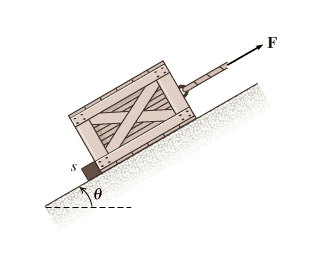
I know when [itex]f < f_{max} = \mu_{s}mgcos(\theta)[/itex], the system isn't moving, and the net force is:
[itex]F - mgsin(\theta) - f = 0[/itex].
[itex]f = F-mgsin(\theta) < \mu_{s}mgcos(\theta)[/itex]
When [itex]t = t_{1}[/itex], [itex]f = \mu_{s}mgcos(\theta)[/itex] so I have:
[itex]325t_{1} - mgsin(\theta) = \mu_{s}mgcos(\theta)[/itex]
[itex]t_{1} = \frac{mg(sin(\theta)+\mu_{s}cos(\theta))}{325}[/itex]
Now plugging in my values:
[itex]t_{1} = \frac{(50.8)(9.81)(sin(33)+(0.325)cos(33))}{325}[/itex]
[itex]t_{1} = 1.25 s[/itex]
So, after 1.25 seconds, the block moves up along the incline and the net force is:
[itex]F - mgsin(\theta) - \mu_{k}mgcos(\theta)[/itex]
The impulse of the net force is:
[itex]\int_{t}^{t_{1}} (F-mgsin(\theta)-\mu_{k}cos(\theta)) = m(v-0)[/itex]
[itex]\int_{t}^{t_{1}}(325t - mgsin(\theta)-\mu_{k}mgcos(\theta)) = mv[/itex]
[itex]162.5(t^{2}-t_{1}^{2}) - mg(sin(\theta)-\mu_{k}cos(\theta))(t-t_{1}) = mv[/itex]
[itex]162.5(t^{2}-(1.25)^{2})-177.4(t-1.25) = 123.95[/itex]
[itex]162.5t^{2} - 177.4t - 126.76 = 0[/itex]
When I solve this quadratic, I get [itex]t = 1.58 s[/itex]. However, this answer is not correct and I am not quite sure where I went wrong. Any help is appreciated. Thanks.
Homework Equations
The Attempt at a Solution
I know when [itex]f < f_{max} = \mu_{s}mgcos(\theta)[/itex], the system isn't moving, and the net force is:
[itex]F - mgsin(\theta) - f = 0[/itex].
[itex]f = F-mgsin(\theta) < \mu_{s}mgcos(\theta)[/itex]
When [itex]t = t_{1}[/itex], [itex]f = \mu_{s}mgcos(\theta)[/itex] so I have:
[itex]325t_{1} - mgsin(\theta) = \mu_{s}mgcos(\theta)[/itex]
[itex]t_{1} = \frac{mg(sin(\theta)+\mu_{s}cos(\theta))}{325}[/itex]
Now plugging in my values:
[itex]t_{1} = \frac{(50.8)(9.81)(sin(33)+(0.325)cos(33))}{325}[/itex]
[itex]t_{1} = 1.25 s[/itex]
So, after 1.25 seconds, the block moves up along the incline and the net force is:
[itex]F - mgsin(\theta) - \mu_{k}mgcos(\theta)[/itex]
The impulse of the net force is:
[itex]\int_{t}^{t_{1}} (F-mgsin(\theta)-\mu_{k}cos(\theta)) = m(v-0)[/itex]
[itex]\int_{t}^{t_{1}}(325t - mgsin(\theta)-\mu_{k}mgcos(\theta)) = mv[/itex]
[itex]162.5(t^{2}-t_{1}^{2}) - mg(sin(\theta)-\mu_{k}cos(\theta))(t-t_{1}) = mv[/itex]
[itex]162.5(t^{2}-(1.25)^{2})-177.4(t-1.25) = 123.95[/itex]
[itex]162.5t^{2} - 177.4t - 126.76 = 0[/itex]
When I solve this quadratic, I get [itex]t = 1.58 s[/itex]. However, this answer is not correct and I am not quite sure where I went wrong. Any help is appreciated. Thanks.