How Long Until a Crate Reaches a Specific Velocity on an Incline?

Click For Summary

Homework Help Overview

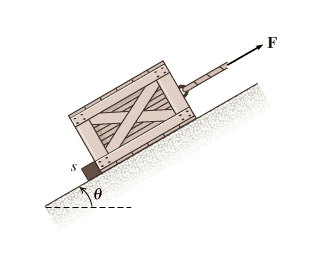
The discussion revolves around a physics problem involving a crate on an incline, where a tensile force acts on it. The participants explore the dynamics of the crate as it moves up the incline, considering factors such as friction, mass, and the angle of the incline.

Discussion Character

  • Mixed

Approaches and Questions Raised

  • Participants discuss the forces acting on the crate, including static and kinetic friction, and how these affect the motion. There are attempts to solve for the time it takes for the crate to reach a specific velocity, with various equations and calculations being presented. Some participants question the correctness of the calculations and the assumptions made during the problem-solving process.

Discussion Status

The discussion is ongoing, with participants providing feedback on each other's calculations and identifying potential errors. There is a collaborative effort to clarify the setup and ensure the correct application of physics principles, although no consensus on the final answer has been reached yet.

Contextual Notes

Participants are working under the constraints of a homework assignment, which may limit the information available or the methods they can use. There are indications of confusion regarding the limits of integration and the signs in the equations, which are being actively addressed in the discussion.

_N3WTON_
Messages
350
Reaction score
3
A stop block, s, prevents a crate from sliding down a \theta = 33 \hspace{2 mm} degrees incline. A tensile force F = (F_{o}t) N acts on the crate parallel to the incline, where F_{o} = 325 \frac{N}{s}. If the coefficients of static and kinetic friction between the crate and the incline are \mu_{s} = 0.325 and \mu_{k} = 0.225, respectively, and the crate has mass of m = 50.8 kg, how long will it take until the crate reaches a velocity of v = 2.44 \frac{m}{s} as it moves up the incline.

upload_2015-3-5_13-0-14.png


Homework Equations

The Attempt at a Solution


I know when f < f_{max} = \mu_{s}mgcos(\theta), the system isn't moving, and the net force is:
F - mgsin(\theta) - f = 0.
f = F-mgsin(\theta) < \mu_{s}mgcos(\theta)
When t = t_{1}, f = \mu_{s}mgcos(\theta) so I have:
325t_{1} - mgsin(\theta) = \mu_{s}mgcos(\theta)
t_{1} = \frac{mg(sin(\theta)+\mu_{s}cos(\theta))}{325}
Now plugging in my values:
t_{1} = \frac{(50.8)(9.81)(sin(33)+(0.325)cos(33))}{325}
t_{1} = 1.25 s
So, after 1.25 seconds, the block moves up along the incline and the net force is:
F - mgsin(\theta) - \mu_{k}mgcos(\theta)
The impulse of the net force is:
\int_{t}^{t_{1}} (F-mgsin(\theta)-\mu_{k}cos(\theta)) = m(v-0)
\int_{t}^{t_{1}}(325t - mgsin(\theta)-\mu_{k}mgcos(\theta)) = mv
162.5(t^{2}-t_{1}^{2}) - mg(sin(\theta)-\mu_{k}cos(\theta))(t-t_{1}) = mv
162.5(t^{2}-(1.25)^{2})-177.4(t-1.25) = 123.95
162.5t^{2} - 177.4t - 126.76 = 0
When I solve this quadratic, I get t = 1.58 s. However, this answer is not correct and I am not quite sure where I went wrong. Any help is appreciated. Thanks.
 
Physics news on Phys.org
Does your answer represent the total time since t = 0? [Edit: Yes, it does. Your work looks good, but I haven't checked your numbers. Let me try it.]
 
TSny said:
Does your answer represent the total time since t = 0? [Edit: Yes, it does. Your work looks good, but I haven't checked your numbers. Let me try it.]
Yes, I'm really not sure where I went wrong on this one...I'm thinking maybe I entered a value incorrectly but I can't see where. I was thinking that having another set of eyes look over the problem would really help :)
 
When you factored out -mg in the third to last line, did you mess up a sign?
 
TSny said:
When you factored out -mg in the third to last line, did you mess up a sign?
I believe that I did, I had:
-mgsin(\theta)-\mu_{k}mgcos(\theta)
-mg(sin(\theta)-\mu_{k}cos(\theta)
instead of
-mg(sin(\theta)+\mu_{k}cos(\theta)) Thank you !
 
Yes. I hope it works out now.
 
TSny said:
Yes. I hope it works out now.
I'm trying it now...
 
so after making the correction, I ended up with
162.5t^{2} - 365.458t - 126.7645 = 0
Solving that quadratic I got:
t = 2.55 s
This answer is incorrect, the correct answer according to Pearson is t = 2.01 s :/
 
I get a different number in place of your -126.7645.
 
  • #10
TSny said:
I get a different number in place of your -126.7645.
is it 78.96 or something close to that?
 
  • #11
Yes.
 
  • #12
TSny said:
Yes.
Ok, I see where I went wrong now, thank you very much!
 
  • #13
OK. Good.
 
  • #14
TSny said:
OK. Good.
and using that number I do get 2.01 seconds after using the quadratic equation :)
 
  • #15
Why do you have the time you found in the upper limit?
 
  • #16
_N3WTON_ said:
t_{1} = \frac{(50.8)(9.81)(sin(33)+(0.325)cos(33))}{325}
t_{1} = 1.25 s
So, after 1.25 seconds, the block moves up along the incline and the net force is:
F - mgsin(\theta) - \mu_{k}mgcos(\theta)
The impulse of the net force is:
\int_{t}^{t_{1}} (F-mgsin(\theta)-\mu_{k}cos(\theta)) = m(v-0)
\int_{t}^{t_{1}}(325t - mgsin(\theta)-\mu_{k}mgcos(\theta)) = mv
162.5(t^{2}-t_{1}^{2}) - mg(sin(\theta)-\mu_{k}cos(\theta))(t-t_{1}) = mv
162.5(t^{2}-(1.25)^{2})-177.4(t-1.25) = 123.95
162.5t^{2} - 177.4t - 126.76 = 0
When I solve this quadratic, I get t = 1.58 s. However, this answer is not correct and I am not quite sure where I went wrong. Any help is appreciated. Thanks.

Why do you have the time you found in the upper limit?
 
  • #17
mohjee said:
Why do you have the time you found in the upper limit?
You are right, t1 should be the lower limit. When _N3WTON_ evaluated the integral, t1 was used as the lower limit. So, it's OK.
 
  • Like
Likes   Reactions: mohjee
  • #18
TSny said:
You are right, t1 should be the lower limit. When _N3WTON_ evaluated the integral, t1 was used as the lower limit. So, it's OK.

Okay, thank you for that, was just making sure, I noticed that the numbers made sense.
 

Similar threads

Replies
46
Views
6K
Replies
6
Views
2K
  • · Replies 8 ·
Replies
8
Views
4K
  • · Replies 4 ·
Replies
4
Views
4K
  • · Replies 4 ·
Replies
4
Views
2K
Replies
1
Views
2K
Replies
6
Views
5K
  • · Replies 1 ·
Replies
1
Views
3K
Replies
13
Views
5K
  • · Replies 8 ·
Replies
8
Views
4K