How many O-rings would a mechanical engineer use here?

Click For Summary

Discussion Overview

The discussion centers on the design of a mechanical face seal involving the use of O-rings for two different fluid cavities. Participants explore the appropriate number of O-rings needed, considering factors such as fluid compatibility, pressure, and potential cross-contamination.

Discussion Character

  • Technical explanation
  • Debate/contested
  • Exploratory

Main Points Raised

  • One participant suggests that if the seal ring material is compatible with both fluids, two O-rings should suffice, but if there are doubts about chemical compatibility, three O-rings may be necessary.
  • Another participant proposes using three O-rings if there are concerns about cross-contamination, recommending venting the space between the two O-rings separating the fluids.
  • A different participant notes that the grooves for the seals are of the same depth, allowing for two inner ring seals between the fluids, and mentions that O-rings seal by being pushed into a corner by differential pressure, questioning the effectiveness of venting in this context.
  • One participant expresses a concern about sealing failure due to the fluids squeezing the O-ring towards the groove's center, indicating that their main concern is not cross-contamination but sealing integrity.
  • Another participant discusses the advantages of using double seal rings in the presence of solid contaminants, arguing that they are less likely to result in leakage compared to single rings, but acknowledges that this may not be relevant for the current case.
  • Concerns about the mechanical failure of a multiple-ring system are mentioned, with a participant stating that such concerns are typically not valid unless the application approaches the mechanical limits of the seal.

Areas of Agreement / Disagreement

Participants express differing views on the number of O-rings needed, with some advocating for two based on compatibility and others suggesting three due to concerns about cross-contamination and sealing integrity. The discussion remains unresolved regarding the optimal number of O-rings.

Contextual Notes

Participants reference specific conditions such as fluid compatibility and pressure levels, but there are unresolved assumptions regarding the effectiveness of venting and the impact of potential contaminants.

Roy S Ramirez
Messages
24
Reaction score
4
Hello everybody!

Happy 2019! I'm trying to design a mechanical face seal for the part shown below, and I'm struggling with the number of o-rings I'm supposed to use. There are two cavities (rings) for two different fluids. The liquid dynamic pressure for both the internal and external fluids is different but somewhere between 165 and 200 psi. I know I need at least two o-rings between them (as shown in the picture), but for a moment I thought maybe using three o-rings, with two of them located between both cavities would work better :/

How many o-rings would a mechanical engineer use in this case?
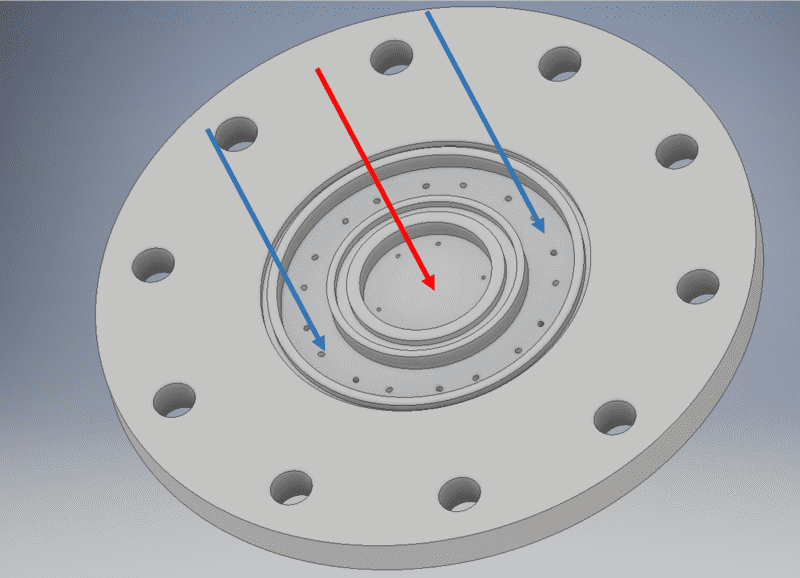
upload_2019-1-2_18-6-51.png

Roy S. Ramirez

School of Aeronautics and Astronautics
Purdue University - Class of 2021
Management and French Minor

<< Personal e-mail and phone number deleted by the Mentors >>
 

Attachments

  • upload_2019-1-2_18-6-51.png
    upload_2019-1-2_18-6-51.png
    56.1 KB · Views: 694
Last edited by a moderator:
Physics news on Phys.org
Roy S Ramirez said:
Hello everybody!

Happy 2019! I'm trying to design a mechanical face seal for the part shown below, and I'm struggling with the number of o-rings I'm supposed to use. There are two cavities (rings) for two different fluids. The liquid dynamic pressure for both the internal and external fluids is different but somewhere between 165 and 200 psi. I know I need at least two o-rings between them (as shown in the picture), but for a moment I thought maybe using three o-rings, with two of them located between both cavities would work better :/

How many o-rings would a mechanical engineer use in this case?
If you have seal ring material perfectly compatible with both fluids, use 2 seal rings. If you have a doubts about chemical compatibility, use 3.
 
If you have special concerns about cross-contamination between the two fluids, maybe use 3 o-rings, and vent the space between the 2 that are separating the fluids.
 
The grooves to take the seals appear to be the same depths, so the seals will all be the same thickness. The outer groove is about half the width of the inner groove, so there is room for two inner ring seals between the fluids.

O-rings seal by being pushed into a hard corner by differential pressure. For that reason, venting the space between two o-rings cannot be effective, unless they are seated in quite separate grooves.
 
Yes, of course, I should have been more clear in my previous post.
 
Thank you very much to all of you! The o-rings are most likely going to be Viton which is compatible with both fluids therefore, I guess two grooves would work just fine. My main concern was not some low level of cross-contamination itself, but sealing failure due to both fluids squeezing the o-ring towards the groove's center.
 
  • Like
Likes   Reactions: berkeman and trurle
Roy S Ramirez said:
Thank you very much to all of you! The o-rings are most likely going to be Viton which is compatible with both fluids therefore, I guess two grooves would work just fine. My main concern was not some low level of cross-contamination itself, but sealing failure due to both fluids squeezing the o-ring towards the groove's center.
From mechanical perspective, double seal rings are advantageous to single rings if you have a solids (i.e. dirt) contaminating your fluid (likely not your case?). Dirt particles in multiple-ring system are less likely to result in leakage, because force exerted by particle lodged between flange and one ring is less effectively transferred to other ring, preserving other ring contact with flange and maintaining the seal.
Concerns about mechanical failure of (less rigid and strong) multiple-ring system similar to one you voiced above are typically not valid, unless you have very demanding application approaching the mechanical limits if the seal.
 
trurle said:
From mechanical perspective, double seal rings are advantageous to single rings if you have a solids (i.e. dirt) contaminating your fluid (likely not your case?). Dirt particles in multiple-ring system are less likely to result in leakage, because force exerted by particle lodged between flange and one ring is less effectively transferred to other ring, preserving other ring contact with flange and maintaining the seal.
Concerns about mechanical failure of (less rigid and strong) multiple-ring system similar to one you voiced above are typically not valid, unless you have very demanding application approaching the mechanical limits if the seal.
Thank you very much @trurle
 
  • Like
Likes   Reactions: berkeman

Similar threads

  • · Replies 7 ·
Replies
7
Views
2K
Replies
23
Views
3K
  • · Replies 9 ·
Replies
9
Views
2K
  • · Replies 13 ·
Replies
13
Views
5K
  • · Replies 4 ·
Replies
4
Views
3K
  • · Replies 4 ·
Replies
4
Views
4K
Replies
8
Views
9K
  • · Replies 5 ·
Replies
5
Views
6K
  • · Replies 6 ·
Replies
6
Views
2K
  • · Replies 1 ·
Replies
1
Views
1K