How much does the raft move with change of position?

  • Thread starter Thread starter ninesixfive
  • Start date Start date
  • Tags Tags
    Change Position
Click For Summary
The discussion revolves around calculating the movement of a raft based on position changes. The user has calculated a shift of -2.12 meters at an angle of -45 degrees but is uncertain about the angle's reference point. It is clarified that the angle should be relative to a clear direction, such as the x-axis. The magnitude of the movement should be expressed as positive, leading to the conclusion that the raft moves 2.12 meters at 135 degrees when viewed from above. The importance of defining the reference direction for the angle is emphasized for clarity.
ninesixfive
Messages
3
Reaction score
0
HW Template missing as it was moved from another forum
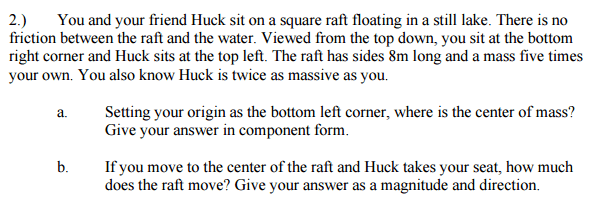
heres the problem...
upload_2015-4-14_9-20-19.png


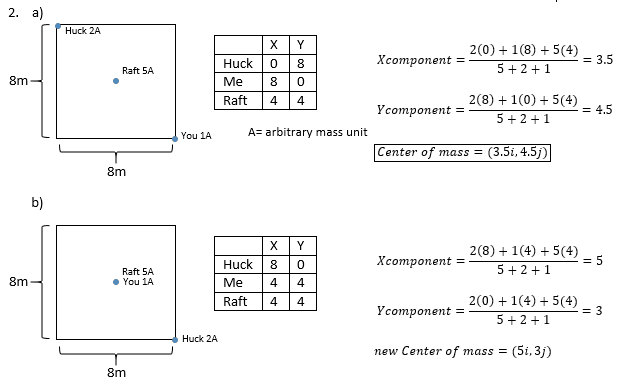
and i figured out part a but don't understand how to get the second part, here is what i have done...
upload_2015-4-14_9-21-49.png

my question is should the angle be from the point of origin? what I am getting is -2.12 meters in a direction of -45 degrees. is this correct? I'm using x2-x1/y2-y1 to get 1.5/-1.5 then using Pythagorean to get the distance of shift and using arctan(-1.5/1.5) to get the -45 ?
 
Physics news on Phys.org
ninesixfive said:
my question is should the angle be from the point of origin?
The vector does not need a reference point, just a reference direction. Relative to the x-axis should be fine. Or relative to some other direction which you clearly describe. Like "from the center towards the new position of [...]".
The magnitude should be positive.
 
So could I say the raft moves 2.12 meters in a direction of 135 degrees when viewing form above?
 
If you clarify 135 degrees relative to what, sure.
 
relative to the point of origin (bottom left corner)... looking at it from above it would move into the the third quadrant , of course the raft would stay square to the x and y axis
 
The book claims the answer is that all the magnitudes are the same because "the gravitational force on the penguin is the same". I'm having trouble understanding this. I thought the buoyant force was equal to the weight of the fluid displaced. Weight depends on mass which depends on density. Therefore, due to the differing densities the buoyant force will be different in each case? Is this incorrect?

Similar threads

  • · Replies 17 ·
Replies
17
Views
1K
  • · Replies 1 ·
Replies
1
Views
1K
  • · Replies 17 ·
Replies
17
Views
1K
  • · Replies 29 ·
Replies
29
Views
9K
  • · Replies 5 ·
Replies
5
Views
2K
  • · Replies 6 ·
Replies
6
Views
2K
Replies
3
Views
1K
  • · Replies 11 ·
Replies
11
Views
3K
Replies
1
Views
2K
Replies
4
Views
2K