How Much Energy Is Needed to Move and Rotate a Weighted Tray Using Rubber Tires?

Click For Summary

Homework Help Overview

The discussion revolves around calculating the energy required to move and rotate a weighted tray using rubber tires. The problem involves understanding the dynamics of a system with a tray weighing 20kg and an additional weight of 200kg, with specific parameters such as tire pressure and rolling resistance on an asphalt surface.

Discussion Character

  • Exploratory, Assumption checking, Problem interpretation

Approaches and Questions Raised

  • Participants discuss the relationship between rolling resistance and the forces acting on the system, questioning how to derive the resistive force from the rolling coefficient.
  • There are inquiries about the relevant equations for calculating energy and forces, with some participants expressing uncertainty about applying basic physics concepts.
  • Assumptions regarding the role of gravity in moving the tray at different angles are debated, particularly concerning the energy required to increase or decrease the angle x.

Discussion Status

The conversation is ongoing, with participants providing insights into the forces at play and the need for free body diagrams. Some guidance has been offered regarding the application of force and torque balance equations, but no consensus has been reached on the specific calculations needed.

Contextual Notes

Participants note the complexity of the problem due to the interplay of forces and the specific conditions of the system, including the effects of rolling resistance and the angle of the tray. There is also mention of the potential for confusion due to varying interpretations of the physics involved.

Home Improvement
Hi,
wheel.png

rotate.png


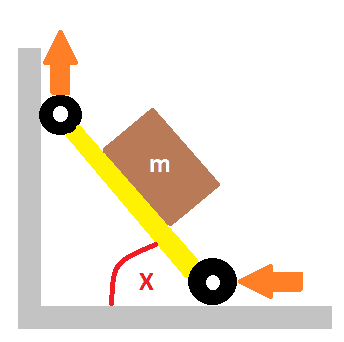
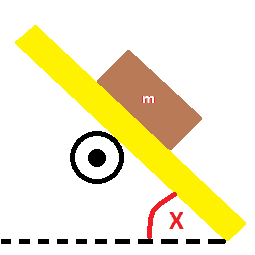
The goal here is to increase/decrease the angle x by 5 degrees. the black circles represent a rubber tire (same as car tires, only smaller), 5cm in diameter, rotating on it's center, powered by a motor. each wheel has 40 psi (2.76 bar) of air in it. the yellow tray on both diagrams are identical, weighing around 20kg and 2m long and 4cm wide. weight (m) on both diagrams are also identical, weighing 200kg, welded shut to the yellow tray.
my questions is I need the formula to calculate the following:
1. in the top diagram, assume front and rear wheels are treading on asphalt surface, so rolling coefficient is around 0.0087. I got this number from https://www.engineeringtoolbox.com/rolling-friction-resistance-d_1303.html. what is the total energy the motor of rear wheel need to exert to move the system from a complete standstill until the increase angle x by 5 degrees?
2. also in the top diagram, I assume the amount of energy exerted would exactly be the same if it's only the front wheel motor that moves?
3. in the bottom diagram, the wheel axis is exactly in the middle of both the weight and the tray. I assume that if x is below 45 degrees, gravity will handle decreasing the angle (motor needs not exert energy to decrease x). the same also applies when angle is above 45 degrees and we want to increase x. if previous assumptions are correct, how much energy does the motor need to exert to decrease x by 5 degrees (when x is greater than 45)? what about increasing x by 5 degrees (when x is less than 45)?
4. for top diagram, I assume we can just rely on gravity if we want to decrease x by 5 degrees? provided that x is not 90 degrees.

thanks
 

Attachments

  • wheel.png
    wheel.png
    1.8 KB · Views: 789
  • rotate.png
    rotate.png
    1.2 KB · Views: 623
Last edited by a moderator:
Physics news on Phys.org
Home Improvement said:
rolling coefficient is around 0.0087
Ok, but what equation turns that into a resistive force?
Home Improvement said:
to move the system from a complete standstill until the increase angle x by 5 degrees?
Please show some attempt. What equations are relevant?
Home Improvement said:
also in the top diagram, I assume the amount of energy exerted would exactly be the same if it's only the front wheel motor that moves?
Interestingly, no. That will become evident if you answer my first question and consider the vertical and horizontal balances of forces.
There is also the matter of whether the tyre against the wall would always have enough friction.
Home Improvement said:
the same also applies when angle is above 45 degrees and we want to increase x
How do you deduce that? Consider potential energy and the way the mass centre will move.
Home Improvement said:
for top diagram, I assume we can just rely on gravity if we want to decrease x by 5 degrees?
Yes, except when close to 90 degrees. There is some rolling resistance to be overcome.
 
haruspex said:
Ok, but what equation turns that into a resistive force?
normally, I'd say the weight of object multiplied by coefficient, but since this is rolling, not skidding, not sure which equation to use.

haruspex said:
Please show some attempt. What equations are relevant?
sorry, but I just drew a blank. it's been 15 years since I last touched any physics subject. the only equations I got was F = ma and basic torque equation (just guessing it's torque because something is rotating), but not sure how to apply these equations in this system.

haruspex said:
Interestingly, no. That will become evident if you answer my first question and consider the vertical and horizontal balances of forces.
There is also the matter of whether the tyre against the wall would always have enough friction.
cant even answer anything

haruspex said:
How do you deduce that? Consider potential energy and the way the mass centre will move.
for bottom diagram, now that you mentioned it, when the wheel rotate, even for a bit, the mass center won't be aligned with the center of wheel, meaning, it will always rotate clockwise, meaning, increase x. so, basically, if angle x is greater than 0, the tendency is it will keep increasing, meaning, the motor needs not do any work to increase angle X

haruspex said:
Yes, except when close to 90 degrees. There is some rolling resistance to be overcome.
I assume this applies only to top diagram. the system in top diagram will be 5 degrees min and 85 degrees max, so never exactly 0 or 90 degrees. but can you explain how there will be rolling resistance if it's 90 degrees?
 
Last edited by a moderator:
Home Improvement said:
the weight of object multiplied by coefficient
More accurately, the normal force multiplied by the coefficient. Both wheels will experience a normal force, so both offer rolling resistance.
Home Improvement said:
the only equations I got was F = ma and basic torque equation
The first step is to draw a free body diagram, showing all the forces on the object, and use force balance and torque balance equations to determine all the forces. (You can treat it as a statics question since you can move very slowly, so acceleration can be ignored.)
Home Improvement said:
if angle x is greater than 0, the tendency is it will keep increasing, meaning, the motor needs not do any work to increase angle X
Yes.
Home Improvement said:
I assume this applies only to top diagram
Both.
Home Improvement said:
can you explain how there will be rolling resistance if it's 90 degrees?
As I noted, it is based on the normal force. At 90 degrees the lower tyre will have maximum normal force, so maximum rolling resistance.
 

Similar threads

Replies
4
Views
2K
Replies
9
Views
2K
  • · Replies 21 ·
Replies
21
Views
5K
  • · Replies 9 ·
Replies
9
Views
3K
Replies
23
Views
3K
  • · Replies 30 ·
2
Replies
30
Views
4K
  • · Replies 5 ·
Replies
5
Views
3K
  • · Replies 22 ·
Replies
22
Views
5K
  • · Replies 3 ·
Replies
3
Views
4K
  • · Replies 16 ·
Replies
16
Views
3K