How much force will be experienced by the sidewall?

  • Context: Engineering 
  • Thread starter Thread starter qnach
  • Start date Start date
  • Tags Tags
    Force Inelastic
Join the discussion
Ask a follow-up here, or get your own question answered by working scientists, mathematicians and engineers — people, not an autocomplete.
Real named experts · corrections over time · the nuance an AI answer skips
7 replies · 2K views
qnach
Messages
155
Reaction score
4
Homework Statement
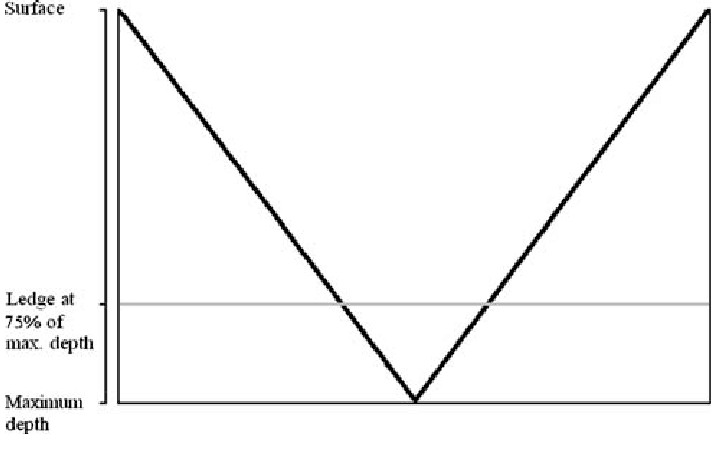
I have a V-shape depression (2-dimensional) with inelastic but deformable material filled.
If the material is pressed atop, how much force will be experienced by the sides?
Relevant Equations
none.
I have a V-shape depression (2-dimensional) with inelastic but deformable material filled.

If the material is pressed atop, how much force will be experienced by the sides?

Schematic-of-a-V-shaped-dive-including-the-ledge-of-the-dive-This-V-dive-does-not-have.png
 
Physics news on Phys.org
Hi.
Say F is force atop, it is equal to ##2N\ sin\theta## where ##\theta## is angle of both the sides from vertical line and N is force from a side.
[tex]N=\frac{F}{2 \sin\theta}[/tex]
 
qnach said:
Homework Statement:: I have a V-shape depression (2-dimensional) with inelastic but deformable material filled.
If the material is pressed atop, how much force will be experienced by the sides?
Relevant Equations:: none.

I have a V-shape depression (2-dimensional) with inelastic but deformable material filled.

If the material is pressed atop, how much force will be experienced by the sides?

View attachment 274375
What do you define as "inelastic but deformable?"
 
Chestermiller said:
What do you define as "inelastic but deformable?"

Yes, your criticism is correct. The force is not large, therefore will not result in large deformation hence can be considered as inelastic. Deformation, such as sands are deformable but inelastic.
 
mitochan said:
Hi.
Say F is force atop, it is equal to ##2N\ sin\theta## where ##\theta## is angle of both the sides from vertical line and N is force from a side.
[tex]N=\frac{F}{2 \sin\theta}[/tex]
How did you got the result? I am not sure about the [tex]\sin \theta[/tex], but the force F should be P presumably.
 
Please find attached sketch to show balance of vertical forces.
 

Attachments

  • img20201220_11054639.jpg
    img20201220_11054639.jpg
    31.5 KB · Views: 194
mitochan said:
Hi.
Say F is force atop, it is equal to ##2N\ sin\theta## where ##\theta## is angle of both the sides from vertical line and N is force from a side.
[tex]N=\frac{F}{2 \sin\theta}[/tex]
Then where does the rest of the force go, for all angles and depths?
 
Tom.G said:
Then where does the rest of the force go, for all angles and depths?
N comes from area integration of pressure on a side
[tex]\mathbf{N}=\int p \ d\mathbf{S}[/tex]