iceT
- 8
- 0
1) Five thousand joules of heat is put into a Carnot engine whose hot and cold reservoirs have temperatures of 500 and 250 K, respectively. How much heat is converted into work?
here's what i did...
i know that... QC / QH = TC / TH
W = 5000, Tc = 250, Th = 500, Qh = ?, Qc = ?
first I found Qh , which = (eCarnot = W/Qh) ----- and solve for Qh and get (Qh = W/eCarnot) ------eCarnot also equals [1-(Tc/Th)] = [1-( 250 / 500 ) ] = 0.5
so Qh = W / [1-(Tc/Th) = 5000 / 0.5 = 10000
after I got Qh I used the equation (Qc = Qh - W) to solve for Qc and this should be the answer...
Qc = Qh - W = 10000-5000 = 5000 , so Qc = 5000 ...but it still wrong
2) The pressure and volume of a gas are changed along a path ABCA in the figure. The vertical divisions on the graph represent 4.5 105 Pa, and the horizontal divisions represent 4.0 10-3 m3. Determine the work done (including algebraic sign) in each segment of the path.
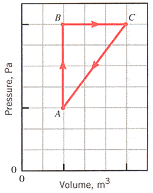
a ) A to B = ? J
b ) B to C = ? J
c ) C to A = ? J
This question..i know that W= P ( Vf-Vi )
but i still can't locate the dots on the graph!
here's what i did...
i know that... QC / QH = TC / TH
W = 5000, Tc = 250, Th = 500, Qh = ?, Qc = ?
first I found Qh , which = (eCarnot = W/Qh) ----- and solve for Qh and get (Qh = W/eCarnot) ------eCarnot also equals [1-(Tc/Th)] = [1-( 250 / 500 ) ] = 0.5
so Qh = W / [1-(Tc/Th) = 5000 / 0.5 = 10000
after I got Qh I used the equation (Qc = Qh - W) to solve for Qc and this should be the answer...
Qc = Qh - W = 10000-5000 = 5000 , so Qc = 5000 ...but it still wrong
2) The pressure and volume of a gas are changed along a path ABCA in the figure. The vertical divisions on the graph represent 4.5 105 Pa, and the horizontal divisions represent 4.0 10-3 m3. Determine the work done (including algebraic sign) in each segment of the path.
a ) A to B = ? J
b ) B to C = ? J
c ) C to A = ? J
This question..i know that W= P ( Vf-Vi )
but i still can't locate the dots on the graph!
