How much power/Electrical energy would this device produce?

  • Context: Undergrad 
  • Thread starter Thread starter Deleted member 656102
  • Start date Start date
  • Tags Tags
    Device Energy
Click For Summary
SUMMARY

This discussion focuses on the feasibility of using human weight and additional pulling force to lift a 1000 kg weight using a lever system, with the goal of generating electrical energy for household use. Participants calculated that lifting this weight 5 meters would require approximately 50 kJ of energy, which could power a 50W lamp for about 17 minutes. The conversation also explored alternative energy storage methods, such as compressed air energy storage (CAES), which can achieve higher efficiency and provide heating and cooling alongside electricity generation.

PREREQUISITES
  • Understanding of basic physics principles, specifically energy and power calculations.
  • Familiarity with mechanical systems, including levers and pulleys.
  • Knowledge of energy storage technologies, particularly compressed air energy storage (CAES).
  • Experience with renewable energy systems, including solar and wind energy generation.
NEXT STEPS
  • Research the efficiency and design of compressed air energy storage (CAES) systems.
  • Explore the construction and operation of parabolic dish Stirling generators.
  • Investigate the design and implementation of vertical axis wind turbines.
  • Learn about the principles of gravitational energy storage and its practical applications.
USEFUL FOR

Engineers, renewable energy enthusiasts, and DIY energy system builders looking to optimize energy generation and storage solutions in residential settings.

Deleted member 656102
Hey, i don't know much about physics but i have heard that gravitational energy is non efficient since it needs a lot of power.

So this is what i had in plan..

Average household has 2 to 3 members with each waiting average 50 kilos.
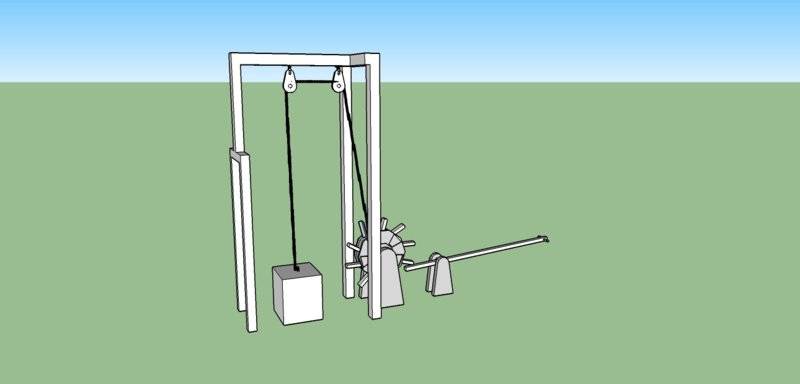
You would use their combined weight force to pull up a 1000 kilo weight up in the air 5 meters using a 1:5 lever, two pulleys, wheel and a cabel.

About the force applied: 3 times 50 kilos if they stand on the lever, + they could use additional force pulling with their hands a rope that's tied to the ground.

The system i am talking about is down on the picture.
robi struja pokaz.jpg

About the wheel: The levers on the wheel can move in one direction letting the lever on which force is applied go down and pus the wheel again.

Whats the use?

So you have two small wind turbines.. two small solar collector.. And you are short of some extra power for your house to be fully independent.

Can someone brainstorm this quickly with me, or do the "calc"?
 

Attachments

  • robi struja pokaz.jpg
    robi struja pokaz.jpg
    13.9 KB · Views: 542
Physics news on Phys.org
People are more efficient pedaling bicycle generators instead of pulling up weights. Maybe look at ways to store that energy (electrically in batteries or gravitationally with pumped water into a water tower).

BTW, maybe this is a good way to keep your teenagers from watching so much TV. "You want to watch an hour of TV? Okay, go pedal the exercise bike for an hour first to store the energy..." :wink:
 
  • Like
Likes   Reactions: anorlunda
berkeman said:
People are more efficient pedaling bicycle generators instead of pulling up weights. Maybe look at ways to store that energy (electrically in batteries or gravitationally with pumped water into a water tower).

BTW, maybe this is a good way to keep your teenagers from watching so much TV. "You want to watch an hour of TV? Okay, go pedal the exercise bike for an hour first to store the energy..." :wink:

I don't know if you red the post, but, the people use their weight, 3, 4, 5 people... and the aditional pull force to lift this.

So it's not just pulling weights.
 
Robert Petrusic said:
I don't know if you red the post, but, the people use their weight, 3, 4, 5 people... and the aditional pull force to lift this.
Yeah, but a bicycle style generator is still more efficient than a Stairmaster style generator. You want the people to keep climbing up on that lever thing, right? The energy has to come from somewhere (from sweaty people in this case)...
 
It's not the same force. I believe this produces more power :D

Edit:Anyway, pedaling is boring.
 
Robert Petrusic said:
It's not the same force. I believe this produces more power :D
Well, we can do a quick calculation to see...

75kg person rising up 0.25m each second is E = mgh, P = E/t

E = 100kg * 9.8m/s^2 * 0.25m = 184J/s, so Power = 184W. That's about the same as pedaling for a reasonable bike rider. I know which one I'd rather do for an hour straight... :smile:
 
How much time for the 184 w? An hour?
 
Robert Petrusic said:
How much time for the 184 w? An hour?
As long as you keep stair climbing or pedaling. You only put power into the storage mechanism while you are doing work on it.
 
We should get some actual figures from the original scenario. However you go about lifting the weight, you will require the same amount of Energy.
The work needed to lift 1000kg by 5m is 50kJ plus whatever losses there are in the mechanism - perhaps double that requirement. That's the maximum energy you could get back out (assuming everything is 100% efficient.
That would drive a 50W lamp for 1000seconds (17minutes) or a 5W lamp / radio / motor for 170 minutes or 2.8hours. Allowing for a realistic figure for overall efficiency, you could probably call it 2 hours. So that's the ball park figure for what the proposed system could give you back.
Bearing in mind that you would need to use electricity in order to make use of the mechanically stored energy then why not use a battery and a commercially available pedal power dynamo system?
Health and safety would need to be considered for the proposed system - use something that's intrinsically safe and off the shelf.
 
  • Like
Likes   Reactions: Deleted member 656102
  • #10
@sophiecentaur Its just gravitational battery, i was very disapointed when i found out its not efficient. Do you know anything about Compressed air energy storage?

I stumbled upon it couple minutes ago.

Its 99 % green.
Low cost.
Only takes up a lot of space.

But i am developing a system where i have a lot of sun, wind, water flow and a lot of space.

My main problem is the parts.

For sun i was planning on making two parabolic dish stirling generators, for wind, a vertical axis wind turbine with a blocker

Picture 2..jpg


And since i have a river by my house, i was planing on putting some water turbines inside.

For solar i have the satelite dishes and mirrors for free, for wind and water turbine i have a lot of motors and parts, and for compressed air battery i was planning to use old boilers and dig them underground, i just need to check the pressure.

So the problem is manufacturing stirlings, They are actually not that complicated, but i am not skilled in making.

There is other problem, with water, and insulating underwater generators.

About the compressed air battery, it actually wouldn't have to be so big, because we have 250 sunny days in croatia, a lot of wind and probably the river too.
So the compressor would be used as a backup, and for apliances that are being used over night when there is no sun and no wind.

How does it feel?
 

Attachments

  • Picture 2..jpg
    Picture 2..jpg
    21 KB · Views: 574
  • #11
"Several research groups have designed, modeled and built small-scale combined heat-and-power CAES units which provide heating and cooling as well as electricity. The high pressure system with a storage volume of only 0.55 m3 that we mentioned earlier, is an example of this type of system. [9] As noted, its electrical efficiency is only 11-17%, but the system also produces sufficient heat to produce 270 litres of hot water per day. If this thermal source of energy is also taken into account, the “exergetic” efficiency of the whole system is close to 70%. Similar "exergy" efficiencies can be found in other studies, with systems operating at pressures between 50 and 200 bar. [11-21]

Heat and cold from compression and expansion can be distributed to heating or cooling devices by means of water or air. The setup of an air cycle heating and cooling system is very similar to a CAES system, except for the storage vessel. Air cycle heating and cooling has many advantages, including high reliability, ease of maintenance, and the use of a natural refrigerant, which is environmentally benign. [11]"

: https://www.lowtechmagazine.com/201...f-the-grid-compressed-air-energy-storage.html
 

Similar threads

Replies
5
Views
2K
  • · Replies 4 ·
Replies
4
Views
2K
  • · Replies 74 ·
3
Replies
74
Views
9K
  • · Replies 11 ·
Replies
11
Views
2K
  • · Replies 22 ·
Replies
22
Views
5K
  • · Replies 15 ·
Replies
15
Views
2K
  • · Replies 20 ·
Replies
20
Views
2K
Replies
23
Views
3K
  • · Replies 9 ·
Replies
9
Views
3K
  • · Replies 16 ·
Replies
16
Views
3K