How should this Beam Loading experiment be designed?

Click For Summary

Homework Help Overview

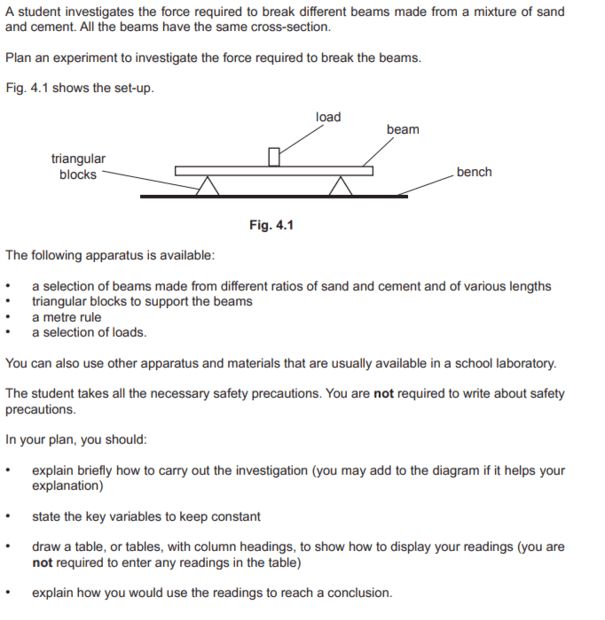
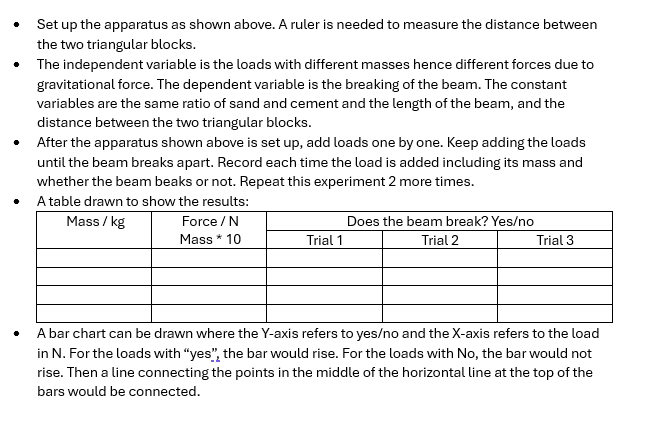
The discussion revolves around designing an experiment to test beam loading, focusing on how to structure the variables and conditions for the experiment. The subject area includes principles of mechanics and experimental design.

Discussion Character

  • Exploratory, Assumption checking, Problem interpretation

Approaches and Questions Raised

  • Participants explore the implications of keeping beam length constant versus varying it, questioning how to determine support distances and load placements. There are discussions about the independent and dependent variables in the context of the experiment.

Discussion Status

The conversation is active, with participants raising concerns about the clarity and completeness of the experimental design. Some guidance is offered regarding the need for specificity in the setup to ensure repeatability, and various interpretations of the variables are being explored.

Contextual Notes

There are constraints noted regarding the lack of specified distances and conditions for the beams, as well as the variability in beam lengths provided for the experiment.
Physical_Fire
Messages
54
Reaction score
11
Homework Statement
Attached.
Relevant Equations
No need.
The question and my attempt at a solution are attached. Thanks.
Question.png
Attempted_Solution.png
 
Last edited by a moderator:
Physics news on Phys.org
The beams are of various lengths. You did not specify where the supports or loads are to be placed, and there is no mention of distances in your table.
 
I kept the beam length constant. Independent variable is the force and the dependent variable is whether the beam breaks or not. The rest are constant.
 
Physical_Fire said:
I kept the beam length constant. Independent variable is the force and the dependent variable is whether the beam breaks or not. The rest are constant.
You cannot keep the beam length constant. You can keep the distance between the supports constant, but how to determine that distance, and where exactly should each beam be placed across them? And where should the load be placed?
A key aspect of experimental design specification is that others can repeat exactly what you did.

A trickier problem is what load to start with and by how much to increase it at each step. You cannot go back and try a slightly smaller load when it breaks. If you increase by large steps you will end up with a big margin of error; if you go in tiny steps it'll take a month.
Maybe that's beyond what is expected here, but can you think of an approach?
 
haruspex said:
You cannot keep the beam length constant. You
Why not?
haruspex said:
A key aspect of experimental design specification is that others can repeat exactly what you did.
Why can't they repeat?
 
haruspex said:
but how to determine that distance
That distance is an arbitrary distance within the scope of the beam, where different masses would be placed on it until the beam breaks
 
Physical_Fire said:
Why not?
Because the beams provided are of various lengths.
Physical_Fire said:
Why can't they repeat?
Because as your description stands there is not enough information. You leave many details unspecified.
Physical_Fire said:
That distance is an arbitrary distance within the scope of the beam, where different masses would be placed on it until the beam breaks
Not good enough. You need to say how you will choose the distance. If the beam lengths available are 2m, 3m and 12m, what distance would you choose?

Now, I did not set this question. Maybe you are not expected to address these points. I can only discuss how I would answer it.
 
I am genuinely confused. Why can't the loads be the independent variable as the loads are being changed?
 
Physical_Fire said:
I am genuinely confused. Why can't the loads be the independent variable as the loads are being changed?
I did not say that. Which of my comments is that a response to?
 
  • #10
haruspex said:
You cannot keep the beam length constant.
This. All in all, I don't get the idea as to what the variables are.
 
  • #11
Gotcha
 

Similar threads

  • · Replies 11 ·
Replies
11
Views
3K
  • · Replies 9 ·
Replies
9
Views
2K
  • · Replies 3 ·
Replies
3
Views
716
Replies
3
Views
2K
  • · Replies 8 ·
Replies
8
Views
2K
  • · Replies 6 ·
Replies
6
Views
2K
Replies
6
Views
2K
  • · Replies 25 ·
Replies
25
Views
3K
  • · Replies 4 ·
Replies
4
Views
1K
Replies
8
Views
2K