enotyphoon
- 17
- 0
*Note: Even for 1 answer for any of the question, I am highly appreciate it. I am understand it quite a burden to answer all. Thank you.
Hi guys,
I am currently seeking a correct approach of getting the reaction force developed on bolt due to the Forward or Upward force experience by the object as per regulation of Title 14 CFR 27.561.
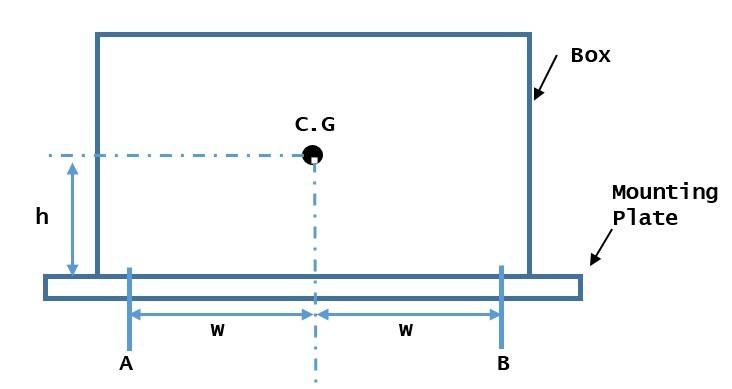
Imagine I have a box secure on plate by 4 bolts in symmetrical way. The box will experience forward force of 20 forward or 4g upward. Hence I have to select the bolt that can withstand these condition. Initially for both cases, I would simply divided the force by 4 to find the reaction on bolt with assumption the C.G of box is located at nicely at the middle between 4 bolt (symmetrical).
Since I would like to know the proper way of finding this reaction force, I have develop a FBD for this case as below.
Basic:
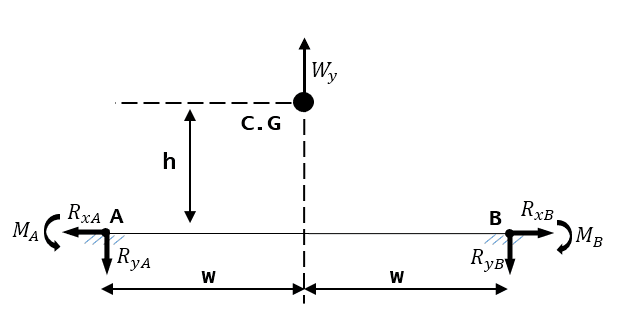
Box experiencing upward force case;
Box experiencing forward force case;
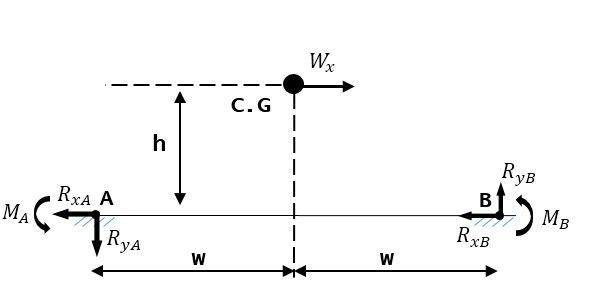
*A and B are Bolted connection, so I am using fixed support. However still not sure if it the correct presentation anc correct support. Correct me if I'm wrong in presenting it.
*Neglecting the effect c.g of plate as it thickness is negligible.
My main concern to find is only on the reaction forces and my question are:
1) Does my basic understanding in this case is correct based on the FBD above?
Upward Force case:-
2) Does it simply divided by 2 to find Rxa or Rxb(due to symmetrical)?, and divided again by 2 to find force on each bolt (4 bolt in symmetrical position, 2 front:2 back)
3) Does height of C.G have effect on finding value of Rxa?
4)I might encounter case where the c.g is not symmetrical with bolt. it is applicable using this equation for this case(diagram below). Since I'm not sure weather it is compatible with my FBD or not.
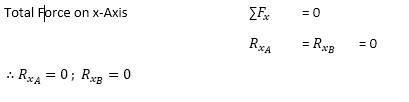
5) is this equation valid for upward case above? and if upward force is not in symmetry between the bolts, does Rx still zero?
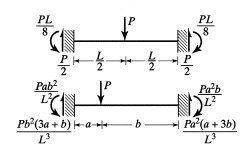 Forward Force case;
5) to find Rxa, I would simply divide by 2 as per Figure below and divide by 2 again to gain force in each bolt (not shown in figure). Is this correct?
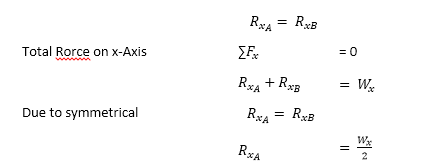
6) If the c.g is not located at the middle between Fxa and Fxb, does equation as figure above applies? (in other word, does location of c.g have effect on shear stress?)
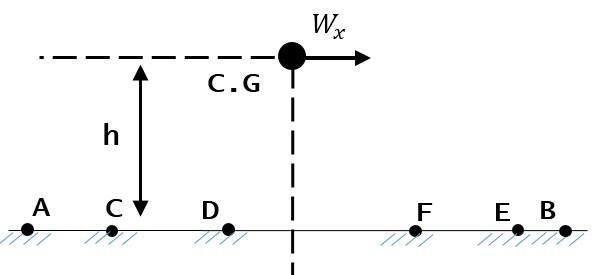
7) If there is more bolts like 3 pairs at the back and 3 pairs at front (Fxa & Fxb have pair of bolt, Figure below). Does shear force (Fx) is same for all pairs of bolt regardless its position.
Sorry for asking very much question, just need to clarify. Feel free to answer any question. Would be glad if you all could help me although with one answer. Do not hesitate to share your opinion.
Thank you.
Hi guys,
I am currently seeking a correct approach of getting the reaction force developed on bolt due to the Forward or Upward force experience by the object as per regulation of Title 14 CFR 27.561.
Imagine I have a box secure on plate by 4 bolts in symmetrical way. The box will experience forward force of 20 forward or 4g upward. Hence I have to select the bolt that can withstand these condition. Initially for both cases, I would simply divided the force by 4 to find the reaction on bolt with assumption the C.G of box is located at nicely at the middle between 4 bolt (symmetrical).
Since I would like to know the proper way of finding this reaction force, I have develop a FBD for this case as below.
Basic:
Box experiencing upward force case;
Box experiencing forward force case;
*A and B are Bolted connection, so I am using fixed support. However still not sure if it the correct presentation anc correct support. Correct me if I'm wrong in presenting it.
*Neglecting the effect c.g of plate as it thickness is negligible.
My main concern to find is only on the reaction forces and my question are:
1) Does my basic understanding in this case is correct based on the FBD above?
Upward Force case:-
2) Does it simply divided by 2 to find Rxa or Rxb(due to symmetrical)?, and divided again by 2 to find force on each bolt (4 bolt in symmetrical position, 2 front:2 back)
3) Does height of C.G have effect on finding value of Rxa?
4)I might encounter case where the c.g is not symmetrical with bolt. it is applicable using this equation for this case(diagram below). Since I'm not sure weather it is compatible with my FBD or not.
5) is this equation valid for upward case above? and if upward force is not in symmetry between the bolts, does Rx still zero?
5) to find Rxa, I would simply divide by 2 as per Figure below and divide by 2 again to gain force in each bolt (not shown in figure). Is this correct?
6) If the c.g is not located at the middle between Fxa and Fxb, does equation as figure above applies? (in other word, does location of c.g have effect on shear stress?)
7) If there is more bolts like 3 pairs at the back and 3 pairs at front (Fxa & Fxb have pair of bolt, Figure below). Does shear force (Fx) is same for all pairs of bolt regardless its position.
Sorry for asking very much question, just need to clarify. Feel free to answer any question. Would be glad if you all could help me although with one answer. Do not hesitate to share your opinion.
Thank you.
Attachments


Last edited by a moderator: