How to calculate entropy of mixing in 2-d systems

Click For Summary
The discussion centers on calculating the entropy of mixing in two-dimensional systems, with a focus on whether the same equations used for three-dimensional systems apply. The proposed equation, ΔS=S1*ln((A1+A2)/A1), is debated, particularly regarding the normalization and the role of temperature in a purely abstract 2D model. Participants emphasize that mixing can occur without temperature, assuming complete random mixing over time, and that entropy is related to the number of particles or microstates. The conversation also touches on the implications of infinite systems and the relevance of theoretical principles like the holographic principle to the topic. Clarification of the physical model and parameters is suggested for a more accurate discussion.
antonima
Messages
28
Reaction score
0
Hello physics forums,
I am writing a paper and I am wondering how to calculate the entropy of mixing in a two dimensional system. I am sure that entropy increases with mixing in a two dimensional system, but I do not know what equation to use. Would I just use the same equation as for 3-d systems?
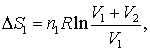
Image254.gif

In which case V (volume) should be replaced with A (area) .. and R would be removed altogether to become

ΔS=S1*ln((A1+A2)/A1)

Is this right? I would appreciate any help. I don't think it would be very scientific if I just said 'the entropy of the system surely increases when size increases'...
 
Physics news on Phys.org
antonima said:
Hello physics forums,
ΔS=S1*ln((A1+A2)/A1)

Is this right? I would appreciate any help. I don't think it would be very scientific if I just said 'the entropy of the system surely increases when size increases'...

If A is a proxy for the number of particles in each system and if as homogenous 2D systems they are a non physical model (concepts of pressure and temperature do not apply), your equation seems to be correct, normalizing on A1.
 
Last edited:
SW VandeCarr said:
If A is a proxy for the number of particles in each system

Yes, particles. Or rather empty spaces which can be modeled as particles.

SW VandeCarr said:
and if as homogenous 2D systems they are a non physical model (concepts of pressure and temperature do not apply), your equation seems to be correct, normalizing on A1.

Hmm, well in order for there to be mixing there has to be some temperature, unless as you say the model is purely non physical. I suppose I am more interested in a physical model however. Do you know that equation perchance?
 
antonima said:
Yes, particles. Or rather empty spaces which can be modeled as particles.
Hmm, well in order for there to be mixing there has to be some temperature, unless as you say the model is purely non physical. I suppose I am more interested in a physical model however. Do you know that equation perchance?

I'm not sure what you mean by a "physical model" in a 2D system which, to me, is a pure abstraction. One simply assumes complete random mixing in a plane given sufficient time. There need not be a "temperature" in such a model. If you want to model pressure and temperature parameters, you need to specify the problem in more detail. I'm not sure what your concept is. All I can think of, in terms of a 2D physical model, is a projection of mixing volumes on a plane.

Also, you left out n_1 R in your own equation, so why are you now saying you're more interested in a physical model? In the purely abstract model, the entropy is simply a function of the number of particles and specifically the relative change in entropy, ln[(n_1 + n_2)/n_1], which you chose to model by area A. Your equation gives sensible answers for the relative change in entropy as far as I can tell.
 
Last edited:
SW VandeCarr said:
I'm not sure what you mean by a "physical model" in a 2D system which, to me, is a pure abstraction. One simply assumes complete random mixing in a plane given sufficient time.

The way I understand it, mixing needs not occur, as long as it is possible in the future. When the 'partition' opens to let all the particles in A1 diffuse into A2, as soon as it opens then entropy is increased.. I think. It has something to do with the number of possible microstates divided by number of occupied microstates. At least that is what I read somewhere.
But then, this doesn't seem right since you can still extract energy from a system before it equalizes, so its entropy shouldn't be going up that soon. Something about total microstates definitely sounds right though.

SW VandeCarr said:
There need not be a "temperature" in such a model. If you want to model pressure and temperature parameters, you need to specify the problem in more detail. I'm not sure what your concept is. All I can think of, in terms of a 2D physical model, is a projection of mixing volumes on a plane.

Consider individual particles diffusing in between two planes, or particles diffusing on a surface.

SW VandeCarr said:
Also, you left out n_1 R in your own equation, so why are you now saying you're more interested in a physical model? In the purely abstract model, the entropy is simply a function of the number of particles and specifically the relative change in entropy, ln[(n_1 + n_2)/n_1], which you chose to model by area A. Your equation gives sensible answers for the relative change in entropy as far as I can tell.

Well, entropy of the system at A1 can be said to be any number above 0, due to the 3rd law of thermodynamics. If A2 is then infinity, then the system can be said to have infinite entropy when A1 and A2 mix since any number above 0 times infinity is infinity. So, any system mixed with an infinite system will have an infinite entropy. This is of course not a physical model since infinite systems do not exist. Still, it is part of the paper that I want to write - which may have implications in physical systems, but I am not sure.
 
It seems you are trying to invoke some aspects of the holographic principle which was developed for the entropy of black holes. According to this principle the increase in entropy at the surface as a result of infalling matter is dS = dM/T. However for ordinary physical models involving ideal gases, the 2D model makes no sense.. Diffusion is not described by the equations you wrote. I would suggest you clarify your question before you re-post.
 
First trick I learned this one a long time ago and have used it to entertain and amuse young kids. Ask your friend to write down a three-digit number without showing it to you. Then ask him or her to rearrange the digits to form a new three-digit number. After that, write whichever is the larger number above the other number, and then subtract the smaller from the larger, making sure that you don't see any of the numbers. Then ask the young "victim" to tell you any two of the digits of the...

Similar threads

  • · Replies 3 ·
Replies
3
Views
2K
  • · Replies 1 ·
Replies
1
Views
2K
Replies
14
Views
1K
  • · Replies 1 ·
Replies
1
Views
679
  • · Replies 3 ·
Replies
3
Views
2K
  • · Replies 1 ·
Replies
1
Views
1K
  • · Replies 7 ·
Replies
7
Views
1K
  • · Replies 5 ·
Replies
5
Views
2K
  • · Replies 13 ·
Replies
13
Views
3K
  • · Replies 3 ·
Replies
3
Views
2K