How to Calculate Inertia and Kinetic Energy for a High Inertia Flywheel?

Click For Summary
SUMMARY

The discussion focuses on calculating inertia and kinetic energy for a high inertia flywheel designed for energy storage. The user proposes using classic formulas for inertia, specifically I_rim = m * R_m^2 for the rim and E = 1/2 * I_r * w^2 for kinetic energy. An alternative approach suggested involves modeling the flywheel as three concentric circles to calculate the energy of each disc and summing them. Additionally, the use of CAD software for precise inertia calculations is recommended over mathematical assumptions due to potential error coefficients in complex geometries.

PREREQUISITES
  • Understanding of rotational dynamics and inertia calculations
  • Familiarity with kinetic energy formulas in physics
  • Basic knowledge of CAD software for engineering design
  • Experience with modeling geometric shapes in engineering contexts
NEXT STEPS
  • Research advanced inertia calculation methods using CAD software
  • Explore the principles of energy storage in flywheel systems
  • Study the effects of geometry on inertia and kinetic energy in mechanical systems
  • Learn about the design considerations for high inertia flywheels in energy applications
USEFUL FOR

Engineers, mechanical designers, and students involved in energy storage solutions, particularly those focusing on flywheel technology and rotational dynamics.

Dean Winchester
Messages
1
Reaction score
0
Hello,

I have to design a high inertia flywheel for energy storage. The flywheel must be something like in the drawing I attached. The question is: how can I calculate the Inertia and the stored kinetic energy in this type of flywheel?
Can I consider it like a classic "Rim , hub and spokes" flywheel, thus considering it like if there was a continuous rim, and use the classic formulas found in literature, such as I_rim=m*R_m^2 (where R_m is the mean radius) for the inertia of the rim and E=1/2*I_r*w^2 for the kinetic energy stored?

Thanks a lot for your help!
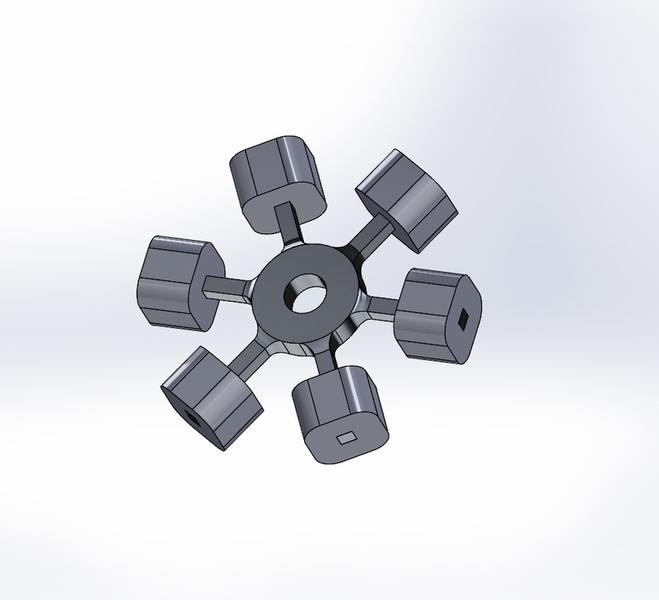
USlYRdM.jpg
 

Attachments

  • assembly.JPG
    assembly.JPG
    19.4 KB · Views: 473
Engineering news on Phys.org
Just curious?
Why not use the Inertia calculations of said CAD program? It's much more precise than a mathematical assumption based formulation, as those intersections and fillets will have high error coefficients.
 

Similar threads

  • · Replies 3 ·
Replies
3
Views
3K
  • · Replies 12 ·
Replies
12
Views
3K
Replies
14
Views
2K
  • · Replies 25 ·
Replies
25
Views
4K
  • · Replies 8 ·
Replies
8
Views
2K
  • · Replies 15 ·
Replies
15
Views
7K
  • · Replies 2 ·
Replies
2
Views
4K
  • · Replies 27 ·
Replies
27
Views
7K
Replies
1
Views
2K
Replies
11
Views
7K