How to calculate kinetics values?

  • Thread starter Thread starter BIOS
  • Start date Start date
  • Tags Tags
    Kinetics
Click For Summary
The discussion centers on understanding enzyme kinetics, specifically for glucose oxidase (GOD) in both free and immobilized forms. Participants express a need for clarity on how to interpret kinetic values, particularly in terms of substrate conversion rates per second per milligram of enzyme. The importance of substrate concentration in these calculations is acknowledged. The Michaelis-Menten equation is suggested as a tool for analysis, with emphasis on understanding parameters like Vmax and Km. There is confusion regarding the units of Vmax, specifically the term dk^-1, with speculation that it may be a typographical error. The conversation highlights the significance of determining the turnover number, which indicates the number of catalytic events per second per active site, requiring knowledge of the enzyme's molecular mass and active sites. Additionally, it is noted that Km values likely pertain to glucose, with considerations for the presence of co-substrates and the conditions under which measurements are taken.
BIOS
Messages
9
Reaction score
0
Hello

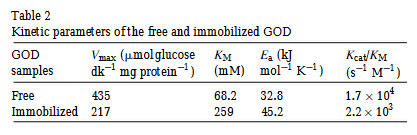
The table below shows some kinetics values for two types of the GOD enzyme, the free and the immobilised.
upload_2018-10-21_20-31-9.png


How can I comprehend what these values mean?
I want to know how many grams of substrate are 'converted' per sec per mg of enzyme.
I assume the substrate concentration plays role so I want to be able to incorporate that into the calculations.

Thanks!
 

Attachments

  • upload_2018-10-21_20-31-9.png
    upload_2018-10-21_20-31-9.png
    4.4 KB · Views: 859
Chemistry news on Phys.org
I admit I know next to nothing about enzyme kinetics, just a bit about kinetics in general (not that they are different, just enzyme kinetics uses its own set of assumptions which allows for some specific approximations), but it is up to whoever creates the table to define symbols (unless they are universally understood in the field). Consider consulting the source about their meaning (although Ea is rather obvious).
 
Vmax units have the term dk-1, any idea what that is?
I would expect to have a unit of time like s-1?
 
Not sure what the dk^-1 is. Presumably this would have to have units of inverse time. Does the source give a definition?
 
We often require a student to make more effort to solve a problem. Here we need more effort to tell us what the problem is! We are not told what GOD is, I guess it is nothing transcendental but glucose oxidasae or something.

Maybe this dk-1 is just a misprint? For dt-1 or something.
Vmax Is just the rate of oxidation when the substrate concentration is high (Saturating) - in whatever the units are.

The μ mole/sec/mg protein might possibly be a useful in practical work, but is pretty boring.. More interesting would be to get the Turnover number, the number of catalytic events per second per active site, for which you need to know the molecular mass and number of active sites of the enzymes
.
The Km etc presumably refer to glucose But there are two cosubstrates of an oxidase and presumably it refers to conditions of constant, solution-saturating, oxygen concentration.
 
Last edited:

Similar threads

  • · Replies 3 ·
Replies
3
Views
7K
  • · Replies 19 ·
Replies
19
Views
8K
  • · Replies 15 ·
Replies
15
Views
1K
  • · Replies 131 ·
5
Replies
131
Views
9K
  • · Replies 3 ·
Replies
3
Views
5K
  • · Replies 138 ·
5
Replies
138
Views
8K
  • · Replies 3 ·
Replies
3
Views
3K
Replies
10
Views
4K
Replies
4
Views
3K
Replies
5
Views
6K