How to Calculate θ3 After Finding θ2 Using Snell's Law?

  • Thread starter Thread starter betterscientist
  • Start date Start date
  • Tags Tags
    Angles Laws
Click For Summary

Homework Help Overview

The discussion revolves around the application of Snell's Law in optics, specifically focusing on calculating the angle θ3 after determining θ2. The original poster has successfully found θ2 but is seeking methods to find θ3 without relying on geometric approaches.

Discussion Character

  • Exploratory, Assumption checking

Approaches and Questions Raised

  • Participants discuss the possibility of applying Snell's Law again to find θ3. There are inquiries about the relevance of a sketch to clarify the situation and the positioning of other elements in the problem.

Discussion Status

The conversation is ongoing, with participants exploring different interpretations of the angles involved. Some guidance has been offered regarding the use of Snell's Law for further calculations, but there is no explicit consensus on the relationship between θ2 and θ3.

Contextual Notes

There is mention of a missing image that could provide additional context, and some participants express confusion about the setup of the problem, indicating that certain elements may have been omitted or misrepresented.

betterscientist
Messages
5
Reaction score
0
Homework Statement
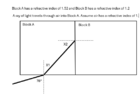
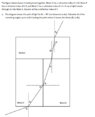
Block A has a refractive index of 1.52, Block B has a refractive index of 1.2, and Block C has a refractive index of 1.4.
A ray of light travels through air into Block A. Assume air has a refractive index of 1 and θ1 = 78°.
Calculate angles θ2-θ8.
Relevant Equations
n1sin(θ1)=n1sin(θ2)
I used Snell's law to find θ2 as 40,1 (3sf) but now I'm stuck on finding θ3.

Is there a way to find θ3 without using geometry? How do I do this?

 
Physics news on Phys.org
:welcome:

betterscientist said:
I'm stuck on finding θ3
How about using the same law again ?

Can you make (and post) a sketch of the situation ?

##\ ##
 
Apologies. I saw I have left out the image.
 

Attachments

  • Screenshot (53).png
    Screenshot (53).png
    4.4 KB · Views: 77
Good thing you now posted the picture. Differs from what I had in mind. And where is block C ? :wink: ?
 
BvU said:
Good thing you now posted the picture. Differs from what I had in mind. And where is block C ? :wink: ?
 
Sorry again. Cropped it out since it was irrelevant to the question I had issues with. I should have double checked my initial question/statement.
 

Attachments

  • Question 5.png
    Question 5.png
    9.3 KB · Views: 96
So far you found angle ##X_1##. So ##X_2 = ## ?
Now draw ##\theta_3## in the picture

Change of notation.
So far you found angle ##\theta_2##. So ##\theta_3 = ## ?

For ##\theta_4## you can use Snellius again. Etc..

##\ ##
 
BvU said:
So far you found angle ##X_1##. So ##X_2 = ## ?
Now draw ##\theta_3## in the picture

Change of notation.
So far you found angle ##\theta_2##. So ##\theta_3 = ## ?

For ##\theta_4## you can use Snellius again. Etc..

##\ ##
would theta 3 be the same as theta 2 (40,1)?
 
betterscientist said:
would theta 3 be the same as theta 2 (40,1)?
Do they look the same?
 
  • #10
Of course not.
1714730073367.png
 

Similar threads

Replies
6
Views
2K
  • · Replies 1 ·
Replies
1
Views
8K
Replies
1
Views
2K
  • · Replies 4 ·
Replies
4
Views
9K
  • · Replies 5 ·
Replies
5
Views
3K
  • · Replies 2 ·
Replies
2
Views
2K
Replies
4
Views
2K
Replies
6
Views
2K
  • · Replies 1 ·
Replies
1
Views
983
  • · Replies 3 ·
Replies
3
Views
6K