Refraction through different mediums: calculating multiple angles help

Click For Summary

Homework Help Overview

The discussion revolves around the calculation of angles of refraction through different mediums using Snell's Law. Participants are exploring the application of geometric principles and the correctness of their methodologies in determining these angles.

Discussion Character

  • Exploratory, Assumption checking, Conceptual clarification

Approaches and Questions Raised

  • The original poster attempts to calculate multiple angles based on Snell's Law and geometric relationships, expressing uncertainty about their approach. Some participants question the appropriateness of using basic geometric laws for this context, while others suggest focusing solely on Snell's Law.

Discussion Status

There is an ongoing exploration of different methods to calculate the angles, with some participants providing guidance on relating angles directly through equations. Multiple interpretations of the problem are being discussed, particularly regarding the reference points for angles and the implications of total internal reflection.

Contextual Notes

Participants note the challenge of scaling diagrams appropriately to represent smaller angles and the necessity of finding all angles to trace the ray accurately. There are mentions of specific conditions under which certain equations may or may not apply.

lpettigrew
Messages
115
Reaction score
10
Homework Statement
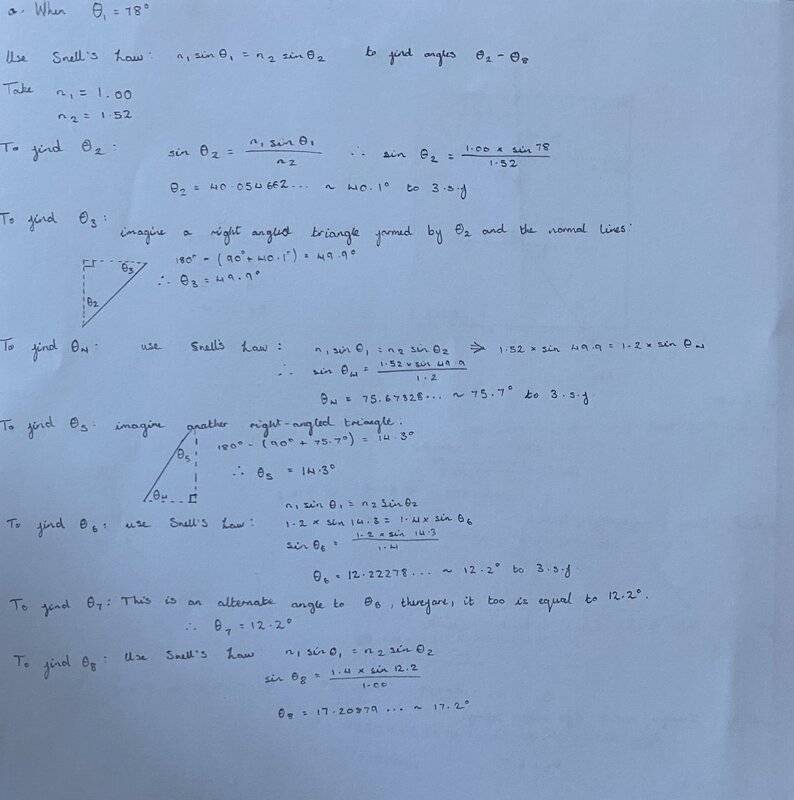
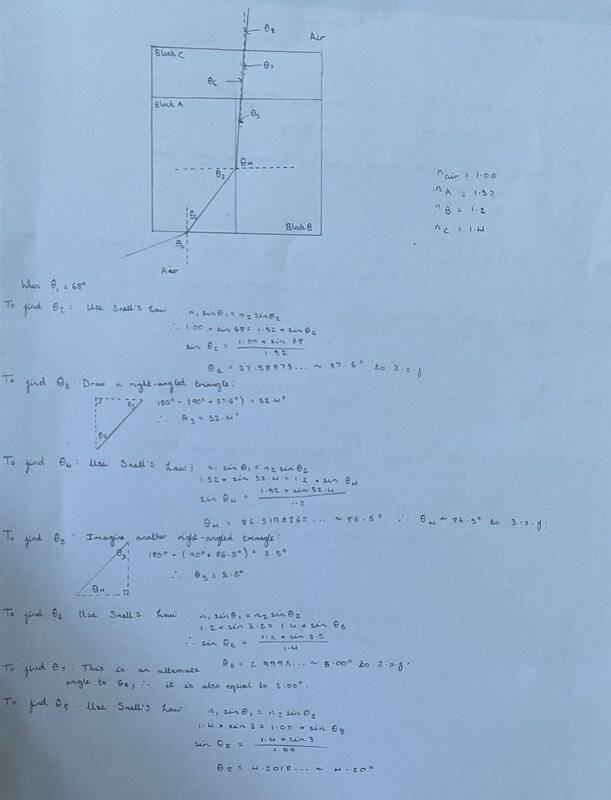
Hello, I have a question concerning calculating the angles of refraction through different mediums. I have attached the questions and a photograph of my workings. I have answered the question fully and thoroughly shown my method but I would be extremely grateful if someone was able to review all of my workings to see if the angles I have calculated are correct. I have not faced such a broad refraction calculation problem like this before which is why I feel a little unsteady.
The question states ;
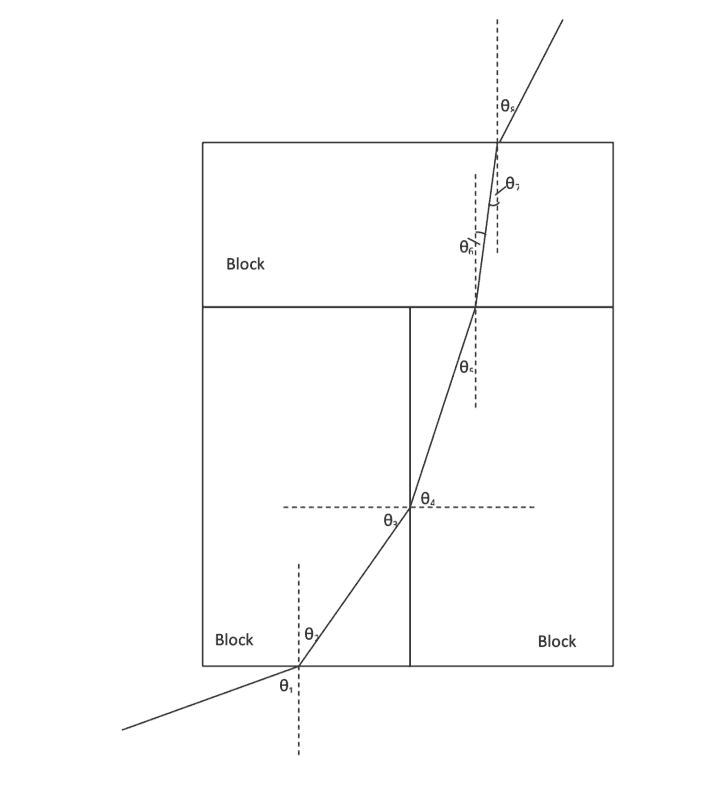
The image attached depicts three different mediums joined together. Block A has a refractive index of 1.52
Block B has a refractive index of 1.2
Block C has a refractive index of 1.4.
A ray of light travels through air into Block A, (assume air has a refractive index of 1.00).

1. The diagram displays the path of light when θ1 = 78.
Calculate all of the remaining angles up to and including the point where it leaves the blocks (θ2 to θ8).

2. Draw another diagram where the angle of incidence of θ1 = 68°. Calculate all of the angles up to and including the point where it leaves the blocks.
Relevant Equations
Snell's Law; n1sinθ1=n2sinθ2
1. I have calculated the first angle using Snell's Law and with subsequent proceeding angles I am uncertain whether my workings are correct since I have used basic laws of geometry that all internal angles of a triangle add up to 180 degrees and that alternate angles are equal to find proceeding angles in the same medium, e.g. to find θ3 I imagined a right-angled triangle, where θ2 and θ3 are the other interior angles.
θ3=180-(90+θ2)

I am not sure whether my methodology is correct or appropriate and would appreciate any advice on improvements I could make.

2. I have assumed the same method and proceeded to calculate angles θ2- θ8 accordingly. I must note that I realize the scale of my diagram is too small to properly exhibit the smaller angles (e.g. θ6=3 degrees) and I will draw another larger scale diagram as a better example.

Thank you to anyone who replies 😊👍
Workings to part 1.jpg
Workings to part 2.jpg
Question diagram.png
 
Last edited by a moderator:
Physics news on Phys.org
Just use Snell's law for all the boundaries. Don't need any 'basic laws of geometry'.
I notice ## \theta_3 and \theta_4 ## are with respect to the plane rather than to the normal. This is not the way to go.
I can't read your paperwork. Type your text. Use LaTex if you know it or want to learn it.
 
rude man said:
I notice ## \theta_3 and \theta_4 ## are with respect to the plane rather than to the normal.
1592255244021.png


The blocks are arranged so that the indicated angles are all with respect to the normals.
 
lpettigrew said:
I am not sure whether my methodology is correct or appropriate and would appreciate any advice on improvements I could make.
...
I must note that I realize the scale of my diagram is too small...

I think your method is correct.

You might see if you can relate ##\theta_8## directly to ##\theta_1## in one equation by combining the separate Snell's law equations before plugging in any numbers. You can then use this one equation to calculate ##\theta_8## for parts 1 and 2. Something interesting occurs regarding ##n_C##.
 
TSny said:
I think your method is correct.

You might see if you can relate ##\theta_8## directly to ##\theta_1## in one equation by combining the separate Snell's law equations before plugging in any numbers. You can then use this one equation to calculate ##\theta_8## for parts 1 and 2. Something interesting occurs regarding ##n_C##.

The single equation relating ##\theta_8## directly to ##\theta_1## is applicable if there aren't any total internal reflections. So, I guess you still need to find the intermediate angles to identify any total internal reflections. My idea of a single formula might not be such a good idea after all. :blushing: Edit: Also, the question statement asks you to find all the angles! And, you need all the angles to trace the ray.

Check your work for part 2 at the A-B interface.
 
Last edited:
TSny said:
I think your method is correct.

You might see if you can relate ##\theta_8## directly to ##\theta_1## in one equation by combining the separate Snell's law equations before plugging in any numbers. You can then use this one equation to calculate ##\theta_8## for parts 1 and 2. Something interesting occurs regarding ##n_C##.
Also if ##n_A =n_B## then the result is very interesting (and correct). I found it easiest to measure all the angles with respect to the vertical axis and use cosines in "Snell's Law" for the ##AB## interface. All you then need is ##cos^2+sin^2=1## The appropriate choice of square root takes care of any possible total internal reflection I think.
 
  • Like
Likes   Reactions: TSny

Similar threads

  • · Replies 1 ·
Replies
1
Views
2K
Replies
1
Views
2K
Replies
6
Views
2K
  • · Replies 1 ·
Replies
1
Views
2K
Replies
9
Views
2K
  • · Replies 2 ·
Replies
2
Views
2K
Replies
14
Views
5K
Replies
3
Views
2K
Replies
3
Views
2K
  • · Replies 1 ·
Replies
1
Views
2K