Undergrad How to Combine Vector Directions for Animated Surfaces in OpenGL?

  • Thread starter Thread starter ADDA
  • Start date Start date
  • Tags Tags
    Applied Vector
Click For Summary
The discussion focuses on combining vector directions for animated surfaces in OpenGL. The user is developing a method to animate surfaces using functions for center and normals, specifically t2center and t2normal, while seeking advice on how to combine normals effectively. They propose using vector translation for center adjustments but are uncertain about the appropriate mathematical operation to merge the normals from two functions, w2normal and t2normal. The conversation also touches on ensuring continuity among surfaces through functional composition of vector fields. Ultimately, the user realizes that applying the sum rule of derivatives could provide a solution for maintaining surface continuity.
ADDA
Messages
67
Reaction score
2
Hi,

I have a question regarding vectors. I am thinking ahead regarding an application that I am writing in OpenGL. Currently, four functions make up the vertex calculations, with one independent variable (w2center, w2normal, w2uv, uv2vector). A per-vertex center variable and per-vertex vector basis, calculated from w2normal, gives additional input uv2vector or the function which outputs the vertex. I would like to be able to animate surfaces rendered by adding two functions t2center and t2normal. Vector translation should be simple for t2center with an addition operation of w2center, yet I am unable to think or remember which operation I would use to combine normals, or directions of the surface, with the two two functions w2normal and t2normal. Would someone suggest an operation?

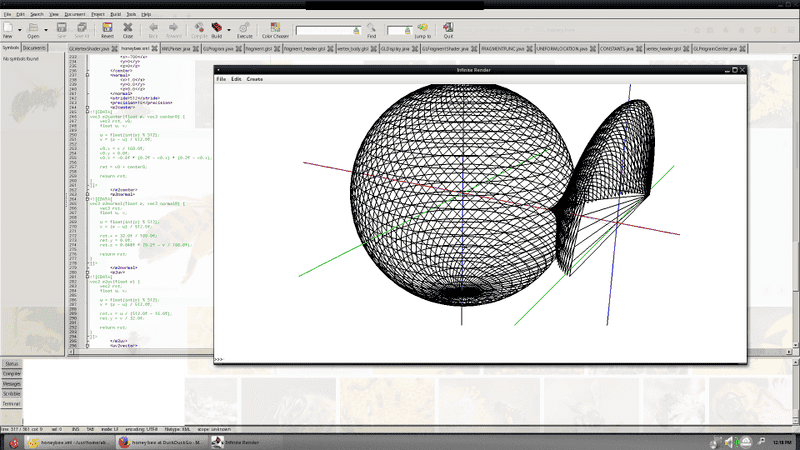
Below is an example image. The process involves relative centering with a surface hierarchy. Axii are drawn from surface centers, red is x or i, green is y or j, blue is z or k. The sphere has a single point center, yet the second surface has a parabolic line as its center, which is slightly able to be viewed by the black dots below the x or i axis. Taking for normal the first derivative of the parabola, I would like to be able to move center through another function, t2center, which would then change the "normal" or direction of the per-vertex basis. I think that addition is correct for centers, yet which operation would I use to combine the normals?
Screenshot-2017-02-09-12-18-22.png
 
Last edited:
Physics news on Phys.org
Adam Bryant Been said:
I have a question regarding vectors. I am thinking ahead regarding an application that I am writing in OpenGL. Currently, four functions make up the vertex calculations, with one independent variable (w2center, w2normal, w2uv, uv2vector). A per-vertex center variable and per-vertex vector basis, calculated from w2normal, gives additional input uv2vector or the function which outputs the vertex. I would like to be able to animate surfaces rendered by adding two functions t2center and t2normal.
Do you mean by writing these two functions or are you actually referring to some addtion operation?
Adam Bryant Been said:
Vector translation should be simple for t2center with an addition operation of w2center
, yet I am unable to think or remember which operation I would use to combine normals, or directions of the surface
What do you mean by "combine normals"?
Adam Bryant Been said:
, with the two two functions w2normal and t2normal. Would someone suggest an operation?

Below is an example image. The process involves relative centering with a surface hierarchy. Axii are drawn from surface centers, red is x or i, green is y or j, blue is z or k. The sphere has a single point center, yet the second surface has a parabolic line as its center, which is slightly able to be viewed by the black dots below the x or i axis. Taking for normal the first derivative of the parabola, I would like to be able to move center through another function, t2center, which would then change the "normal" or direction of the per-vertex basis. I think that addition is correct for centers, yet which operation would I use to combine the normals?
I am not understanding what you're trying to do here.

BTW, the plural of "axis" is "axes," not "axii."
 
Thank you for your reply, Mark44. I am planning on using vector translation (addition) for dynamically changing the center point or curves, given a time variable, t.

With my current setup, the normal (or direction or first derivative of the center curve) would not combine with translation, rotation, an inner product or cross product. I'm defining the normal as a direction pointing in the positive x direction, the right as a direction pointing in the positive y direction, and the up as a direction pointing in the positive z direction. These three directions are what I refer to as a basis.

I've been writing various GLSL functions with my current setup, and the center variable is loosely defined and may output a set of points ranging from a
singular point (the sphere), a curve (the second surface), or a plane in 3-space, or a surface in 3-space.

So, thinking backward from uv2vector, to ensure continuity among separate surfaces through animation with a time variable t, I am unsure how to combine normals or directions or a vector field. Instead of using standard cartesian coordinates <1,0,0> as normal <0,1,0> as right <0,0,1> as up, I'm defining a function for normal then forming cross products to produce an orthonormal basis.

I've extended the above example with a few more sceenshots:

surface_example1.png

surface_example2.png


In these the center curve is more clearly seen. The normal would be a vector field of directions corresponding to each derivative. I'm attempting to keep this simple, yet it's getting complex quick. Since the outer surface's vertices are calculated from the point-wise basis, if I were to use a function for the initial shape of the surface, then a separate function to animate it, as creativity may permit, I'm lost as to how I might combine directions.
 
Adam Bryant Been said:
yet I am unable to think or remember which operation I would use to combine normals, or directions of the surface, with the two two functions w2normal and t2normal.

Got a bit wordy here. I am referring to the directions of the center curve, seen in the above examples with the parabolic dots.

I'm trying to figure out functional composition applied to a vector field. At least I think that's the proper term. I think, perhaps...

f(w) = w2normal (initial vector field)
g(t) = t2normal (animated vector field)

To ensure continuity among surfaces I would need a different parametric function of w and t instead of separate functions. However, I would like to compose it of f(w) and g(t), so that I may write different g(t) functions for one f(w) function.

h(w,t) = ?
 
Mark44, I guess all that I needed was the sum rule of derivatives... the gifs are not animating?
frame_00000000.png
frame_00000015.png
frame_00000030.png
frame_00000045.png
frame_00000060.png
frame_00000075.png
frame_00000090.png
 

Attachments

  • frame_00000006.png
    frame_00000006.png
    18.3 KB · Views: 413
  • frame_00000000.png
    frame_00000000.png
    18 KB · Views: 444
  • frame_00000029.png
    frame_00000029.png
    18.8 KB · Views: 420
There is a solution to surface continuity:

 
End Result:


Similar threads

  • · Replies 3 ·
Replies
3
Views
12K
  • · Replies 5 ·
Replies
5
Views
4K
  • · Replies 12 ·
Replies
12
Views
2K
  • · Replies 9 ·
Replies
9
Views
2K
  • · Replies 0 ·
Replies
0
Views
1K
  • · Replies 14 ·
Replies
14
Views
4K
  • · Replies 4 ·
Replies
4
Views
3K
Replies
24
Views
2K
  • · Replies 9 ·
Replies
9
Views
2K
Replies
13
Views
3K