How to create a camera mount with basic materials?

  • Thread starter Thread starter Sneaky6666
  • Start date Start date
  • Tags Tags
    Camera Materials
Click For Summary

Discussion Overview

The discussion revolves around designing a camera mount using basic materials to capture precise images of an object from multiple angles. The focus is on creating a mechanical device that can hold a phone steady while allowing for adjustable camera positioning, with specific requirements for construction and functionality.

Discussion Character

  • Exploratory
  • Technical explanation
  • Debate/contested
  • Experimental/applied

Main Points Raised

  • One participant outlines the need for a camera mount that can hold any phone, with adjustable positioning to ensure the camera aligns with the center of the object being photographed.
  • Another participant questions the size of the distance x and the required precision for camera location and rotation angles, suggesting that a "hole and alignment points" construction may be more reliable than using rubber bands.
  • Some participants propose keeping the camera stationary and rotating the object instead, while others emphasize the importance of maintaining consistent lighting to avoid shadows.
  • Concerns are raised about the flexibility of rubber bands leading to inconsistent camera positioning, with suggestions for more stable alternatives such as a vice grip or a fixed support structure.
  • A sketch is shared to illustrate a proposed design featuring a large hole for accommodating various phone types, although there is confusion about how this design would function in practice.
  • Participants discuss the trade-offs between material usage and construction effort, with some advocating for simpler designs that minimize cost and complexity.
  • There is mention of the potential for the device to be used by others in the future, emphasizing the need for simplicity in assembly.

Areas of Agreement / Disagreement

Participants express differing views on the best approach to constructing the camera mount, with no consensus reached on the optimal design or materials. There are multiple competing ideas regarding the stability of the camera, the method of capturing images, and the overall construction strategy.

Contextual Notes

Participants highlight limitations related to the precision of camera positioning, the need for adjustable features to accommodate different phone sizes, and the balance between material costs and construction effort. The discussion remains open-ended with various unresolved technical considerations.

Sneaky6666
Messages
14
Reaction score
0
I have a project which requires me to get 5 very specific images of an object from various angles. The user can't use their hands because it would be too shakey and introduce error. These images have to be precise and steady. So that's why I need to build a helper camera mounting device to help. I need help in designing this. The background of the images also needs to be removed.

The 5 angles I need is 4 from it's sides 0 degrees, 90 degrees, 180 degrees, 270 degrees. Where the camera is x distance away from the center of the object. The fifth angle is a top down view of the object, but the camera also needs to be x distance away from the center of the object.

How could I construct such a device that can attach any phone to it and use it's camera?

Requirements:
1. The device can attach any size phone to it.
2. Camera position has to be adjustable so that the camera is pointing at the center (horizontally and vertically) of the object.
3. Can only be mechanical, and no wires, circuits, or electronics, or motors.
4. Materials used can be bought from big hardware stores such rona, home depot, home hardware.
5. Need to minimize cost of materials and general effort to assemble it.
6. Need to be able to see the phone screen to see what the camera is showing.
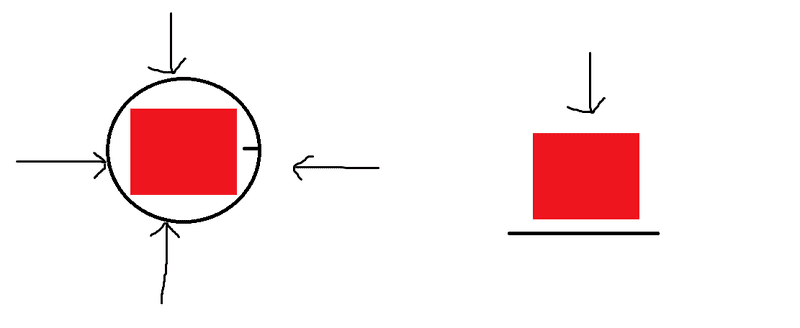
7. A green screen that becomes the background of all 5 shots, so that a program can automate removing the background.What I had in mind, would be a a plank of wood, with a circular piece on the center which the object rests on. The initial rotation a marker lines up with the 0 degree marker. There is also markers marked for 90, 180 and 270 degrees. So the user can just rotate the circular thing and align the markers to exactly rotate the object with each of the 4 degrees, so the camera can get the 4 side shots. Then there would be two thin L shape sticks attached to the main wood plank. The phone would rest in the center of the 2 L sticks held by rubber bands. It can be attached on the bottom for the 4 side shots, and also on the top to get the top down view. For the bottom position, it needs something to stand on, so perhaps another rubber band twisted in a 8 shape. Then I could tape green papers all around it. With a green wall behind it.

Does anyone have any better ideas?

Thanks
DNBebNA.png

4V8CCkg.png
 
Last edited:
Engineering news on Phys.org
How large is x?

What is the required precision for the camera location and the rotation angles? In particular, how does that compare to the different camera locations on different phones, and how well does that work with rubber bands?

A "hole and alignment points" construction looks more reliable than rubber bands.
 
Alternatively, you might find it easier to keep the camera in one place and move/rotate/tilt the object being photographed.
 
x is probably going to be around 1.5-2 feet. The location of the phone should be such that when the camera takes the picture, the center of the image should align with the center of the object. I don't have any exact numbers for precision, but it should basically be as close as possible to center align. I know different phones have different sizes and different camera positions, so this device will have to take that into account and be adjustable so that the phone can be positioned so the camera is properly aligned. I was thinking rubber bands could do that since you can adjust its position. When taking the bottom position, its possible I need to raise the phone a little, so that's why I thought of having a rubber band twisted in a 8 shape be the thing the phone rests on, if it needs to be higher than ground level.

I also thought about just manually rotating the object with each of it's 4 degrees, but this device will ultimately be used by average joe's and they could easily not rotate it enough or too much. For this to work, it has to be rotated at exactly 0, 90, 180, 270 degrees. Using a marker, might help the user to get the best accuracy to rotate.

Also I'm not familiar with the "hole and alignment points" construction. Do you have an image? Also if it's what I think your saying, there would only be a limited fixed amount of spots I can use. What if I need a spot in between 2 holes to use?

Also I need the top view because the object could be a glass of water, if I tilt it, the water will spill.
 
Last edited:
The light source really needs to be rotated with the camera to prevent shadows from the various fixture elements and the camera; particularly, when the camera is directly above the object.

How large are the objects you want to photograph?
 
Rubber bands are flexible, they every image will have a slightly different position and orientation of the camera.

All phones I know of have their camera in the upper half. If you make a support for the lower half (including some features sticking out of the surface to help with alignment), you can make a big hole in the wooden sheet to have the camera point through that hole.
 
True, the images will need the same lighting without shadow. So that would mean the light source should come from the camera. Maybe I can just use the camera flash to handle that.

The objects will basically be food items from restaurants, so it should be safe to assume the biggest will probably be a large dinner plate size. Although there can be large pizza's, but I wouldn't worry so much about that. I can probably modify the design later to handle bigger things by scaling everything, or using longer materials.

Rubber bands are flexible and they might wobble or shake, so you might have a point there. In that case I would need something more sturdy to hold the phone at any position. Holes in a stick might not work because they limit the number of positions, and I need to be as flexible as possible. Maybe something like a vice grip to stick to a pole would work better.

Also do you mean to make a hole in the wood base floor and put the phone in that? Also how would I raise it if it needs to go higher?
 
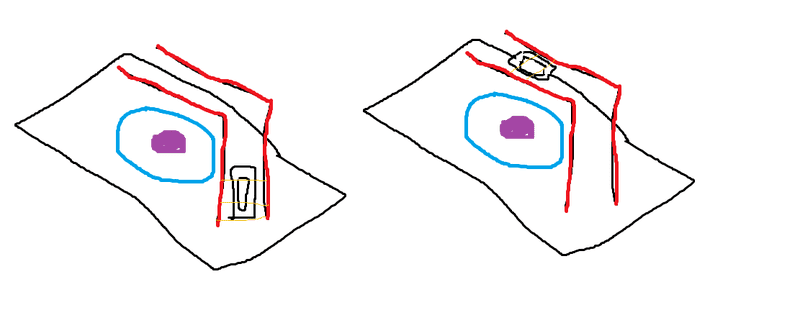
Here is a sketch showing what I meant. The hole can be really big to accommodate all common phone types. The alignment corner makes sure the phone has the correct orientation.

sketch.png
 
It's a bit confusing because it looks like the phone is flat on the ground. How would it take the picture of the object, and where would the object be?
 
  • #10
The board is the distance x above the surface where the object rests on.
At the place where you want to take the picture - where else?
 
  • #11
oh ok, so that whole thing would be on top, but it looks like there is a lot of extra material needed for the top then. I was looking to minimize on material used. In my example, I have two L shape sticks, which is much less material.
 
  • #12
You don't need a large board. Just large enough for the phone. Don't take the sketch too literal.
 
  • #13
It could work, but I'm also looking to minimize other factors. Your idea would increase material compared to my idea. It would need an extra base on top. Then you would need to cut a hole in it, then construct that alignment piece and stick it on the base. It just seems like it would be more effort and cost to construct compared to my example.

Basically, as part of the requirements, the total cost and effort to build the whole device, should be minimized. So I'm looking for a way to make this sturdy but using materials that don't really need much modifications. In other words, putting them together like lego blocks (not literally as easy but you get the point).
 
  • #14
Do you intend for there to be multiple units like this and/or be assembled on site by different users?
 
  • #15
For starters the prototype would be developed by me so I can use, but it could potentially be used by others to assemble and use, so just looking for simplicity.
 
  • #16
One advantage of making it a box with multiple camera holes that can be covered is that then it will prevent possible stray external light created shadings and shadows if it is not always used in a dark environment. Other wise you are going to need some kind of shrouding with your open frame design to deal with that problem.

I don't know how much of a background you have with quality display and precision photography, but one the biggest problems for indoor shooting of objects is controlling all of the ambient light intrusion issues. If you are going to try and combine your multiple shots into some type of a composite then consistent (and preferably diffuse) lighting across all views is absolutely necessary.
 
  • #17
Sneaky6666 said:
Basically, as part of the requirements, the total cost and effort to build the whole device, should be minimized. So I'm looking for a way to make this sturdy but using materials that don't really need much modifications. In other words, putting them together like lego blocks (not literally as easy but you get the point).
Even Lego would be much more robust than a rubber band solution.

The alignment blocks can be small wooden pieces or small metal angles. Something that takes 10 minutes to add with a negligible budget, and it will lead to a very precise alignment of the phone.
 

Similar threads

  • · Replies 9 ·
Replies
9
Views
2K
  • · Replies 4 ·
Replies
4
Views
3K
  • · Replies 30 ·
2
Replies
30
Views
9K
Replies
2
Views
903
  • · Replies 3 ·
Replies
3
Views
8K
  • · Replies 3 ·
Replies
3
Views
4K
  • · Replies 8 ·
Replies
8
Views
3K
  • · Replies 2 ·
Replies
2
Views
3K
  • · Replies 42 ·
2
Replies
42
Views
5K
Replies
5
Views
3K