How to Determine Elevator Speed with Winch Mechanics?

Click For Summary

Homework Help Overview

The discussion revolves around determining the speed of an elevator using winch mechanics, specifically analyzing the relationship between the velocities of ropes involved in the system. The original poster expresses confusion regarding the answer provided in their textbook and seeks clarification on the mechanics involved.

Discussion Character

  • Exploratory, Mathematical reasoning, Assumption checking

Approaches and Questions Raised

  • Participants discuss the relationships between the velocities of different segments of rope and the implications of these relationships on the elevator's speed. There are attempts to differentiate equations related to rope lengths and velocities, and questions arise about the assumptions made regarding the velocities being equal.

Discussion Status

Several participants are actively engaging with the problem, offering different equations and reasoning. There is a recognition of potential discrepancies in the original poster's approach, and some guidance is provided regarding the relationships between the variables involved. However, there is no explicit consensus on the correct interpretation or solution at this point.

Contextual Notes

Participants note that the velocities of the ropes are not necessarily equal, which raises questions about the assumptions made in the original setup. The original poster also mentions a discrepancy between their calculations and the answer provided in the textbook, indicating a potential misunderstanding of the problem's constraints.

ilya
Messages
3
Reaction score
0
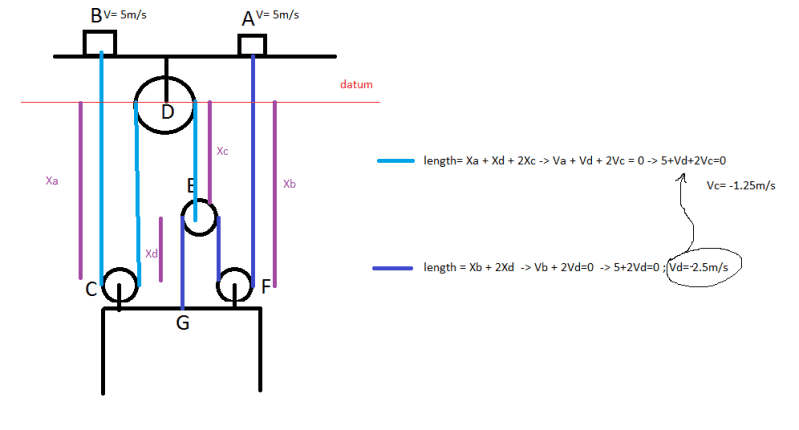
Please help. I am starting to think the answer in the back of my book is wrong. Refer to picture below. Question: Find the speed of the elevator if the winches A and B both pull the rope at 5 m/s. Answer is 2.14m/s. How? I have no idea. I am not the kind to just give up.
199.png


Thank you very much!
 
Physics news on Phys.org
The length of both ropes changes in a rate -5 m/s. So the sum of the velocities is not zero.

More: notice that xa=xb, xa=xd+xc.

ehild
 
Thank you for your reply. In class we set these types of equations as:

Rope 1:

Step one: Xb+Xc+Xd= length(which is just Some constant)
Step two: Differentiate both sides to get velocity since previous equation is length or displacement.

there fore we get Vb+Vc+Vd=0

Step three: we know Vb=Va=5m/s and we can substitute. 5+Vc+Vd=0 -> Vc+Vd= -5m/s

Rope 2:
Step one: Xa+Xa+Xc= length(some constant)
Step two: differentiate both sides to get 2Va+Vc=0
Step three: substitute known. 2(5) + Vc = 0 -> Vc= -10m/s

Finaly
Solving for the last unknown Vc+Vd=-5 -> -10+Vd=-5 -> Vd = 5m/s

Somewhere I am not doing something right because the answer is 2.14m/s (sign is disregarded)
What doesn't make sense is that Vd and Vc are different velocities, and I think they should be the same because how can the elevator go up with a constant velocity. MY GUESS IS THAT I LABELED THE PROBLEM WRONG
 
P012810001.jpg
 
When the system moves, total changes in each segments of the string must be zero.
In the blue string
change in the 1st segment = Xb - Xc
change in the 2nd segment= Xd - Xc, but Xd = Xb, so
= Xb - Xc
change in the 3rd segment =- Xd - y
So total change in the blue string = (Xb)-2(Xc) - y = 0...(1)
Now in the purple string
change in the 1st segment = Xa - Xf
change in the 2nd segment = y - Xf
change in the 3rd segment = y - Xg
So total change in the purple string = Xa - 3Xf + 2y = 0...(2)
From eq.1 y = (Xb - 2Xc). Substitute it in equation (2). Note that Xf = Xc and Xa = Xb,
Find Xf in terms of Xa. Put Xa = 5m/s and find Xf.
 

Similar threads

  • · Replies 15 ·
Replies
15
Views
2K
Replies
3
Views
2K
  • · Replies 33 ·
2
Replies
33
Views
4K
  • · Replies 22 ·
Replies
22
Views
2K
  • · Replies 4 ·
Replies
4
Views
3K
Replies
4
Views
2K
  • · Replies 4 ·
Replies
4
Views
1K
  • · Replies 11 ·
Replies
11
Views
2K
  • · Replies 11 ·
Replies
11
Views
2K
  • · Replies 10 ·
Replies
10
Views
2K