How to determine the area of intersecting circles?

  • Thread starter Thread starter elegysix
  • Start date Start date
  • Tags Tags
    Area Circles
Click For Summary
SUMMARY

The discussion focuses on calculating the area of intersection between two overlapping circles, specifically when one circle has a radius R and the other has a radius r (where R > r). The simpler case involves the larger circle centered at the origin and the smaller circle centered at (R,0). The area of overlap can be determined by finding the endpoints of the chord connecting the intersection points of the circles and calculating the angles formed with the centers. The area of the intersection is then derived from the sector areas of both circles minus the area of the isosceles triangle formed within each sector.

PREREQUISITES
  • Understanding of circle geometry and properties
  • Knowledge of trigonometric functions and angles
  • Familiarity with calculating areas of sectors and triangles
  • Basic algebra for manipulating equations
NEXT STEPS
  • Research methods for calculating the area of a circular sector
  • Learn about the properties of isosceles triangles in relation to circles
  • Explore advanced geometric concepts involving multiple circles
  • Study computational geometry techniques for circle intersection problems
USEFUL FOR

Mathematicians, geometry enthusiasts, and anyone interested in solving problems related to the intersection of circles and their applications in various fields such as physics and engineering.

elegysix
Messages
404
Reaction score
15
I've been wondering how to calculate the area of intersection of two overlapping circles in terms of their radii. There's two cases I'm interested in:

The easier case:
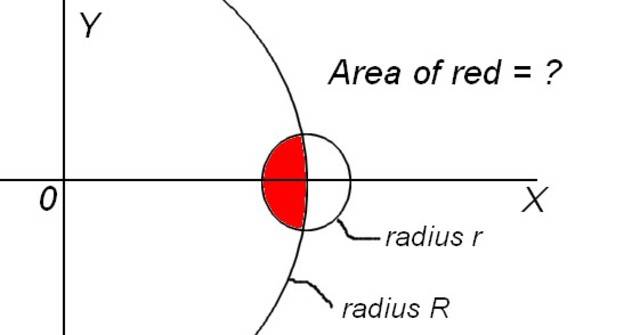
Suppose there are two circles of radius R and r (R > r). The center of the larger circle is at the origin, and the center of the other circle is at (x,y)=(R,0). How can I find the area of the overlap in terms of R and r? I can't think of any clear way to do this by hand.

The more complicated case:
Do the same except let the center of the smaller circle lie between (R-r,0) < (x,y) < (R+r,0)

I've attached a drawing to help show the problem.
Thanks for any insight. This isn't for school, so there's no rush or anything. Just curious.
circles.jpg
 
Mathematics news on Phys.org
More complicated case is irrelevant. The distance between the centers (and the radii) are all that matter.

General approach: Get end points of chord which connects the points of intersection of the circles.

For each circle, calculate the angle made by connecting these end points to the center. Now the problem is reduced to a pair of problems of obtaining for each circle the area of the sector minus the area of the isosceles triangle within the sector.
 

Similar threads

  • · Replies 2 ·
Replies
2
Views
4K
  • · Replies 4 ·
Replies
4
Views
2K
  • · Replies 3 ·
Replies
3
Views
2K
  • · Replies 3 ·
Replies
3
Views
2K
  • · Replies 4 ·
Replies
4
Views
1K
  • · Replies 8 ·
Replies
8
Views
2K
Replies
1
Views
3K
  • · Replies 4 ·
Replies
4
Views
2K
  • · Replies 2 ·
Replies
2
Views
2K
  • · Replies 23 ·
Replies
23
Views
4K