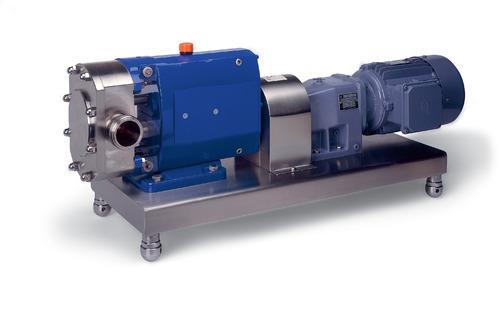
How to determine the power of a rotary lobe pump?

Click For Summary
SUMMARY

To determine the power requirements of a rotary lobe pump, follow a systematic approach: first, establish the maximum flow rate and pressure needed for your system. Next, select a pump that meets these specifications and read the pump RPM from its curve. Choose an appropriate motor RPM and gear ratio, then read the motor power from the pump curve, adding a safety factor to the motor size. For example, if the calculated motor size is 0.5 kW, opt for a 0.75 kW motor to ensure adequate performance.

PREREQUISITES
  • Understanding of rotary lobe pump mechanics
  • Familiarity with pump curves and performance metrics
  • Knowledge of flow rate and pressure calculations
  • Experience with motor selection and sizing
NEXT STEPS
  • Research rotary lobe pump efficiency calculations
  • Learn about variable frequency drives for pump applications
  • Study the impact of fluid viscosity on pump performance
  • Explore methods for calculating line loss in piping systems
USEFUL FOR

Engineers, pump system designers, and maintenance professionals involved in selecting and sizing rotary lobe pumps for various industrial applications.

Minghan
Messages
17
Reaction score
2
TL;DR
Is there any method to measure the power of the pump?
Want to know how to get the actual power the pump needs.
I can measure the flow rate by the flow meter and count the revolutions of the pump.
But selecting the proper motor for the pump would be a problem.
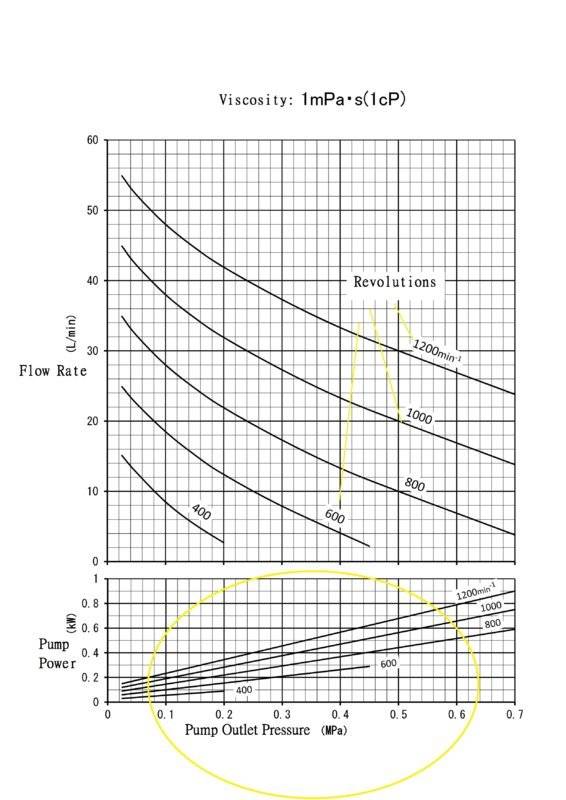
So I want to know how to determine the power of the rotary lobe pump and generate the graph like below.
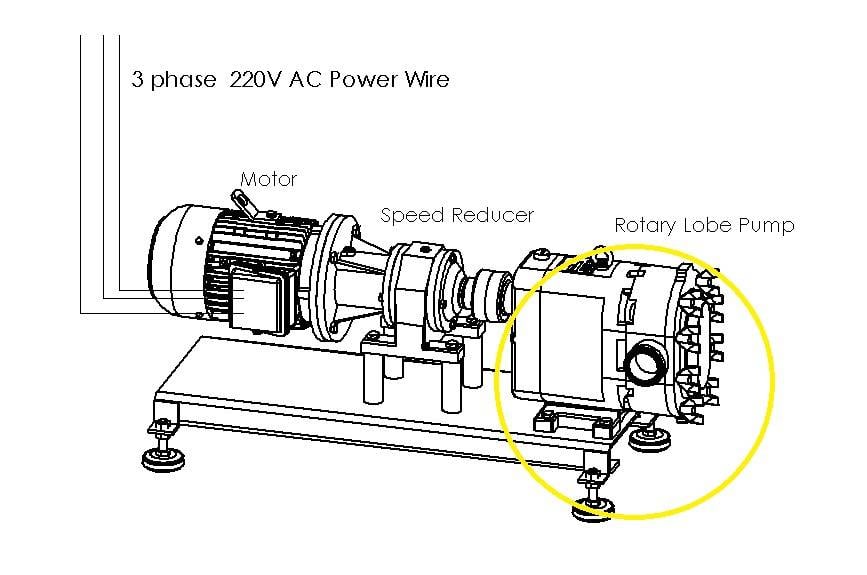
P.JPG

0001 (1).jpg

lobe-pump-with-motor-500x500.jpg
 
Engineering news on Phys.org
Have you considered looking at the energy you used on the electric meter that supplies your electricity?
 
  • Like
Likes   Reactions: Minghan, Asymptotic and anorlunda
Dr_Nate said:
Have you considered looking at the energy you used on the electric meter that supplies your electricity?
My guess is that there is a pump but no motor. And perhaps the lower figure isn't available for that particular pump either ...

From the lower figure one could deduce a typical efficiency for that type of pump by looking at ##\Delta pV##

Which comes out pretty low -- but I'm used to centrifugal pumps. E.g: 1200/min at 6 Barg outlet pressure would be 2700 x 10-3m3/min / 60 s/min * 6 x 10⁵N/m2 = 270 Nm/s while the lower plot shows 800 W, so around 1/3. The motor/gearbox efficiency will be over 90% , so a 1 kW motor should be adequate for that throughput. Careful calculations are in order, since the world is full of overdimensioned pump motors that waste a lot of energy money.​
 
  • Like
Likes   Reactions: Minghan and scottdave
Minghan said:
Want to know how to get the actual power the pump needs.
I can measure the flow rate by the flow meter and count the revolutions of the pump.
But selecting the proper motor for the pump would be a problem.
So I want to know how to determine the power of the rotary lobe pump and generate the graph like below.

Pump and motor selection starts from the system requirements, which are specified first. This can be challenging at times, but you can usually figure out the maximum flow rate by a system mass balance, and the pressure by calculating the line loss.

Step 1: Determine the required maximum flow rate and maximum pressure.
Step 2: Select a pump that delivers that flow rate at that pressure.
Step 3: Read the pump RPM from the pump curve.
Step 4: Select the motor RPM and reducer gear ratio.
Step 5: Read the motor power from the pump curve.
Step 6: Add a safety factor to the motor size. If the motor size from the pump curve is 0.5 kW, then select a 0.75 KW motor.

If you have absolutely no clue about pressure and flow, and a large budget, there is another option. Oversize the pump and motor, then add a variable frequency drive. This is a good option if management is saying "we don't care what it costs, just make it work".
 
  • Like
Likes   Reactions: Minghan and anorlunda
jrmichler said:
This is a good option if management is saying "we don't care what it costs, just make it work".
That will be the day! I'm sure I never heard that particular statement from management.
 
It's fairly common in a paper mill, especially in a case where the first pump installed by the engineer did not do the job. And yes, I have been there and done that.
 
  • Like
Likes   Reactions: Dullard
I don't know what you're pumping, but:

a couple of considerations:

The viscosity of the fluid is important. Note that viscosity varies with temperature.
All lobe pumps have some fluid slip. Fluid slip causes extra wear. Extra wear causes more slip. You're probably going to see an increase in your power requirement over time (assuming that you maintain a fixed PV requirement).

'Over Sizing' the pump/motor is not a bad idea.
 
  • Like
Likes   Reactions: Minghan
Dr.D said:
That will be the day! I'm sure I never heard that particular statement from management.
They probably phrase it as "Just shut up and do it." 😉

But yes, suppose you have million dollar project. You don't want to waste 2 man months calculating whether you need a $2000 motor or a $1000 motor. That's the same as money is no object.
 
  • Like
Likes   Reactions: Minghan, jrmichler and Dullard
The application will decide the motor speed and power required.
What fluid will be pumped?
What is the maximum required flow rate and pressure?

What is the displacement per revolution?
What information is written on the pump, make, model, capacity?
What is the diameter of the pump input shaft? That indicates maximum torque.
 
  • Like
Likes   Reactions: Asymptotic and Minghan

Similar threads

  • · Replies 9 ·
Replies
9
Views
2K
  • · Replies 19 ·
Replies
19
Views
4K
  • · Replies 5 ·
Replies
5
Views
3K
  • · Replies 6 ·
Replies
6
Views
3K
  • · Replies 3 ·
Replies
3
Views
3K
  • · Replies 8 ·
Replies
8
Views
4K
  • · Replies 3 ·
Replies
3
Views
3K
  • · Replies 15 ·
Replies
15
Views
4K
Replies
58
Views
8K
  • · Replies 10 ·
Replies
10
Views
2K