How to enter measurement results into Bell inequality?

Click For Summary
SUMMARY

The discussion focuses on calculating expectation values in the context of the Bell (CHSH) inequality for entangled particles. Participants clarify that to compute the expectation values, one must consider the number of matches and mismatches at specific detector settings, dividing by the total detections. The conversation also distinguishes between "counterfactual definiteness" and "local realism," emphasizing that the assumptions of locality, realism, and linearity of expectation values are crucial in deriving the inequality limit of 2. The article referenced is "Endspiel für den lokalen Realismus" from Physik unserer Zeit, 6/2015.

PREREQUISITES
  • Understanding of Bell's theorem and CHSH inequality
  • Knowledge of quantum mechanics concepts such as entanglement and expectation values
  • Familiarity with statistical methods for calculating matches and mismatches in measurements
  • Basic grasp of the philosophical implications of realism and counterfactual definiteness
NEXT STEPS
  • Study the derivation of Bell's theorem and its implications in quantum mechanics
  • Explore the concept of "fair sampling loophole" in quantum experiments
  • Learn about the differences between classical and quantum expectation values
  • Read the article "Endspiel für den lokalen Realismus" for deeper insights into local realism
USEFUL FOR

Quantum physicists, researchers in quantum mechanics, and students studying the implications of Bell inequalities and entangled particle measurements.

greypilgrim
Messages
581
Reaction score
44
Hi.

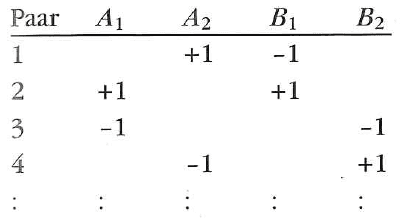
I can calculate the expectation values in the Bell (or in this case, CHSH) inequality and show that they violate it for entangled particles. But I'm confused about how to calculate them for an actual sequence of measurements, which could look like this ("Paar" is for photon pair):
1713975871025.png


How do i now calculate from this the expectation values in
##\langle A_1 B_1 \rangle+\langle A_1 B_2 \rangle+\langle A_2 B_1 \rangle-\langle A_2 B_2 \rangle\ ?##
For example, how do I calculate ##\langle A_1 B_1 \rangle## for for the pairs 1, 3 and 4 where Alice's or Bob's detector where at setting 2? Or do I only consider cases like pair 2 for this?
 
Physics news on Phys.org
greypilgrim said:
Or do I only consider cases like pair 2 for this?
That's right. For each pair of detector settings you are calculating the number of matches at that setting minus the number of mismatches at that setting, then dividing by the total number of detections at that setting.
 
Thanks!
The article I was reading proved that
##\langle A_1 B_1 \rangle+\langle A_1 B_2 \rangle+\langle A_2 B_1 \rangle-\langle A_2 B_2 \rangle\le 2##
by using
##A_1 B_1+A_1 B_2+A_2 B_1-A_2 B_2=A_1 (B_1+B_2)+A_2 (B_1-B_2)=\pm 2##
which only makes sense if all four values are defined, even if they might not be actually measured. I thought this assumption was called "counterfactual definiteness", a term that does not appear in this article, only "local realism".

What exactly is the difference between "counterfactual definiteness" and "realism"? I'm confused by all those very similar concepts that are used around Bell inequalities.
 
greypilgrim said:
The article I was reading
Which article? Please give a reference.
 
I can, but it's in German.
 
greypilgrim said:
I can, but it's in German.
We still need to have it as a reference.
 
It's "Physik unserer Zeit", 6/2015 (46), "Endspiel für den lokalen Realismus".
 
greypilgrim said:
Thanks!
The article I was reading proved that
##\langle A_1 B_1 \rangle+\langle A_1 B_2 \rangle+\langle A_2 B_1 \rangle-\langle A_2 B_2 \rangle\le 2##
by using
##A_1 B_1+A_1 B_2+A_2 B_1-A_2 B_2=A_1 (B_1+B_2)+A_2 (B_1-B_2)=\pm 2##
which only makes sense if all four values are defined, even if they might not be actually measured. I thought this assumption was called "counterfactual definiteness", a term that does not appear in this article, only "local realism".

What exactly is the difference between "counterfactual definiteness" and "realism"? I'm confused by all those very similar concepts that are used around Bell inequalities.
Realism is often confused with other kinds of philosophical realisms. Thus some people prefer the term counterfactual definiteness instead of realism, to refer to the idea that values are predefined previous to measurement. The whole of the assumptions of Bell's theorem is often called local realism.

Edit: unfortunately, by the very nature of the interpretation problem of quantum mechanics and by the fact that some proofs use different assumptions, not everybody agrees on the terminology and interpretational implications.
 
Last edited:
  • Like
Likes   Reactions: DrChinese
greypilgrim said:
It's "Physik unserer Zeit", 6/2015 (46), "Endspiel für den lokalen Realismus".
Link, please?
 
  • #10
greypilgrim said:
which only makes sense if all four values are defined, even if they might not be actually measured.
Run enough of pairs through and you will have enough counts to calculate all four combinations of ##\langle A_iB_j\rangle##, and then you can use these in identities such as the one your paper uses.
 
  • #11
PeterDonis said:
Link, please?
https://onlinelibrary.wiley.com/doi/abs/10.1002/piuz.201501412
But it's behind a paywall.

Nugatory said:
Run enough of pairs through and you will have enough counts to calculate all four combinations of ##\langle A_iB_j\rangle##, and then you can use these in identities such as the one your paper uses.
But isn't
##A_1 B_1+A_1 B_2+A_2 B_1-A_2 B_2=A_1 (B_1+B_2)+A_2 (B_1-B_2)=\pm 2##
assuming a single experiment?
 
  • #12
greypilgrim said:
But isn't
##A_1 B_1+A_1 B_2+A_2 B_1-A_2 B_2=A_1 (B_1+B_2)+A_2 (B_1-B_2)=\pm 2##
assuming a single experiment?
No. The assumption is that the behavior of the (for example) ##A_1B_2## pairs is representative of what all the other pairs would have done if they had happened to pass through the apparatus at the moment that detector A was in the 1 position and B was in the 2 position. Given this assumption, we can combine the results across all four combinations even though the results for each combination are calculated from different sets of detections.
Another way of thinking about it: For all practical purposes we are running four different experiments on the same entangled pair source: One to measure the ##A_1B_1## behavior of our source, one to measure the ##A_1B_2## behavior, one to measure the ##A_2B_1## behavior, and one to measure the ##A_2B_2## behavior.

The possibility that this assumption is wrong is the so-called "fair sampling loophole", and experiments of the sort that you are considering in this thread are hypothetically vulnerable to it. However, there are many reasons to think that fair sampling is in fact valid (for example, the experimental results do not change when the entire apparatus is rotated around the longitudinal axis) and other experiments that do not require the fair sampling assumption have also confirmed the violation of Bell's inequality.
 
Last edited:
  • Like
Likes   Reactions: PeterDonis
  • #13
So as I understand it, the fact that the expectation value of a sum is the same as the sum of the expectation values is crucial in the derivation of the limit 2 of this inequality.
As far as I know this is problematic in QM for non-commutative operators and broke the neck of von Neumann's "proof" of his no-hidden-variables theorem.

I'm probably missing something again, but doesn't this mean that in the derivation of this inequality we actually use the assumptions
  1. locality
  2. realism
  3. expectation values are linear (in the observables)
and the violation by QM could also just be attributed to 3. being wrong or not well-defined, as apparently *is* actually the case?
 
  • #14
greypilgrim said:
So as I understand it, the fact that the expectation value of a sum is the same as the sum of the expectation values is crucial in the derivation of the limit 2 of this inequality.
As far as I know this is problematic in QM for non-commutative operators and broke the neck of von Neumann's "proof" of his no-hidden-variables theorem.

I'm probably missing something again, but doesn't this mean that in the derivation of this inequality we actually use the assumptions
  1. locality
  2. realism
  3. expectation values are linear (in the observables)
and the violation by QM could also just be attributed to 3. being wrong or not well-defined, as apparently *is* actually the case?
Where is 3 used?
 
  • #15
The article I read first showed
##A_1 B_1+A_1 B_2+A_2 B_1-A_2 B_2=A_1 (B_1+B_2)+A_2 (B_1-B_2)=\pm 2##
from which follows that
##\langle A_1 B_1+A_1 B_2+A_2 B_1-A_2 B_2\rangle = \langle A_1 B_1 \rangle+\langle A_1 B_2 \rangle+\langle A_2 B_1 \rangle-\langle A_2 B_2 \rangle\le 2##

Wikipedia does ist the same and even explicitly says
"No single trial can measure this quantity, because Alice and Bob can only choose one measurement each, but on the assumption that the underlying properties exist, the average value of the sum is just the sum of the averages for each term."
 
  • #16
greypilgrim said:
I'm probably missing something again, but doesn't this mean that in the derivation of this inequality we actually use the assumptions
  1. locality
  2. realism
  3. expectation values are linear (in the observables)
and the violation by QM could also just be attributed to 3. being wrong or not well-defined, as apparently *is* actually the case?
The expectation values are numbers, so what you’re calling a third assumption is just the rules of arithmetic, which say that numbers can be added and multiplied . Of course just because they can be doesn’t mean that they should (there’s the old saying about adding apples and oranges) but in this case the arithmetic is justified as long as fair sampling is satisfied.
 
  • #17
If ##A_i## and ##B_i## were QM operators and we were calculating QM expectation values would then the equation
##\langle A_1 B_1+A_1 B_2+A_2 B_1-A_2 B_2\rangle = \langle A_1 B_1 \rangle+\langle A_1 B_2 \rangle+\langle A_2 B_1 \rangle-\langle A_2 B_2 \rangle##
be problematic?

I know that this isn't what Bell or CHSH did (their inequalities aren't about QM at all), but I'm trying to understand what's wrong with von Neumann's argument.
 
  • #18
greypilgrim said:
If ##A_i## and ##B_i## were QM operators and we were calculating QM expectation values would then the equation
##\langle A_1 B_1+A_1 B_2+A_2 B_1-A_2 B_2\rangle = \langle A_1 B_1 \rangle+\langle A_1 B_2 \rangle+\langle A_2 B_1 \rangle-\langle A_2 B_2 \rangle##
be problematic?
That equation is perfectly fine in quantum and classical mechanics.
 

Similar threads

  • · Replies 2 ·
Replies
2
Views
1K
  • · Replies 1 ·
Replies
1
Views
2K
  • · Replies 4 ·
Replies
4
Views
2K
  • · Replies 4 ·
Replies
4
Views
1K
  • · Replies 1 ·
Replies
1
Views
2K
  • · Replies 1 ·
Replies
1
Views
1K
  • · Replies 5 ·
Replies
5
Views
2K
  • · Replies 8 ·
Replies
8
Views
1K
  • · Replies 1 ·
Replies
1
Views
2K
  • · Replies 1 ·
Replies
1
Views
2K