How to estimate a spring-mass-damper system's damping ratio?

Click For Summary
SUMMARY

The discussion focuses on estimating the damping ratio of a spring-mass-damper system constructed using a torsional balance to measure thrust from a propulsion system. The user observes a decaying oscillation curve after turning off the thruster and seeks to determine the natural frequency and damping ratio from this response. Key techniques mentioned include utilizing the log decrement method to extract damping data from the measured oscillation response. The conversation emphasizes the importance of understanding the system's dynamics and the relationship between thrust force and angular displacement.

PREREQUISITES
  • Understanding of spring-mass-damper system dynamics
  • Familiarity with torsional balance mechanics
  • Knowledge of oscillation frequency and damping ratio concepts
  • Experience with data analysis techniques, specifically log decrement
NEXT STEPS
  • Research the log decrement method for calculating damping ratios
  • Explore techniques for measuring natural frequency in oscillating systems
  • Study the principles of torsional balance and its applications in thrust measurement
  • Investigate data fitting methods for analyzing decaying oscillation curves
USEFUL FOR

Engineers, physicists, and researchers involved in dynamics, control systems, and propulsion testing who are looking to understand and analyze damping characteristics in mechanical systems.

aerograce
Messages
63
Reaction score
1
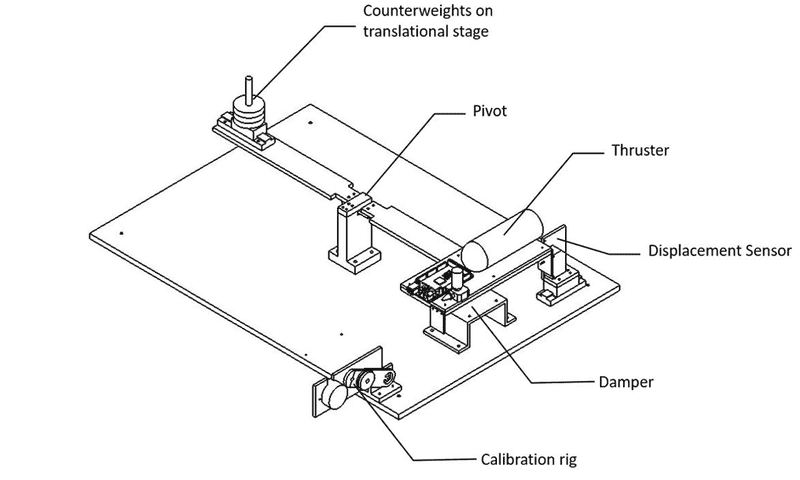
I have constructed a torsional balance, which basically consists of a torsional spring, and a damper. I model this as a spring mass damper system. And it is used to measure thrust of some propulsion system.
upload_2017-4-5_0-18-23.png


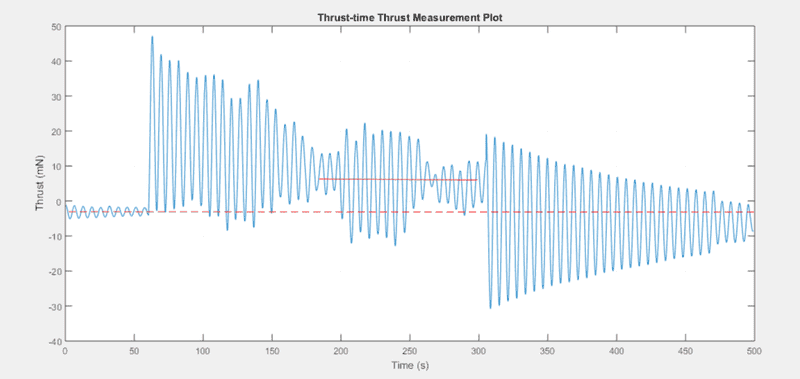
This is how the system looks like. I am just very eager to find out, how to model the damping ratio from the experiment result I have got. Basically I turn on the thruster , and let it fire for certain duration, and then turn off the thruster. I don't see a good step response here because of the flow variation noises from the thruster, but I do see a perfect decaying oscillation curve after I turn off the thruster. I already have the curve fit equation for this decaying oscillation. What should I do to get its natural frequency and damping ratio? Is the systems oscillation frequency after this thruster firing at its damped frequency?
upload_2017-4-5_0-22-20.png
 
Physics news on Phys.org
I'm having difficulty understanding what you are doing here . Could you please explain some more about the purpose of your experiments and how that test rig actually works ?
 
Look up information on the idea of the log decrement to get the damping data from your measured response.
 
Nidum said:
I'm having difficulty understanding what you are doing here . Could you please explain some more about the purpose of your experiments and how that test rig actually works ?

Sure. This torsional balance is able to rotate around the pivot axis, and the pivot is basically a torsional spring. Thruster is mounted at one side of the torsional balance and the counterweight is used to balance the two arms to make sure it stays in horizontal plane. When thrust force is exerted, the torsional balance will rotate to a certain angle. When it is at steady state, the angle should be fixed and the torsional restoring moment of the torsional spring will be equal to the moment created by the thrust force. Here, instead of measuring angle displacement, I measure linear displacement because the rotational angle is very small.

The plot may look confusing. I am sorry about that. It is actually displacement over time plot instead of thrust over time plot. I am trying to find the damping ratio and natural frequency of the system using the oscillating waves after thruster firing.
upload_2017-4-5_9-42-14.png

Hope this clarifies.
 
Dr.D said:
Look up information on the idea of the log decrement to get the damping data from your measured response.
Thank you! I am looking it up, seems useful!
 

Similar threads

  • · Replies 7 ·
Replies
7
Views
2K
  • · Replies 131 ·
5
Replies
131
Views
8K
  • · Replies 5 ·
Replies
5
Views
1K
  • · Replies 1 ·
Replies
1
Views
2K
  • · Replies 2 ·
Replies
2
Views
2K
  • · Replies 3 ·
Replies
3
Views
5K
  • · Replies 2 ·
Replies
2
Views
5K
  • · Replies 1 ·
Replies
1
Views
4K
  • · Replies 6 ·
Replies
6
Views
4K
  • · Replies 15 ·
Replies
15
Views
7K