How to express ωₙ in terms of only mass (m) and stiffness (k)?

Join the discussion
Registration is free. Ask a follow-up in this thread, or start your own.
4 replies · 2K views
Rae
Messages
2
Reaction score
2
Summary: How to express ωₙ in terms of only mass (m) and stiffness (k)? I tried doing it with F=kx but it is out of my ability to simplify it to only m and k.
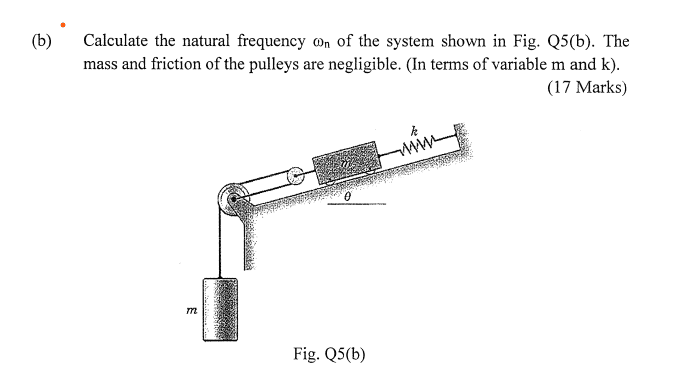
Screenshot 2022-05-17 155003.png


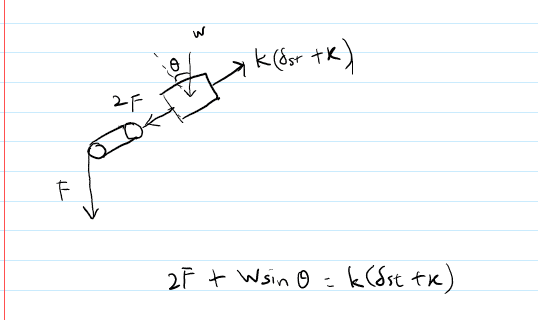
Here is my approach:
Screenshot 2022-05-17 175502.png
 
Physics news on Phys.org
Tell me what is ##\delta_{st}##?
You need (a free body diagram and) Newton's law for each mass, and the constraint on the positions (and hence accelerations) engendered by the pulley system.
 
hutchphd said:
Tell me what is ##\delta_{st}##?
You need (a free body diagram and) Newton's law for each mass, and the constraint on the positions (and hence accelerations) engendered by the pulley system.
From what i was taught in my lecture classes, ##\delta_{st}## means the initial displacement that the spring has before we displace it further by x. I am not sure if it is needed in this case.

Is my free body diagram correct for the 2 identical masses?
Screenshot 2022-05-17 194156.png
 
Although you can solve this by finding the force equations and considering the tension in the string etc, there is a much simpler way by using energy methods if you can manage to introduce a generalised coordinate ##x## that describes the position of the system and write down the kinetic and potential energies as depending on ##x##. Generally, if the total energy is on the form ##E = (\mu \dot x^2 + k (x-a)^2)/2 + C##, where ##C##, ##\mu##, ##k##, and ##a## are constants, then the natural frequency is given by ##\omega^2 = k/\mu##.
 
Good. Write Newton's Law for body 1 and for body 2 (along the direction of travel for each). Eliminate T. Use constraint to eliminate coordinate 1 (or 2 if you prefer). Choose ##\delta_{st}## to give the correct static limit.
This should now look like an oscillator diff. equation.
Perhaps you can use energy conservation to get to the same answer more easilly, but you should be able to do either, I reckon.