How to express this Fourier coefficient without trig function?

  • Thread starter Thread starter zenterix
  • Start date Start date
  • Tags Tags
    Fourier series
Click For Summary
SUMMARY

This discussion focuses on expressing the Fourier coefficient ##b_n## without using trigonometric functions, specifically exploring the use of complex exponentials. The coefficients are defined for both even and odd indices, with the formulas ##b_{2k}=\frac{4}{2k\pi}(1-(-1)^k)## for even indices and ##b_{2k+1}=\frac{4}{(2k+1)\pi}## for odd indices. The function under consideration is defined as periodic with a period of ##2\pi## and is specified to be even, which influences the formulation of the coefficients.

PREREQUISITES
  • Understanding of Fourier series and coefficients
  • Familiarity with complex exponentials in mathematical analysis
  • Knowledge of periodic functions and their properties
  • Basic trigonometric identities and their applications
NEXT STEPS
  • Research the derivation of Fourier coefficients using complex exponentials
  • Study the properties of even and odd functions in Fourier analysis
  • Explore the implications of periodicity on function representation
  • Learn about convergence of Fourier series and its applications
USEFUL FOR

Mathematicians, physics students, and anyone studying Fourier analysis or signal processing who seeks to deepen their understanding of Fourier coefficients and their derivation without trigonometric functions.

zenterix
Messages
774
Reaction score
84
Homework Statement
Consider the expression

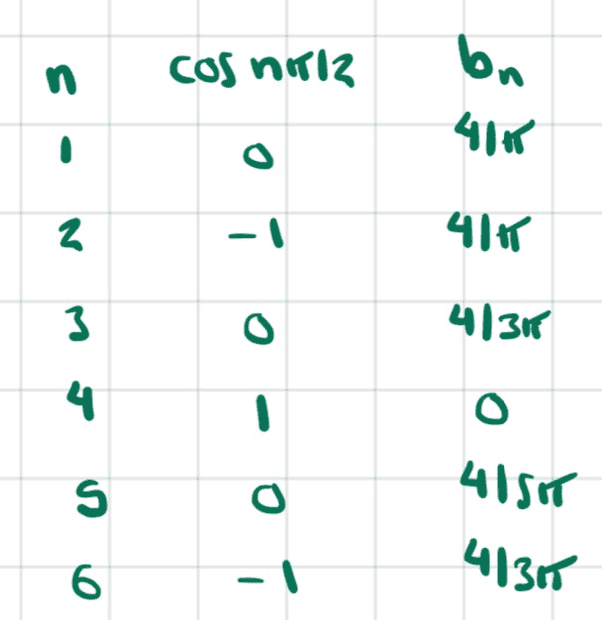
$$b_n=\frac{4}{n\pi}\left (1-\cos{\left (n\frac{\pi}{2}\right )}\right )$$

This is the ##n##-th Fourier coefficient for sine factors for the function

$$f(t)=\begin{cases} 2\ \ \ \ \ 0<t<\pi/2 \\ 0\ \ \ \ \ \frac{\pi}{2}<t<\pi\end{cases}$$
Relevant Equations
Can we express this without the cosine?
Here is a little table I made with the values of ##b_n## for ##n=1,2,3,4,5,6##.
1709688834378.png


Is there a way to write a formula for ##b_n## not involving a trigonometric function?
 
Physics news on Phys.org
How about complex exponentials?
 
The coefficients for the cosine factors are

$$a_n=\frac{4}{n\pi}\sin{\left (n\frac{\pi}{2}\right )}$$

and noting that as ##n## varies the ##\sin## is ##1,0,-1,0,1,-1,0,\ldots## we can write

##a_{2k+1}=\frac{4(-1)^{k+1}}{\pi(2k+1)}## for ##k=0,1,2,\ldots##.

I'm looking for something similar.
 
I think what I am looking for is something like

$$b_{2k}=\frac{4}{2k\pi}(1-(-1)^k)\tag{1}$$

for ##k=1,2,3,\ldots##

and

$$b_{2k+1}=\frac{4}{(2k+1)\pi}\tag{2}$$

for ##k=0,1,2,3,\ldots##.

We could further break down (1) as

$$b_{2+4k}=b_{2(2k+1)}=\frac{4\cdot 2}{2(1+2k)\pi}=\frac{4}{(2k+1)\pi}\tag{3}$$

$$b_{4k}=0$$

Oh well, given all these cases, not sure if this is useful at all at this point.
 
Last edited:
This is all part of the first problem of this problem set.

I just looked at the solution and noticed I confused something though it is my impression that the problem set itself is the one that wasn't specific enough.

A function ##f## was defined as

$$f(t)=\begin{cases} 2\ \ \ \ \ 0<t<\pi/2 \\ 0\ \ \ \ \ \frac{\pi}{2}<t<\pi\end{cases}$$

and now I see that they explicitly said it has period ##2\pi##. I had understood that they were giving me one period's worth of function.

So the function looks like this according to the solutions

1709692916745.png


That being said, with only the definition and the information that it has (minimal) period ##2\pi##, the function could also be

1709693065172.png


right?
 
zenterix said:
right?
No. It also says that the function is even.
 
oh, right!
 

Similar threads

  • · Replies 16 ·
Replies
16
Views
2K
  • · Replies 6 ·
Replies
6
Views
2K
  • · Replies 3 ·
Replies
3
Views
2K
  • · Replies 8 ·
Replies
8
Views
3K
Replies
3
Views
2K
  • · Replies 1 ·
Replies
1
Views
1K
  • · Replies 6 ·
Replies
6
Views
1K
  • · Replies 2 ·
Replies
2
Views
2K
  • · Replies 4 ·
Replies
4
Views
1K
Replies
3
Views
2K