How to find beam spring stiffness coefficient?

Click For Summary
SUMMARY

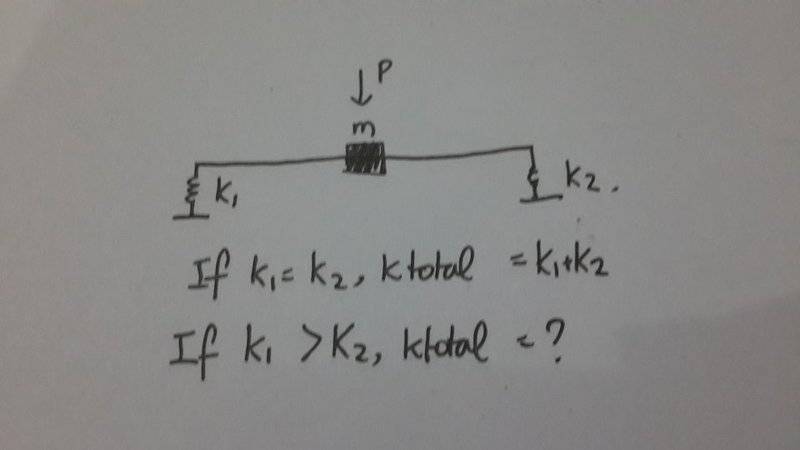
The discussion focuses on calculating the beam spring stiffness coefficient using the formula Ktotal = F/Δtotal, where Δtotal is defined as ½(Δ1 + Δ2). It emphasizes that if K1 equals K2, then Ktotal equals K1 + K2, indicating no flexibility in the beam. The conversation also highlights the distinction between parallel and series springs, asserting that a unique formula must be derived for cases where springs displace differently to maintain equilibrium.

PREREQUISITES
  • Understanding of beam mechanics and stiffness coefficients
  • Familiarity with spring constants and their calculations
  • Knowledge of equilibrium principles in mechanical systems
  • Basic grasp of series and parallel spring configurations
NEXT STEPS
  • Research the derivation of unique formulas for non-uniform spring displacement
  • Study the principles of beam mechanics in greater detail
  • Explore advanced applications of stiffness coefficients in engineering
  • Learn about the implications of spring configurations on system equilibrium
USEFUL FOR

Mechanical engineers, physics students, and professionals involved in structural analysis or spring system design will benefit from this discussion.

cognosco123
Messages
1
Reaction score
0
The problem is attached.
2015-09-13 22.58.08.jpg
 
Engineering news on Phys.org
I think you can solve it generally using the relationships:
Ktotal =F/Δtotal
Δtotal = ½(Δ1 + Δ2)

assuming the mass is located at mid-span.
 
Last edited:
The statement "If K1 = K2, Ktotal = K1 + K2" implies that there is no flexibility in the beam. The post title suggest that you want the stiffness to reflect the stiffness of the beam as well. Which is it?
 
Daniel Sadlier said:
The equivalent spring constant Ktot = k1 + k2 no matter the values of k1 or k2.
I'll disagree on this. The parallel springs formula assumes that both springs displace the same. Here, however, the springs will displace differently to maintain equilibrium. Therefore, a unique formula needs to be derived.
 

Similar threads

  • · Replies 3 ·
Replies
3
Views
14K
  • · Replies 3 ·
Replies
3
Views
2K
Replies
4
Views
2K
Replies
6
Views
6K
  • · Replies 9 ·
Replies
9
Views
2K
Replies
6
Views
4K
  • · Replies 16 ·
Replies
16
Views
4K
  • · Replies 1 ·
Replies
1
Views
3K
  • · Replies 9 ·
Replies
9
Views
2K
  • · Replies 7 ·
Replies
7
Views
5K