How to find forces in wires at equilibrium

Click For Summary

Homework Help Overview

The discussion revolves around determining the tensions in suspension wires at equilibrium, specifically through the analysis of equilibrium equations related to forces and moments in a system involving a beam and wires.

Discussion Character

  • Exploratory, Assumption checking, Mathematical reasoning

Approaches and Questions Raised

  • The original poster attempts to set up equilibrium equations but encounters a matrix with rank two, indicating insufficient equations for the number of unknowns. Some participants suggest that assumptions about the deformation of the wires and beam are necessary to progress. Others explore relationships between the forces based on the deformation equations derived from the setup.

Discussion Status

Participants are actively discussing the implications of their assumptions regarding the rigidity of the beam and the elasticity of the wires. There is a recognition that further assumptions may lead to a solvable system, but no consensus has been reached on the best approach or the validity of the proposed assumptions.

Contextual Notes

Participants note that the problem involves multiple variables and equations, with some expressing concern over the adequacy of the equations derived from the force balances. The discussion reflects a mix of theoretical exploration and practical application of mechanics principles.

harmyder
Messages
33
Reaction score
1
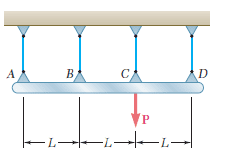
I need to find tensions in suspensions wires on the picture:
fZruy.png


I wrote 4 equilibrium equations for moments in A, B, C, D and equilibrium about y-axis, but i got matrix with rank two.

\begin{pmatrix}<br /> 3 &amp; 2 &amp; 1 &amp; 0 \\<br /> 0 &amp; 1 &amp; 2 &amp; 3 \\<br /> -1 &amp; 0 &amp; 1 &amp; 2 \\<br /> -2 &amp; -1 &amp; 0 &amp; 1 \\<br /> 1 &amp; 1 &amp; 1 &amp; 1<br /> \end{pmatrix}<br /> \begin{pmatrix}<br /> F_A \\<br /> F_B \\<br /> F_C \\<br /> F_D<br /> \end{pmatrix}<br /> =<br /> \begin{pmatrix}<br /> 1 \\<br /> 2 \\<br /> 1 \\<br /> 0 \\<br /> 1<br /> \end{pmatrix}

How to find the forces?
 
Physics news on Phys.org
Yes, there ard only two equations to be had from the usual linear and rotational force balances. To get further, you will need to make assumptions about how the wires and beam deform under loads.
 
  • Like
Likes   Reactions: harmyder
haruspex said:
Yes, there ard only two equations to be had from the usual linear and rotational force balances. To get further, you will need to make assumptions about how the wires and beam deform under loads.
... Specifically, I would suggest taking the beam to be completely straight and rigid, but allow the wires all the same modulus of elasticity. That is enough to get a solution.
 
  • Like
Likes   Reactions: harmyder
\delta_A = \delta_C - 2x\delta_B = \delta_C - x\delta_D = \delta_C + x
Thus,
F_A = \frac{\delta_A SE}{L} = \frac{\delta_C SE}{L} - 2x\frac{SE}{L}

And further,
F_B - F_A = F_C - F_B = F_D - F_C.

Now matrix looks like this:
\begin{pmatrix}<br /> -1 &amp; 2 &amp; -1 &amp; 0 \\<br /> 0 &amp; -1 &amp; 2 &amp; -1 \\<br /> 3 &amp; 2 &amp; 1 &amp; 0 \\<br /> -1 &amp; 0 &amp; 1 &amp; 2<br /> \end{pmatrix}<br /> \begin{pmatrix}<br /> F_A \\<br /> F_B \\<br /> F_C \\<br /> F_D<br /> \end{pmatrix}<br /> =<br /> \begin{pmatrix}<br /> 0 \\<br /> 0 \\<br /> 1 \\<br /> 1<br /> \end{pmatrix}

It has solution 0.1, 0.2, 0.3, 0.4.
 

Attachments

  • wire_deformations.png
    wire_deformations.png
    1.3 KB · Views: 479
Last edited:
harmyder said:
\delta_A = \delta_C - 2x
\delta_B = \delta_C - x
\delta_D = \delta_C + x
Thus,
F_A = \frac{\delta_A SE}{L} = \frac{\delta_C SE}{L} - 2x\frac{SE}{L}

And further,
F_B - F_A = F_C - F_B = F_D - F_C.

Now matrix looks like this:
\begin{pmatrix}<br /> -1 &amp; 2 &amp; -1 &amp; 0 \\<br /> 0 &amp; -1 &amp; 2 &amp; -1 \\<br /> 3 &amp; 2 &amp; 1 &amp; 0 \\<br /> -1 &amp; 0 &amp; 1 &amp; 2<br /> \end{pmatrix}<br /> \begin{pmatrix}<br /> F_A \\<br /> F_B \\<br /> F_C \\<br /> F_D<br /> \end{pmatrix}<br /> =<br /> \begin{pmatrix}<br /> 0 \\<br /> 0 \\<br /> 1 \\<br /> 1<br /> \end{pmatrix}

It has solution 0.1, 0.2, 0.3, 0.4.
That's the answer I get.
 
  • Like
Likes   Reactions: harmyder

Similar threads

Replies
3
Views
3K
  • · Replies 8 ·
Replies
8
Views
2K
  • · Replies 3 ·
Replies
3
Views
2K
  • · Replies 15 ·
Replies
15
Views
7K
Replies
4
Views
2K
  • · Replies 5 ·
Replies
5
Views
4K
  • · Replies 6 ·
Replies
6
Views
2K
  • · Replies 8 ·
Replies
8
Views
2K
  • · Replies 2 ·
Replies
2
Views
1K
  • · Replies 7 ·
Replies
7
Views
4K