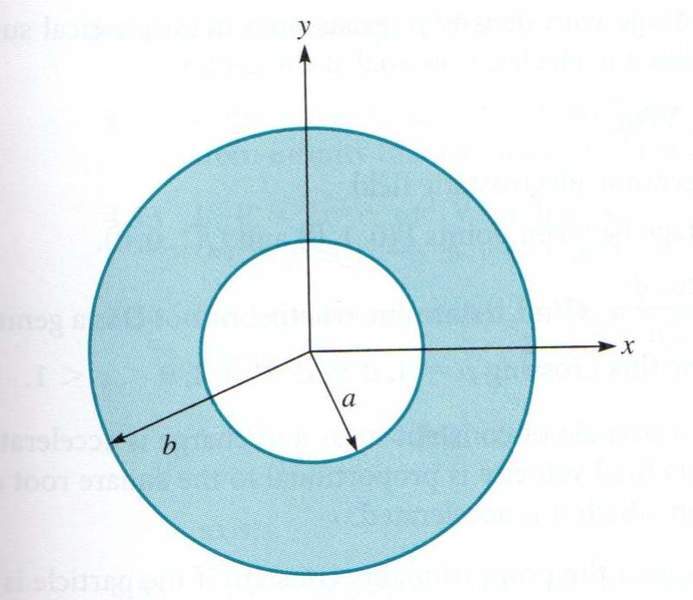
How to Find the Electric Field at the Center of a Charged Ring?

Click For Summary

Homework Help Overview

The discussion revolves around finding the electric field at the center of a charged ring with a uniform charge distribution. The original poster presents a problem involving a charge Q distributed on a circular ring and seeks to determine the electric displacement field D at a specific point along the z-axis.

Discussion Character

  • Exploratory, Conceptual clarification, Mathematical reasoning, Assumption checking

Approaches and Questions Raised

  • Participants discuss calculating the charge using charge density and integrating to find the potential along the z-axis. There are attempts to set up integrals for the electric field and potential, with some participants questioning the notation and the relationship between charge density and total charge. Others express confusion about the variables used in cylindrical coordinates and the implications of treating the charge distribution as a point charge.

Discussion Status

The discussion is active, with participants providing various approaches to the problem and clarifying concepts related to charge distribution and potential. Some guidance has been offered regarding the integration process and the relationship between electric field and potential, but there is no explicit consensus on the final approach or solution.

Contextual Notes

Participants note the challenge of integrating over a range of radii and the implications of using different variables (h and z) in cylindrical coordinates. There is also mention of the need to clarify the definitions of charge density and enclosed charge in the context of the problem.

Tater
Messages
9
Reaction score
0
Hi everyone,

Homework Statement


Ring.jpg

Let a charge Q be uniformly distributed on a circular ring defined by a < [itex]\rho[/itex] < b. Find D at (0,0,h).


Homework Equations


E = kQ/r2 ar
D = [itex]\epsilon[/itex]o E

The Attempt at a Solution


Well I thought I had this figured out, but I was wrong and I still can't figure it out after 2 hours :(

Since I have a range for the radius (a and b), I thought that I could calculate the E-field for both a and b separately then simply apply b-a to the field.

Finding both r1 and r2:
cos ∅1 = h / r1 = h / [itex]\sqrt{a^2 + h^2}[/itex]
cos ∅2 = h / r2 = h / [itex]\sqrt{b^2 + h^2}[/itex]

Then, E = kQh / r^2 [ cos ∅1 - cos ∅2 ]

I just don't know how to tackle this one. I have a large gap that I need to make note of.

The solution in the back of the book is D = [itex]\frac{Qh}{2\pi(b^2-a^2)}[/itex] [[itex]\frac{1}{\sqrt{a^2+h^2}}[/itex] - [itex]\frac{1}{\sqrt{b^2+h^2}}[/itex] ]

I would greatly appreciate any help! I kind of think I had the right idea, I just don't understand how to fix what I've done wrong.

Any help is greatly appreciated! :)
 
Physics news on Phys.org
First you need to calculate the charge using the charge density. We know that:
[itex]Q = \int_{a}^{b}\int_{0}^{2\pi}\rho_lrd\phi[/itex]

From there you should find the potential of a disk along the z-axis. The integral should be set up as:
[itex]d\phi = \frac{\rho_l*2*\pi*rdr}{4*pi*\epsilon_o\sqrt{z^2+r^2}}[/itex].

If you integrate correctly it should come out to be in terms of both b and a. Then using the fact that [itex]E =-\nabla\phi[/itex] in the z-direction should get you to the answer. Let me know if you need more explicit help.
 
runnergirl said:
First you need to calculate the charge using the charge density. We know that:
[itex]Q = \int_{a}^{b}\int_{0}^{2\pi}\rho_lrd\phi[/itex]

From there you should find the potential of a disk along the z-axis. The integral should be set up as:
[itex]d\phi = \frac{\rho_l*2*\pi*rdr}{4*pi*\epsilon_o\sqrt{z^2+r^2}}[/itex].

If you integrate correctly it should come out to be in terms of both b and a. Then using the fact that [itex]E =-\nabla\phi[/itex] in the z-direction should get you to the answer. Let me know if you need more explicit help.

Thanks for your response :)

A few questions though,

Charge enclosed: Qenc= ρsdS
I don't understand how I can solve for this when I don't know what ρs or Qenc are.

Also I don't understand your last comment: E=−∇ϕ
Did you mean to use E=−∇V (where V is the potential)?

As always, thanks for the help :)
 
That is true you don't know what [itex]\rho_s[/itex] or [itex]Q_{enc}[/itex] is but you do know that there is going to be a charge distribution on the ring. You know that it will have a total charge Q enclosed. If you recall from your solution, it is indeed in terms of Q which is the charge on the ring.

So you want to integrate [itex]Q = \int_{a}^{b}\int_{0}^{2\pi}\rho_srd\phi[/itex] and solve for [itex]\rho_s[/itex] in terms of Q.

And sorry about the notation for [itex]E =-\nabla\phi[/itex] in this case I did mean that [itex]\phi[/itex] was the potential and that's just the notation I'm used to. So yes, [itex]\phi[/itex] is the same as V.

Also, when you do [itex]E =-\nabla\phi[/itex], you want to solve for when z = h.

If you have any more questions let me know.
 
Qenc= ρsdS
Qencs2∏*[itex]\frac{1}{2}[/itex](b2-a2)
ρs=Qenc/∏(b2-a2)

So now I'd have to find resultant vector R (I'm bad at this). Here goes though:
If I drew a triangle with a radius of r and a height of h I would get: R=(r2+h2)1/2. But now I'd have to convert this to cylindrical coordinates, so I would replace h with z and r with ? (I don't exactly know how to do this here because I don't have a value for the radius - I have 2 possible values. I'm over-complicating it in my head. I don't really understand what radius I need/want.)

Then after that, I can simply plug it into the formula for potential.

Because it's a point charge, the potential is simply:

V=[itex]\frac{Q}{4\piεR}[/itex]

After I find the potential, I can apply [itex]E =-∇V[/itex], then apply [itex]D =εE[/itex]

Also, why is it that we sometimes use h (the length) and sometimes we refer to it as z? This really confuses me when I try to write my vectors going from cartesian to cylindrical.

Thank you so much for your help runnergirl :D
 
So you're close. In this case we're integrating over r so instead of [itex]R = (r^2+h^2)^{1/2}[/itex] you'll use [itex]R = (r^2+z^2)^{1/2}[/itex]. This is because you're not solving for z = h yet. So when it's written like this, it is in cylindrical coordinates (a function of r and z). So yes, use a triangle with r being the change in the radial direction, which I'll show in a minute is what you integrate over, and z since that too is a variable in which you will use later.

So now if you plug it all in:
[itex]V = \int_{a}^{b}\frac{Q}{2\pi\epsilon_o(b^2-a^2)}\frac{rdr}{\sqrt{z^2+r^2}}[/itex]

It's a fairly nice integral with a integral table. From there you do indeed apply [itex]E = -\nabla V[/itex] where in this case it will be only in the z-direction and solving for when z = h. So more explicitly:
[itex]E = -\frac{\partial V}{\partial z}\mid_{z=h}[/itex].

Well typically it is usually z that is used because most of the time in problems like these we're looking for the E-field along the z-axis which z is a variable. In this case, the reason it is h at the end is because you're evaluating the E(0,0,h) on the z-axis, so you're looking for the E-field at a particular point along the z-axis.

Hope that helps.
 
So out of curiosity, since this was a point charge:

V=[itex]\frac{Q}{4\piεR}[/itex]

But is it also fair to say that we could have used V = - ∫E dl ? I'm just curious as to why we're integrating to find potential because technically it is a point charge and we don't have to.

This problem was a disaster and you've cleared it up for me. Thank you so much.
 
Well since this is a charge Q distributed over the entire ring, it cannot be thought of as a point charge, unless you're looking at the far field. If z>>a,b the potential will due to the disk charge Q will behave like a point charge. So in this case, it is easier to find the potential, V (and we have to integrate over the entire ring), and then use [itex]E = -\nabla V[/itex] in the z-direction because the field is expected to be along the z-axis (this is due to the cylindrical symmetry of the problem). Now if we were given the E-field right away and asked to find the potential, then yes applying [itex]V = -\int E\cdot dl[/itex] would be a good method.

Glad it makes more sense to you.
 

Similar threads

  • · Replies 23 ·
Replies
23
Views
4K
Replies
12
Views
2K
  • · Replies 13 ·
Replies
13
Views
6K
Replies
19
Views
3K
  • · Replies 5 ·
Replies
5
Views
2K
  • · Replies 0 ·
Replies
0
Views
2K
  • · Replies 5 ·
Replies
5
Views
4K
Replies
2
Views
3K
  • · Replies 6 ·
Replies
6
Views
3K
  • · Replies 5 ·
Replies
5
Views
2K