How to Find the Normal Force of a Spring on a Ball in a Non-Concentric Slot?

Click For Summary
SUMMARY

The discussion focuses on calculating the normal force exerted by a spring on a ball within a non-concentric slot mechanism. Participants emphasize the need for an equation to determine the normal force based on the displacement of the pin, suggesting the use of F = μ * N for frictional force calculations. The conversation also highlights the importance of considering the angle of the ball's normal in relation to the slot and the potential impact of wear on the mechanism's performance. Recommendations include using trigonometry to resolve angular forces and considering standard ball spring plungers for design solutions.

PREREQUISITES
  • Understanding of spring mechanics and Hooke's Law (k * Δx)
  • Basic knowledge of trigonometry for force vector resolution
  • Friction concepts, specifically the equation F = μ * N
  • Familiarity with mechanical design principles, particularly regarding non-concentric systems
NEXT STEPS
  • Research the application of Hooke's Law in non-linear systems
  • Learn about trigonometric methods for resolving forces in mechanical systems
  • Explore design guidelines for ball spring plungers from manufacturers
  • Investigate the effects of wear on mechanical components and how to mitigate them
USEFUL FOR

Mechanical engineers, product designers, and anyone involved in the design and analysis of spring-loaded mechanisms and non-concentric slot systems.

gogogsr
Messages
9
Reaction score
0
Hey guys,

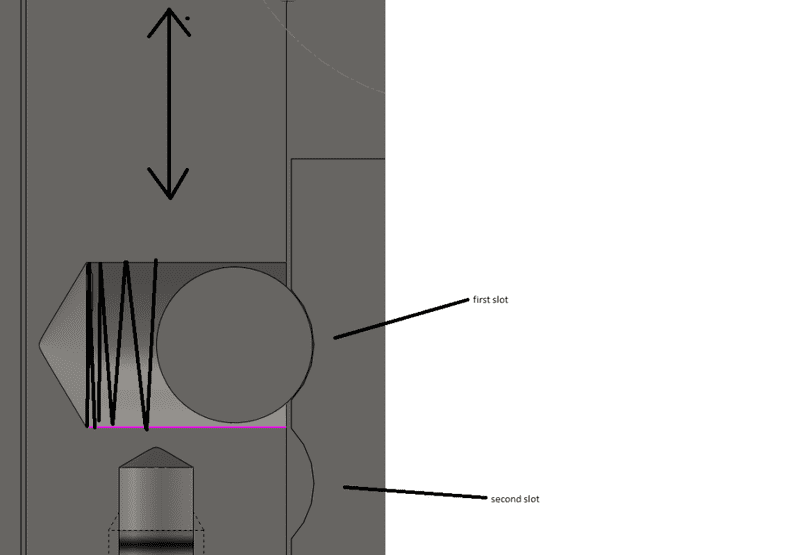
i'm building an apparatus with a sliding pin containing a spring and a ball. I want to lock in two different positions so I've rounded two slots in the housings. I would like to know what is the equation two find the normal force of the spring on the ball depending on the displacement of the pin. I'm having a hard time finding the normal with an equation, i can find it manually by moving the pin at different points and then drawing the tangent and normal to find the angle but i know there must be an equation. the slot diameter is bigger than the ball diameter to make sure it slides easily (meaning the slot and ball are not concentric)Thanks guys
Untitled.png
 
Engineering news on Phys.org
Shouldn't the normal force of the spring on the ball just be k * Δx?
 
berkeman said:
Shouldn't the normal force of the spring on the ball just be k * Δx?

yes but i want it in the movement direction of the pin so perpendicular, in relation with the ball normal angle on the slot
 
gogogsr said:
yes but i want it in the movement direction of the pin so perpendicular, in relation with the ball normal angle on the slot

Are you trying to calculate the force required to move the pin when the ball is in one of the slots? And that's why you are looking for a normal force, so you can use F = μ * N ?
 
I would recommend you slightly round the land between the detent poitions to ease tha passage of the ball.
That will happen anyway with wear, but the mechanism will then become sloppy.
 
berkeman said:
Are you trying to calculate the force required to move the pin when the ball is in one of the slots? And that's why you are looking for a normal force, so you can use F = μ * N ?

yes, that is exactly what I'm looking for, but with the use of an equation to get the normal angle vs stroke of ball.

thank you
 
Studiot said:
I would recommend you slightly round the land between the detent poitions to ease tha passage of the ball.
That will happen anyway with wear, but the mechanism will then become sloppy.

yes i know I'm putting small radius on the land, thx
 
I believe the max force would occur at the extreme point of the detent feature. This would happen when sliding starts, and decrease abruptly after that. It's a sine function, isn't it? Resolve that angular force with trigonometry into a force vector parallel with the axis of the hole. But you'll need to amp it up a bit to accommodate non-spericity of the detent, ball/hole tolerance fits & associated friction, etc. UNLESS your detent feature is a cone shape from a drill, then a lot of things change.

Seems you could just use standard ball spring plungers and change as required if it doesn't hold your load. Companies that sell those sometimes have design guidelines that answer many of your questions. But that's just me, being lazy.
 

Similar threads

Replies
24
Views
3K
  • · Replies 5 ·
Replies
5
Views
2K
  • · Replies 28 ·
Replies
28
Views
2K
Replies
43
Views
4K
  • · Replies 2 ·
Replies
2
Views
5K
Replies
4
Views
2K
  • · Replies 2 ·
Replies
2
Views
3K
  • · Replies 4 ·
Replies
4
Views
1K
  • · Replies 15 ·
Replies
15
Views
2K
  • · Replies 8 ·
Replies
8
Views
4K