How to Find the Resultant Vector of this Quadrilateral ?

Click For Summary
SUMMARY

The resultant vector of the quadrilateral ABCD, where forces BA, BC, CD, and DA act at a point, is definitively 2BA. This conclusion is derived from the Polygonal Law of vectors, which states that the resultant is the line joining the initial point to the final point. The vectors AB, BC, CD, and DA form a closed polygon, resulting in a net force of zero, expressed mathematically as AB + BC + CD + DA = 0. Thus, BA is equal to the sum of the other vectors, leading to the resultant force being 2BA.

PREREQUISITES
  • Understanding of vector addition and subtraction
  • Familiarity with the Polygonal Law of vectors
  • Basic knowledge of force representation in physics
  • Ability to visualize vector direction and orientation
NEXT STEPS
  • Study vector addition using the Polygonal Law in detail
  • Learn about vector representation and directionality in physics
  • Explore examples of resultant forces in closed polygons
  • Investigate the implications of reversing vector directions in calculations
USEFUL FOR

Students of physics, particularly those studying mechanics, educators teaching vector concepts, and anyone interested in understanding force interactions in closed systems.

5416339
Messages
18
Reaction score
0
This question is from a "Solved Problems" book where they give the solutions but I'm not able to get the reason !

Question :

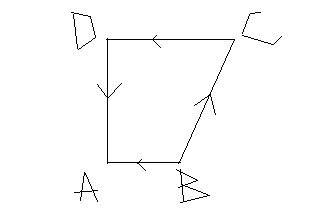
ABCD is a quadrilateral.Force BA,BC,CD and DA act at a point.Their resultant is :
f0n59e.jpg


Options:

a. 2AB
b. 2DA
c. 2BC
d. 2BA

The given answer is : 2BA

Formulas Related

Polygonal Laws of vector which states that the resultant will be the Line joining the Initial point and the final point !

My Attempt:

How is this possible.I'm not able to understand how we should find the resultant of the Quadrilateral because AB is not joining "Head to Tail" and "Tail to Head" instead it is joining from "Tail to Tail" and "Head to Head" ! So how do i solve this please give a proper explanation for this !

What i think is that only "AB" is the answer because When we join the initial point "B" with the final point "D" we should get the resultant ! So how do we do this ?

Please help me Understand this ! Am i mixing up the concepts or what ?
 
Last edited:
Physics news on Phys.org
As the vectors AB, BC, CD, DA form a quadrilateral, their resultant is zero. AB + BC + CD + DA = 0. The vectors AB and BA are opposite: AB =-BA, so BA = BC + CD + DA.

You have to determine the resultant force Fr= BA + BC + CD + DA. The last three add up to BA.

ehild
 
ehild said:
As the vectors AB, BC, CD, DA form a quadrilateral, their resultant is zero. AB + BC + CD + DA = 0. The vectors AB and BA are opposite: AB =-BA, so BA = BC + CD + DA.

You have to determine the resultant force Fr= BA + BC + CD + DA. The last three add up to BA.

ehild

But how can you take that AB+BC+CD+DA = 0 Because AB is an exception it is not Joining "Head to Tail" and "Tail to Head" instead it is joining "Tail to Tail" and "Head to "Head".So how can we tell that

Only when AB is joined "Head to Tail" and "Tail to Head" only then we can tell the resultant is 0 !

And how can you add them up to find the resultant force..We need to find the resultant vector only that will be the resultant force right ?

Please explain about my question !
 
Bump.......
 
Hi 5416339! :smile:

Suppose the arrow on AB was reversed, what would be resultant be then?

Now what's the difference between the forces given, and the forces with the arrow on AB reversed? :wink:
 
I explained your question in the previous post. I thought you know how to add vectors with the polygon method. Well, again: The first letter means tail, the second letter is the head of a vector. See your picture: The vector BA (head at A and tail at B) is the vector sum of BC+CD+CA=BA. So BA+BC+CD+DA= BA+(BC+CD+DA) = BA +BA=2BA

By the way, if you consider the sides of a polygon as vectors, all joining with head to tail, then the sum of this vectors is zero. If you reverse the direction of the vector BA (it becomes AB, and AB=-BA) all vectors will join with head to tail and their sum is zero, as it is a closed polygon: AB+BC+CD+DA=0 --->-AB = BA = BC+CD+DA.

ehild
 
The book claims the answer is that all the magnitudes are the same because "the gravitational force on the penguin is the same". I'm having trouble understanding this. I thought the buoyant force was equal to the weight of the fluid displaced. Weight depends on mass which depends on density. Therefore, due to the differing densities the buoyant force will be different in each case? Is this incorrect?

Similar threads

Replies
5
Views
1K
Replies
11
Views
2K
  • · Replies 5 ·
Replies
5
Views
2K
  • · Replies 9 ·
Replies
9
Views
1K
  • · Replies 5 ·
Replies
5
Views
3K
  • · Replies 1 ·
Replies
1
Views
4K
  • · Replies 11 ·
Replies
11
Views
5K
Replies
4
Views
2K
  • · Replies 4 ·
Replies
4
Views
2K
  • · Replies 6 ·
Replies
6
Views
3K