How to Find the Resultant Vector of this Quadrilateral ?

Click For Summary

Homework Help Overview

The discussion revolves around finding the resultant vector of a quadrilateral formed by four forces acting at a point, specifically the vectors AB, BC, CD, and DA. The original poster expresses confusion regarding the application of vector addition and the conditions under which the resultant can be determined.

Discussion Character

  • Conceptual clarification, Assumption checking

Approaches and Questions Raised

  • The original poster attempts to understand how to find the resultant vector given that the vectors do not seem to connect in a conventional head-to-tail manner. They question whether their understanding of vector addition is correct.
  • Some participants clarify that the vectors form a closed quadrilateral, suggesting that their sum is zero, and they explore the implications of reversing the direction of one of the vectors.
  • Others question the original poster's interpretation of vector addition and the conditions necessary for determining the resultant.

Discussion Status

The discussion is ongoing, with participants providing insights into vector addition and the properties of closed polygons. There is an exploration of different interpretations regarding the arrangement of vectors and their resultant, but no consensus has been reached yet.

Contextual Notes

Participants are navigating the complexities of vector addition, particularly in the context of a quadrilateral, and are addressing assumptions about how vectors should be connected. The original poster's reference to a "Solved Problems" book adds a layer of complexity, as they seek clarity on the reasoning behind the provided solution.

5416339
Messages
18
Reaction score
0
This question is from a "Solved Problems" book where they give the solutions but I'm not able to get the reason !

Question :

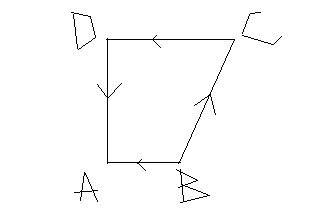
ABCD is a quadrilateral.Force BA,BC,CD and DA act at a point.Their resultant is :
f0n59e.jpg


Options:

a. 2AB
b. 2DA
c. 2BC
d. 2BA

The given answer is : 2BA

Formulas Related

Polygonal Laws of vector which states that the resultant will be the Line joining the Initial point and the final point !

My Attempt:

How is this possible.I'm not able to understand how we should find the resultant of the Quadrilateral because AB is not joining "Head to Tail" and "Tail to Head" instead it is joining from "Tail to Tail" and "Head to Head" ! So how do i solve this please give a proper explanation for this !

What i think is that only "AB" is the answer because When we join the initial point "B" with the final point "D" we should get the resultant ! So how do we do this ?

Please help me Understand this ! Am i mixing up the concepts or what ?
 
Last edited:
Physics news on Phys.org
As the vectors AB, BC, CD, DA form a quadrilateral, their resultant is zero. AB + BC + CD + DA = 0. The vectors AB and BA are opposite: AB =-BA, so BA = BC + CD + DA.

You have to determine the resultant force Fr= BA + BC + CD + DA. The last three add up to BA.

ehild
 
ehild said:
As the vectors AB, BC, CD, DA form a quadrilateral, their resultant is zero. AB + BC + CD + DA = 0. The vectors AB and BA are opposite: AB =-BA, so BA = BC + CD + DA.

You have to determine the resultant force Fr= BA + BC + CD + DA. The last three add up to BA.

ehild

But how can you take that AB+BC+CD+DA = 0 Because AB is an exception it is not Joining "Head to Tail" and "Tail to Head" instead it is joining "Tail to Tail" and "Head to "Head".So how can we tell that

Only when AB is joined "Head to Tail" and "Tail to Head" only then we can tell the resultant is 0 !

And how can you add them up to find the resultant force..We need to find the resultant vector only that will be the resultant force right ?

Please explain about my question !
 
Bump.......
 
Hi 5416339! :smile:

Suppose the arrow on AB was reversed, what would be resultant be then?

Now what's the difference between the forces given, and the forces with the arrow on AB reversed? :wink:
 
I explained your question in the previous post. I thought you know how to add vectors with the polygon method. Well, again: The first letter means tail, the second letter is the head of a vector. See your picture: The vector BA (head at A and tail at B) is the vector sum of BC+CD+CA=BA. So BA+BC+CD+DA= BA+(BC+CD+DA) = BA +BA=2BA

By the way, if you consider the sides of a polygon as vectors, all joining with head to tail, then the sum of this vectors is zero. If you reverse the direction of the vector BA (it becomes AB, and AB=-BA) all vectors will join with head to tail and their sum is zero, as it is a closed polygon: AB+BC+CD+DA=0 --->-AB = BA = BC+CD+DA.

ehild
 

Similar threads

Replies
5
Views
1K
Replies
11
Views
2K
  • · Replies 5 ·
Replies
5
Views
2K
  • · Replies 9 ·
Replies
9
Views
1K
  • · Replies 5 ·
Replies
5
Views
3K
  • · Replies 1 ·
Replies
1
Views
4K
  • · Replies 11 ·
Replies
11
Views
5K
Replies
4
Views
2K
  • · Replies 4 ·
Replies
4
Views
2K
  • · Replies 6 ·
Replies
6
Views
3K