How to Fix Limits of Integration for Gamma Integral #6?

  • Thread starter Thread starter AhmedHesham
  • Start date Start date
  • Tags Tags
    Gamma Integral
Click For Summary

Homework Help Overview

The discussion revolves around a gamma integral, specifically how to adjust the limits of integration to align with the standard form of the gamma function. The original poster presents an integral that is not straightforward in terms of its limits and seeks assistance in transforming it appropriately.

Discussion Character

  • Exploratory, Assumption checking, Problem interpretation

Approaches and Questions Raised

  • Participants discuss various transformations of the integral, including attempts to express it in terms of the gamma function. Some participants suggest using substitutions to rewrite the integral, while others express concerns about the relevance of incomplete gamma functions and error functions to the problem at hand.

Discussion Status

The conversation is ongoing, with participants exploring different interpretations of the integral and its limits. Some guidance has been offered regarding the use of incomplete gamma functions, but there is no consensus on how to proceed within the constraints of the original poster's course material.

Contextual Notes

Participants note that incomplete gamma functions and error functions may not be appropriate for the exercises, as they are outside the scope of the course. The original poster expresses uncertainty about the suitability of the problem given their current curriculum.
AhmedHesham
Messages
96
Reaction score
11
Hi
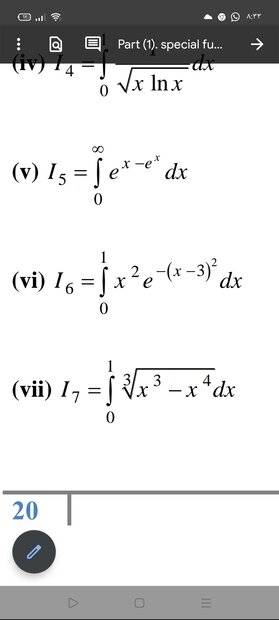
I have a gamma integral in which it is not obvious how I can fix the limits of integration in order to match the standard form of gamma function.I just need someone to tell me how to fix them.
Screenshot_2021-05-02-20-33-03-14_e2d5b3f32b79de1d45acd1fad96fbb0f.jpg

I mean the integral number 6 in the picture.
You can see my attempt in the PDF .
 

Attachments

Physics news on Phys.org
I_6=\int_2^3 (3-y)^2 e^{-y^2}dy

I_6=\frac{1}{2}\int_4^9 (z^{1/2}-6+9z^{-1/2}) e^{-z}dz

By partial integration

\int_4^9 z^{1/2} e^{-z}dz=[-z^{1/2}e^{-z}]_4^9 + \frac{1}{2} \int_4^9 z^{-1/2}e^{-z}dz

Gauss error function works to estimate the integral of RHS.
 
Last edited:
anuttarasammyak said:
I_6=\int_2^3 (3-y)^2 e^{-y^2}dy

I_6=\frac{1}{2}\int_4^9 (z^{1/2}-6+9z^{-1/2}) e^{-z}dz

By partial integration

\int_4^9 z^{1/2} e^{-z}dz=[-z^{1/2}e^{-z}]_4^9 + \frac{1}{2} \int_4^9 z^{-1/2}e^{-z}dz

Gauss error function works to estimate the integral of RHS.
Thanks for help
You didn't use the gamma function
The error function is not the subject of my course .
These exercises are on gamma function
Please make it in terms of gamma function.
 
If you want to put the integrand in the form f(t)e^{-t} then you are forced to take t = (x - 3)^2 and hence <br /> \int_0^1 x^2 e^{-(x-3)^2}\,dx = \int_4^9 \frac{(3 - \sqrt {t})^2}{2 \sqrt{t}}e^{-t}\,dt. That's not a sum of gamma functions, because the limits are 4 and 9 not 0 and \infty. It can, however, be expresed as a sum of incomplete gamma functions.
 
  • Like
Likes   Reactions: Delta2
Ok
I will ask my professor
Incomplete gamma function is beyond the scope of my course .
May be it was a mistake to give us it in the exercises on gamma function
 
AhmedHesham said:
Please make it in terms of gamma function.
Incomplete gamma function and error function have the relation
\gamma(\frac{1}{2},x)=\sqrt{\pi}\ erf(\sqrt{x})
 
anuttarasammyak said:
Incomplete gamma function and error function have the relation
\gamma(\frac{1}{2},x)=\sqrt{\pi}\ erf(\sqrt{x})
Ok
Thanks
You seem to be at a higher level.
 

Similar threads

  • · Replies 16 ·
Replies
16
Views
3K
  • · Replies 3 ·
Replies
3
Views
2K
Replies
9
Views
2K
  • · Replies 1 ·
Replies
1
Views
2K
  • · Replies 4 ·
Replies
4
Views
2K
  • · Replies 8 ·
Replies
8
Views
2K
  • · Replies 5 ·
Replies
5
Views
2K
  • · Replies 6 ·
Replies
6
Views
2K
Replies
5
Views
1K
Replies
10
Views
2K