How to Formulate Circuit Analysis Equations into Matrix Form?

Click For Summary

Homework Help Overview

The discussion revolves around formulating circuit analysis equations into matrix form using superposition. Participants are working through a circuit problem involving multiple variables and equations related to voltages and currents.

Discussion Character

  • Mixed

Approaches and Questions Raised

  • Participants discuss using superposition to derive equations for voltages and currents in the circuit. There are attempts to express these equations in matrix form for solving. Some participants question the correctness of their equations and calculations, while others suggest corrections and clarifications regarding the setup.

Discussion Status

There is an ongoing exploration of the equations and their implications. Some participants have provided guidance on correcting specific equations and clarifying assumptions. However, there is no explicit consensus on the final outcomes or solutions, as participants continue to question and refine their approaches.

Contextual Notes

Participants are navigating through potential errors in their equations and calculations, with some noting discrepancies between their results and those obtained from simulation software. The discussion includes checking assumptions about current directions and the inclusion of all relevant components in the analysis.

VinnyCee
Messages
486
Reaction score
0
Using superposition, find [itex]v_0[/itex] in the following circuit.
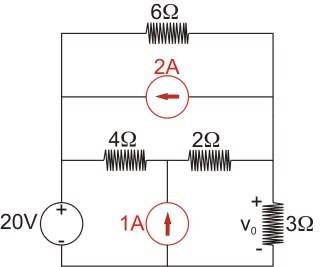
ch4prob14.jpg


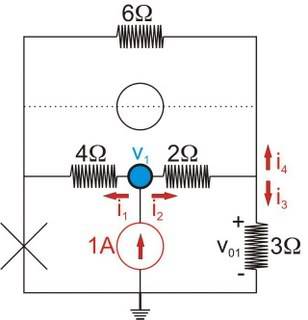
My work so far:

ch4prob14_Part1.jpg


[tex]v_1\,=\,2\,i_2\,+\,v_{0\,1}[/tex]

[tex]v_1\,=\,4\,i_1[/tex]

[tex]v_{0\,1}\,=\,3\,i_3[/tex]

[tex]v_{0\,1}\,=\,6\,i_4[/tex]

KCL @ v1:
[tex]1\,A\,=\,i_1\,+\,i_2[/tex]

[tex]i_2\,=\,i_3\,+\,i_4[/tex]


Using these six equations, with 6 variables:

[tex]v_{0\,1}\,=\,\frac{12}{7}\,V[/tex]

Is that correct?

My real question is how to put the six equations above into matrix form to enable solving using RREF.

Thanks:-p

EDIT: I have fixed this part with Paallikko's guidance (thanks!)

[tex]i_1\,=\,\frac{1}{4}\,v_1[/tex]

[tex]i_2\,=\,\frac{1}{2}\,v_1\,-\,\frac{1}{2}\,v_{01}[/tex]

[tex]i_3\,=\,\frac{1}{3}\,v_{01}[/tex]

[tex]i_4\,=\,\frac{1}{6}\,v_{01}[/tex]

[tex]i_1\,+\,i_2\,=\,1\,A\,\,\,\Rightarrow\,\,\,\frac{3}{4}\,v_1\,-\,\frac{1}{2}\,v_{01}\,=\,1[/tex]

[tex]i_3\,+\,i_4\,=\,i_2\,\,\,\Rightarrow\,\,\,\frac{1}{3}\,v_{01}\,+\,\frac{1}{6}\,v_{01}\,=\,\frac{1}{2}\,v_1\,-\,\frac{1}{2}\,v_{01}[/tex]

[tex]v_{01}\,=\,1\,V[/tex]
 
Last edited:
Physics news on Phys.org
Apply superposition two:

ch4prob14_Part2.jpg


[tex]i_3\,=\,i_2\,-\,2\,A[/tex]

[tex]i_1\,=\,i_0\,+\,i_2[/tex]

[tex]v_{0\,2}\,=\,6\,i_1\,=\,6\,i_3\,=\,3\,i_o[/tex]

From these five equations, I put into a matrix and solve.

[tex]v_{0\,2}\,=\,-6\,V[/tex]


Next, I do the last superposition:

ch4prob14_Part3.jpg


The circuit above can be simplified:

ch4prob14_Part4.jpg


[tex]v_{0\,3}\,=\,3\,I[/tex]

[tex]v_{0\,3}\,=\,3\,\left(\frac{20\,V}{3\,\ohm}\right)\,=\,20\,V[/tex]

Total them up:

[tex]v_0\,=\,v_{0\,1}\,+\,v_{0\,2}\,+\,v_{0\,3}[/tex]

[tex]v_0\,=\,\left(\frac{12}{7}\,V\right)\,+\,(-6\,V)\,+\,(20\,V)[/tex]

[tex]v_0\,=\,15.7\,V[/tex]

Does this look right? If not, please explain the errors and how to correct them. Thanks:-p
 
Well, you've understood how to use superposition (setting the sources to 0), you even seem to have most of the equations right*. However, all your calculations are wrong.

The first one in matrix form would be (solve for ix from the first equations and substitute into the KCL equations):

[tex] \left[ {\begin{array}{*{20}c}<br /> {3/4} & { - 1/2} \\<br /> { - 1/2} & 1 \\<br /> <br /> \end{array} } \right]\left[ {\begin{array}{*{20}c}<br /> {V_1} \\<br /> {V_2} \\<br /> <br /> \end{array} } \right] = \left[ {\begin{array}{*{20}c}<br /> 1 \\<br /> 0 \\<br /> <br /> \end{array} } \right][/tex]

* the two equations below are wrong
[tex]i_1=i_0 + i_2[/tex]
[tex]v_{0\,3}\,=\,3\,\left(\frac{20\,V}{3\,\ohm}\right) \,=\,20\,V[/tex]PS. If you're not familiar with PSpice, there's a free version available for download eg. here: http://www.electronics-lab.com/downloads/schematic/013/ you can quickly check if your answers are correct with it.
PPS. the topic's more engineering or introductory physics than advanced physics.
 
Last edited:
For the first incorrect equation (in the 2nd part of problem), I see that all the currents are going out of the node. Does this mean that the actual equation is [tex]i_0\,+\,i_1\,+\,i_2\,=\,0[/tex]?

In the third part of the problem, is the error because I didn't include both resistors in the I = equation?

[tex]v_{03}\,=\,3\,I[/tex]

[tex]v_{03}\,=\,3\,\left(\frac{20\,V}{6\,\ohm}\right)\,=\,10\,V[/tex]

Is that right now?
 
Yep, they're right now.
 
How do I solve the second part? I keep getting 0V for [tex]v_{02}[/tex].

I also used Pspice and got an 8V differential at the resistor for [tex]v_0[/tex].

[tex]v_0\,=\,v_{01}\,+\,v_{02}\,+\,v_{03}[/tex]

[tex]v_0\,=\,1V\,+\,0V\,+\,10V\,=\,11V[/tex]

This is 3V higher than Pspice reports though.
 
You've written:
v02 = 3i0 = 6i1 = 6i3 (1)
i2 - i3 = 2 (2)
i0 + i1 + i2 = 0 (3)

Substituting (2) into (3) (Eliminating i2):
i0 + i1 + i3 = -2

Substituting (1) into the above:
v02(1/3 + 1/6 + 1/6) = -2

=> v02 = -3 (V)
 
Last edited:

Similar threads

  • · Replies 6 ·
Replies
6
Views
3K
  • · Replies 2 ·
Replies
2
Views
2K
Replies
1
Views
2K
Replies
7
Views
1K
  • · Replies 1 ·
Replies
1
Views
2K
  • · Replies 2 ·
Replies
2
Views
2K
  • · Replies 16 ·
Replies
16
Views
2K
Replies
0
Views
2K
  • · Replies 4 ·
Replies
4
Views
2K
Replies
1
Views
2K