How to get a Chaos Sequence from this Equation?

Click For Summary

Discussion Overview

The discussion revolves around calculating a chaotic sequence from the Rossler system, specifically focusing on the integration of ordinary differential equations (ODEs) associated with the system. Participants explore methods for simulating chaotic behavior, including the use of programming languages and software tools.

Discussion Character

  • Exploratory
  • Technical explanation
  • Homework-related
  • Mathematical reasoning

Main Points Raised

  • One participant seeks guidance on calculating a chaotic sequence from the Rossler system, expressing a desire to learn more about chaotic behavior.
  • Another participant suggests using an ODE solver and provides a Python script for simulating the Rossler attractor, emphasizing its advantages over traditional methods like Runge-Kutta 4 (RK4).
  • There is a request for clarification on how to integrate the equations and the meaning of parameters in the provided Python command.
  • Participants discuss the output of the simulation, specifically the representation of variables and the structure of the output data, including the significance of the four columns in the results.
  • One participant corrects another regarding the notation of the equations, pointing out the correct representation of derivatives.
  • There are inquiries about the use of GitHub and how to run the provided Python script, indicating varying levels of familiarity with programming and software tools.
  • Some participants express confusion about executing commands and the requirements for running the simulations, including dependencies like matplotlib.

Areas of Agreement / Disagreement

Participants generally agree on the need to use ODE solvers for the Rossler system, but there are multiple viewpoints regarding the best approach to implement the simulation and varying levels of understanding about the underlying mathematics and programming requirements. The discussion remains unresolved on some technical aspects and the best practices for execution.

Contextual Notes

Some participants express uncertainty about the integration process and the specific parameters used in the Python script. There are also limitations noted regarding the execution environment, particularly for users unfamiliar with command-line interfaces or specific software dependencies.

Who May Find This Useful

This discussion may be useful for students and practitioners interested in chaos theory, mathematical modeling, and programming simulations of dynamical systems, particularly those new to the concepts of ODEs and chaotic systems.

ohaited
Messages
24
Reaction score
1
Hi, I have this equation about Rossler system, describe as Eq. 1. Given that the chaotic behavior of the system for parameter values a=b=0.2 and c=5.7.

How can I calculate the chaotic sequence for this equation below.
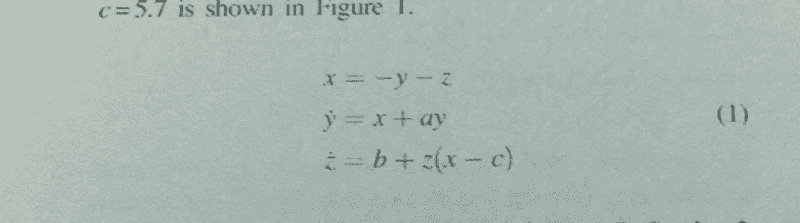
upload_2018-12-9_20-33-7.png
The equation also referred from http://mathworld.wolfram.com/RoesslerAttractor.html

Your help is highly appreciated.

P/S: I'm a student that doesn't have any physics background. But I'm willing to learn more about chaotic behavior and system. Thanks!
 

Attachments

  • upload_2018-12-9_20-33-7.png
    upload_2018-12-9_20-33-7.png
    24.4 KB · Views: 998
Physics news on Phys.org
ohaited said:
How can I calculate the chaotic sequence for this equation below.
P/S: I'm a student that doesn't have any physics background. But I'm willing to learn more about chaotic behavior and system. Thanks!
Firstly, this is a mathematical problem, not a physics one. It is a system of "ordinary differential equations" or ODEs. To solve it you "just" need to integrate the equations on the right hand side.

The standard answer here would be to use a standard ODE solver in Octave, Sage, Scipy, whatever (which will probably user Runge-Kutta 4 - RK4 under the covers).

Here is a different answer - I have written open source software that will perform this calculation (as well as many other chaotic systems) here. Invoke the Python version as follows:

Code:
./tsm-mp.py rossler 16 10 0.01 1001 0.0 -6.78 0.02 .2 .2 5.7

This performs a simulation to 16 decimal places and 10th order Taylor approximation, with 1001 points starting from x=0.0, y = -6.78, z = 0.02, and parameter values a=b=0.2 and c=5.7.

The program is pure Python3 i.e. no external dependencies. Learning how the software works is even more interesting than the Rossler attractor IMO - It is far superior to RK4 ;)
 
Last edited:
m4r35n357 said:
Firstly, this is a mathematical problem, not a physical one. It is a system of "ordinary differential equations" or ODEs. To solve it you "just" need to integrate the equations on the right hand side.

The standard answer here would be to use a standard ODE solver in Octave, Sage, Scipy, whatever (which will probably user Runge-Kutta 4 - RK4 under the covers).

Here is a different answer - I have written open source software that will perform this calculation (as well as many other chaotic systems) here. Invoke the Python version as follows:

Code:
./tsm-mp.py rossler 16 10 0.01 1001 0.0 -6.78 0.02 .2 .2 5.7

This performs a simulation to 16 decimal places and 10th order Taylor approximation, with 1001 points starting from x=0.0, y = -6.78, z = 0.02, and parameter values a=b=0.2 and c=5.7.

The program is pure Python3 i.e. no external dependencies. Learning how the software works is even more interesting than the Rossler attractor IMO - It is far superior to RK4 ;)
Hey, Thanks for responding! Actually, I want to create a cryptosystem using a chaotic map. So I choose this Rossler system to implement in cryptography field.

Okay,

1.) How to integrate by using Right Hand Side? Hee, I need some "kickstart" to refresh my knowledge in maths.

2.) RK4, Yeah I've tried that one by simulate an example I got from youtube : (Oh is it true how he demonstrate the RK4? Or do you have any references on RK4 for beginners)

3.) I'm sorry sir, but I'm a bit lost on your answer right after the code for phyton. (I'm sorry, but I really need to know about it)

Oh, so that I need to run the phyton script in your github, which one should I choose (Oh ya, I'm quite new with the github things)

Thank you sir, I hope you can consider my questions.
 
ohaited said:
Oh, so that I need to run the phyton script in your github, which one should I choose (Oh ya, I'm quite new with the github things)

Thank you sir, I hope you can consider my questions.

You will need to use git in a shell and do this:
Code:
git clone https://github.com/m4r35n357/ODE-Playground

Then go into the directory it makes, and type the command I gave above.

Then you can go and learn about crypto coding ;)
 
m4r35n357 said:
./tsm-mp.py rossler 16 10 0.01 1001 0.0 -6.78 0.02 .2 .2 5.7

Oh wait, one question. What does those numbers after tsm-mp.py rossler do? I mean it represent which represent the variables in RK4 for rossler part?
 
ohaited said:
How can I calculate the chaotic sequence for this equation below.
In post 1, your first equation is shown as ##x = -y - z##, which is incorrect. From the website you gave, this equation should be ##\dot x = -y - z##. The three equations are for the derivatives of x, y, and z, with respect to t.

BTW, the programming language is python (like the snake), not phyton.
 
ohaited said:
Oh wait, one question. What does those numbers after tsm-mp.py rossler do? I mean it represent which represent the variables in RK4 for rossler part?
Have you looked at the line you quoted back to me? I did miss one parameter, the step size is 0.01.
 
  • Like
Likes   Reactions: ohaited
m4r35n357 said:
Have you looked at the line you quoted back to me? I did miss one parameter, the step size is 0.01.
Oh, okay! Thanks. Now I get it. Yeah got to do a little research for what those variables does. Thanks :)
 
m4r35n357 said:
Have you looked at the line you quoted back to me? I did miss one parameter, the step size is 0.01.

Oh does all variables declared can be use in other system from your script?
 
  • #10
m4r35n357 said:
You will need to use git in a shell and do this:
Code:
git clone https://github.com/m4r35n357/ODE-Playground

Then go into the directory it makes, and type the command I gave above.

Then you can go and learn about crypto coding ;)
Sir, why does it shows in 4 columns with 10 starting point. as i initialise it with 10 starting point. What does those columns means?
 
  • #11
m4r35n357 said:
Here is a different answer - I have written open source software that will perform this calculation (as well as many other chaotic systems) here. Invoke the Python version as follows:

Code:
./tsm-mp.py rossler 16 10 0.01 1001 0.0 -6.78 0.02 .2 .2 5.7

This performs a simulation to 16 decimal places and 10th order Taylor approximation, with 1001 points starting from x=0.0, y = -6.78, z = 0.02, and parameter values a=b=0.2 and c=5.7.

The program is pure Python3 i.e. no external dependencies. Learning how the software works is even more interesting than the Rossler attractor IMO - It is far superior to RK4 ;)

Hey sir, I got this as output (in the picture below) I want to ask, what's with the four columns. what does it represent? As I changed the 1001 points starting, to 10 points. Can you clear me up?

1.jpeg
 

Attachments

  • 1.jpeg
    1.jpeg
    106.7 KB · Views: 676
  • #12
ohaited said:
Hey sir, I got this as output (in the picture below) I want to ask, what's with the four columns. what does it represent? As I changed the 1001 points starting, to 10 points. Can you clear me up?
That looks right. the first three numbers are x, y, z, and the fourth is time.

BTW looks like you have '.' on your path, you did not use './tsm-mp.py'!
 
  • #13
m4r35n357 said:
That looks right. the first three numbers are x, y, z, and the fourth is time.

BTW looks like you have '.' on your path, you did not use './tsm-mp.py'!

Oh okay then! That's the for the columns.

Oh btw, I've tried to execute using ./ but doesn't work. Look at this picture
upload_2018-12-10_17-30-31.png
 

Attachments

  • upload_2018-12-10_17-30-31.png
    upload_2018-12-10_17-30-31.png
    40.5 KB · Views: 1,026
  • #14
ohaited said:
Oh okay then! That's the for the columns.

Oh btw, I've tried to execute using ./ but doesn't work. Look at this picture
View attachment 235532
Ah, that is your operating system - don't worry about it then ;)

There are now some things you can do on a unixy os, but they depend on pipes. I don't know if cmd.exe can use them. You will also need matplotlib installed. Then firstly you can try:
Code:
./tsm-rossler-dbg 16 10 0.01 150001 0.0 -6.78 0.02 .2 .2 5.7 | ./plotAnimated.py 1 -20 30
without the './' I suppose. If the pipes work, you should see a progressive data plot of the x, y, z coordinates.

If this does not work, I would suggest you try this on a spare Linux box or virtual machine - there is really no excuse for not having one or the other these days IMO ;) It should also work on a mac.
 
  • #15
Not sure how to add a picture to an existing post, but this is what you should see.

x=green, y=yellow, z=cyan.

Once this is working you can think about plotting the trajectories in animated 3D, but you need either visual python or Pi3d to display them.
 

Attachments

  • Figure_1.png
    Figure_1.png
    12.2 KB · Views: 489
  • #16
m4r35n357 said:
Not sure how to add a picture to an existing post, but this is what you should see.

x=green, y=yellow, z=cyan.

Once this is working you can think about plotting the trajectories in animated 3D, but you need either visual python or Pi3d to display them.
Hey man, I know this is quite sometimes but can you help me with this error below? Actually I just got it a few days ago.

upload_2019-2-25_3-52-38.png


P/S: I really don't know how to solve this. I've tried to install back again my Python but it doesn't make any changes. Really appreciate some help right here.

Thank you in advance :)
 

Attachments

  • upload_2019-2-25_3-52-38.png
    upload_2019-2-25_3-52-38.png
    30.3 KB · Views: 673
  • #17
ohaited said:
P/S: I really don't know how to solve this. I've tried to install back again my Python but it doesn't make any changes. Really appreciate some help right here.
Did you follow the instructions in the README for gmpy2? You need to set up a virtual environment, or install the dependencies yourself. Does this make sense?
 
  • Like
Likes   Reactions: ohaited

Similar threads

  • · Replies 3 ·
Replies
3
Views
3K
  • · Replies 5 ·
Replies
5
Views
3K
  • · Replies 3 ·
Replies
3
Views
3K
  • · Replies 1 ·
Replies
1
Views
2K
  • · Replies 3 ·
Replies
3
Views
2K
  • · Replies 1 ·
Replies
1
Views
2K
  • · Replies 8 ·
Replies
8
Views
2K
  • · Replies 1 ·
Replies
1
Views
3K
  • · Replies 14 ·
Replies
14
Views
3K
  • · Replies 7 ·
Replies
7
Views
2K