How to get the best pressure control for branches

  • Thread starter Thread starter happylearner
  • Start date Start date
  • Tags Tags
    Control Pressure
Click For Summary
SUMMARY

This discussion centers on optimizing pressure control for three liquid flow branches (A, B, and C) connected to a water pump providing 200 bar pressure. The Pressure Relief Valve (PRV) is set to 195 bar, and opinions diverge on whether changes in Branch A affect Branches B and C. Key insights include the necessity of calculating line losses under extreme conditions and the inadequacy of using a PRV for control purposes. A professional configuration should involve active volume control and pressure regulation to ensure stable flow rates across all branches.

PREREQUISITES
  • Understanding of fluid dynamics and pressure control systems
  • Knowledge of pressure relief valve functionality and limitations
  • Familiarity with flow rate calculations and system response
  • Experience with high-pressure systems and safety protocols
NEXT STEPS
  • Research active volume control techniques for fluid branches
  • Learn about pressure control systems and their components
  • Investigate the design and operation of multistage centrifugal pumps
  • Study the effects of transient conditions on pressure stability in fluid systems
USEFUL FOR

Engineers, fluid dynamics specialists, and professionals involved in high-pressure system design and optimization will benefit from this discussion.

happylearner
Messages
6
Reaction score
0
I am discussing with my friends to see which way is the best way to get the most stable branch outputs when one branch condition changed suddenly.

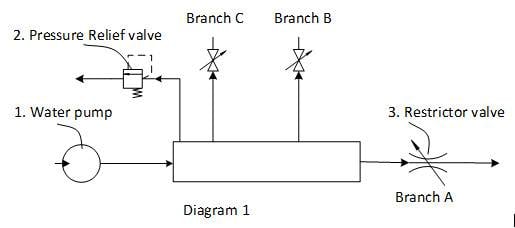
There are three liquid flow branches, A, B and C, connected together with one pressure source, like this configuration:
2019-01-06_125513.jpg


The Water Pump, #1, guarantees to provide the pressure of 200 bar to the system. The Pressure Relief Valve, #2, will be set to 195 bar and assume it will open to relieve the extra pressure when the pressure is over that value. Branch A, B and C are all expected to have a pressure of 195 bar to work properly.After the system is in perfect working condition, we manually change the Restrictor valve, #3, to make more resistance in Branch A. We assume the change is NOT small. Then the system pressure may increase immediately due to the change from Branch A. But the increase may be relieved by the Pressure Relief valve, #2, immediately, as well.Now there are two different opinions for the result of the change from Branch A:Opinion 1: Branch B and Branch C will not be affected, because the Pressure Relief valve is three for this purpose.

Opinion 2: Branch B and Branch C will be affected, because the Pressure Relief valve is far from the change source and the change reaches Branch B and C first.Q1: What is your opinion about this?

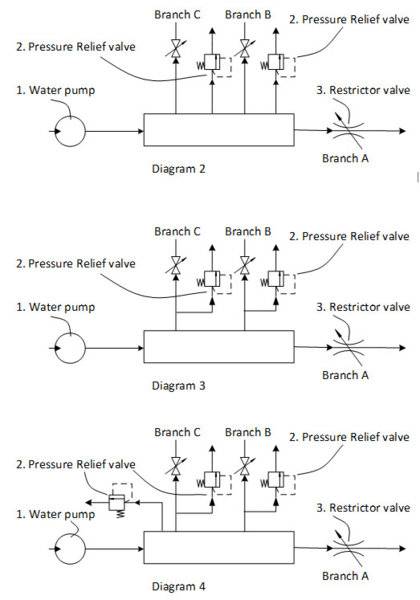
Because of above different opinions, there are more configurations come out:
2019-01-06_125615.jpg
Q2: Which configuration is the best configuration in order to get the most stable working pressure for Branch B and C?NOTE: let's only focus on pressure increase here for now.

Thanks,
James
 

Attachments

  • 2019-01-06_125513.jpg
    2019-01-06_125513.jpg
    10.8 KB · Views: 1,164
  • 2019-01-06_125615.jpg
    2019-01-06_125615.jpg
    26.3 KB · Views: 714
Engineering news on Phys.org
You need to calculate the line losses for the extreme operating conditions. Those conditions include, but are not limited to, all flow through A, all flow through the PRV, maximum flow through B, maximum flow through C. If constant pressure under transient conditions is important, you need the maximum rate of change of the valves at A, B, and C, plus the transient response of the PRV. Is the water pump a multistage centrifugal or positive displacement pump?

Then, and only then, you can start to look at solutions.
 
  • Like
Likes   Reactions: happylearner, Asymptotic, russ_watters and 1 other person
jrmichler said:
You need to calculate the line losses for the extreme operating conditions. Those conditions include, but are not limited to, all flow through A, all flow through the PRV, maximum flow through B, maximum flow through C. If constant pressure under transient conditions is important, you need the maximum rate of change of the valves at A, B, and C, plus the transient response of the PRV. Is the water pump a multistage centrifugal or positive displacement pump?

Then, and only then, you can start to look at solutions.

I am not in this field. I am asking these questions here because I want to see if I am right conceptually, or in the right direction. So I don't need answers with actual numbers. I only need answers to tell me which one makes more sense from you expert point of view.
 
happylearner said:
There are three liquid flow branches, A, B and C, connected together with one pressure source, like this configuration:
View attachment 236880

The Water Pump, #1, guarantees to provide the pressure of 200 bar to the system. The Pressure Relief Valve, #2, will be set to 195 bar and assume it will open to relieve the extra pressure when the pressure is over that value. Branch A, B and C are all expected to have a pressure of 195 bar to work properly.

After the system is in perfect working condition, we manually change the Restrictor valve, #3, to make more resistance in Branch A. We assume the change is NOT small. Then the system pressure may increase immediately due to the change from Branch A. But the increase may be relieved by the Pressure Relief valve, #2, immediately, as well.
Everything about this setup and question is odd:
  • Why are you using a pressure relief valve for control? Usually they are for safety. Using something not meant for control, for control, seems like a bad way to achieve stable control.
  • Why are you changing the position of valve #3? In response to what?
  • Are you really interested in the pressure at valves B & C or the flow rate?
  • Is there any control in this system other than the relief valve and valve #3? If not, why not?
Opinion 1: Branch B and Branch C will not be affected, because the Pressure Relief valve is three for this purpose.

Opinion 2: Branch B and Branch C will be affected, because the Pressure Relief valve is far from the change source and the change reaches Branch B and C first.

Q1: What is your opinion about this?
The purpose of a header is to ensure the pressure is equal to everything connected to the header. If it isn't, it is usually because it is undersized. If it's a transient condition you are worried about - essentially the time the pressure change requires to propagate through the system at the speed of sound in water- that's an incredible level of required precision/responsiveness...and by the way, you didn't actually say what your requirements in terms of flow rate, accuracy and responsiveness are.
Because of above different opinions, there are more configurations come out:

Q2: Which configuration is the best configuration in order to get the most stable working pressure for Branch B and C?
The last one, but I doubt even it would give a stable pressure. Relief valves don't modulate, they go open/closed, so what I foresee with all is the pressure jumping up and down wildly as the relief valves snap open and closed repeatedly.
 
  • Like
Likes   Reactions: happylearner
russ_watters said:
Everything about this setup and question is odd:
  • Why are you using a pressure relief valve for control? Usually they are for safety. Using something not meant for control, for control, seems like a bad way to achieve stable control.
  • Why are you changing the position of valve #3? In response to what?
  • Are you really interested in the pressure at valves B & C or the flow rate?
  • Is there any control in this system other than the relief valve and valve #3? If not, why not?

If I want to make Branch A, B and C all the same having a stable flow rate and also minimize the possible impact from each other, what should a professional configuration look like?
 
happylearner said:
If I want to make Branch A, B and C all the same having a stable flow rate and also minimize the possible impact from each other, what should a professional configuration look like?
Active volume control by each valve and pressure control in the header by the pump. This require pressure and flow sensors and feedback control.
 
  • Like
Likes   Reactions: happylearner and anorlunda
russ_watters said:
Active volume control by each valve and pressure control in the header by the pump. This require pressure and flow sensors and feedback control.
Thank you, Russ.

If I want to allow one of the branches leave and join occasionally, how to minimize the possible impact on other branches? One active volume control on each branch can handle this?
 
Operating a 195 psi relief valve at exactly 195 psi will cause chatter. As @russ_watters said, a relief valve must never be used as a pressure regulator.
 
  • Like
Likes   Reactions: russ_watters and happylearner
anorlunda said:
Operating a 195 psi relief valve at exactly 195 psi will cause chatter. As @russ_watters said, a relief valve must never be used as a pressure regulator.
yes, I understand now.
 
  • #10
195 bar is almost 3000 PSI. That's serious pressure. A pinhole leak will drill a stream of water right into your body. An uncle learned this the hard way when he was standing near a log loader that developed a pinhole leak. It shot hydraulic fluid into a fingertip from two feet away. The fluid traveled through his arm up past his elbow. He was lucky, the doctors were able to save his arm, although it was permanently partly crippled.

The paper mill had a high pressure washdown system designed to run at 2000 PSI. The safety class for new cleaners included using the wash gun to cut a 2X4 in half to show why any horseplay with high pressure water would result in immediate termination of employment.

High pressure requires special materials, fittings, valves, and special knowledge. A group of people that do not understand basic flow calculations, or basic concepts of pressure control, are not even close to qualified to work on 3000 PSI systems. Pay what it takes, but get somebody with experience in high pressure systems on this project.

On the other hand, if you meant 195 PSI instead of 195 bar, then standard Schedule 40 pipe and readily available valves will work just fine.

Relief valves are designed to be full open or full closed. Using one as a pressure control valve will cause it to fail in a short time.
 
  • Like
Likes   Reactions: russ_watters and happylearner
  • #11
jrmichler said:
High pressure requires special materials, fittings, valves, and special knowledge. A group of people that do not understand basic flow calculations, or basic concepts of pressure control, are not even close to qualified to work on 3000 PSI systems. Pay what it takes, but get somebody with experience in high pressure systems on this project.

My friends and I are talking about a basement experiment which is in need of a pressured fluid input with a constant flow rate. The flow rate expected is very small, about 1ml/min. The operating pressure can be 50 - 100 bar (725 - 1450 psi), but may be higher. We don't know if we can build one with all available components on the market. That is why I am here to ask for help. Do you think it is possible (for us or for some professionals) to build a reliable input resource for our experiment with these parts available on the market?
 
  • #12
The previous post revealed that the topic of this thread is an extremely dangerous DIY basement experiment.

PF rules do not allow public discussion of dangerous topics. Thread closed.
 
Last edited:

Similar threads

Replies
6
Views
9K
  • · Replies 1 ·
Replies
1
Views
2K
Replies
8
Views
2K
Replies
13
Views
4K
Replies
8
Views
4K
  • · Replies 10 ·
Replies
10
Views
3K
  • · Replies 29 ·
Replies
29
Views
9K
  • · Replies 3 ·
Replies
3
Views
3K
  • · Replies 7 ·
Replies
7
Views
2K
Replies
8
Views
2K