How to Implement Current Conservation for SU(N) in the Adjoint Representation?

Join the discussion
Ask a follow-up here, or get your own question answered by working scientists, mathematicians and engineers — people, not an autocomplete.
Real named experts · corrections over time · the nuance an AI answer skips
2 replies · 2K views
Tian
Messages
5
Reaction score
0
Homework Statement
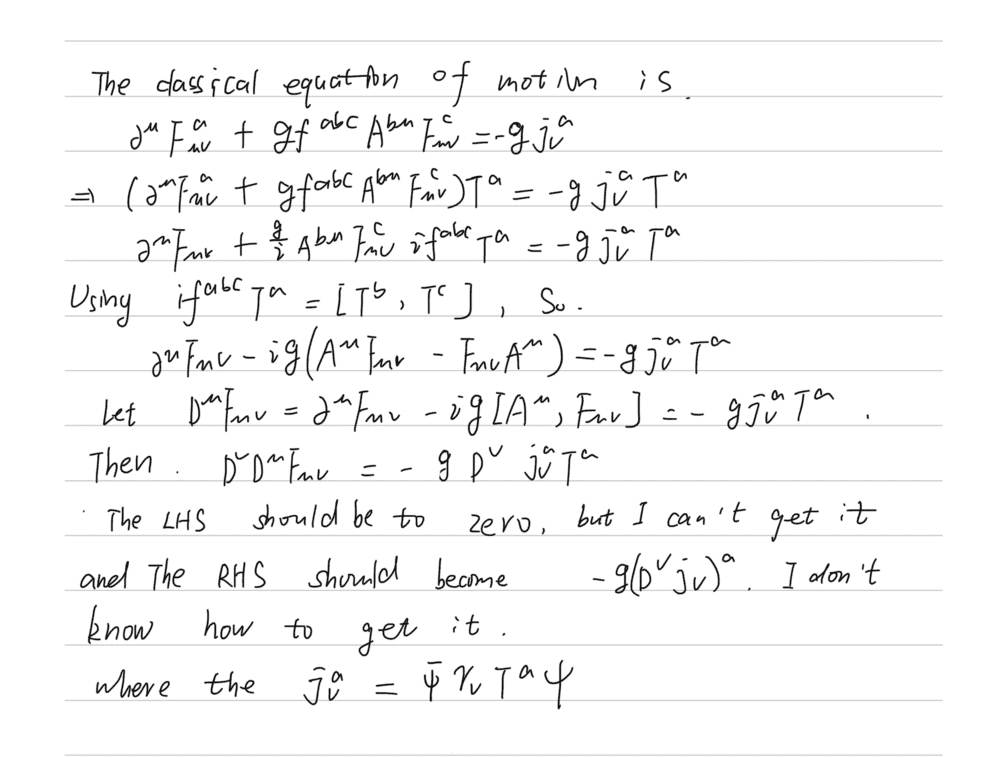
In the "An introduction to Quantum Field Thoery" of Peskin and Schroeder, the equation(15.51) of the chapter 15.3 gives the classical equation of motion, so from this equation to derive the current conservation.
Relevant Equations
the classical equation of motion for SU(N), please see my picture
Here is my solution
2C869620FEBDBAA1F955AC83ADAF6638.png
 
Physics news on Phys.org
[tex]D^{\mu}F_{\mu\nu} = - j_{\nu},[/tex] Differentiate this covariantly and anti-symmetrized to obtain [tex]\frac{1}{2}[D^{\mu}, D^{\nu}]F_{\mu\nu} = D^{\nu}j_{\nu}. \ \ \ \ (1)[/tex] Now, from the definition of the covariant derivative in the adjoint representation (acting on any matrix-valued field) [tex]D^{\mu}M \equiv \partial^{\mu}M + [A^{\mu} , M],[/tex] you can show that [tex][D^{\mu} , D^{\nu}]M = [F^{\mu\nu} ,M][/tex] Thus, for [itex]M = F_{\mu\nu}[/itex], eq(1) becomes [tex]D^{\nu}j_{\nu} = \frac{1}{2}[F^{\mu\nu} , F_{\mu\nu}] = 0.[/tex]
 
Thank you veery much . It should be done in the adjoint repesentation.