How to increase a hole/thread diameter in gold

Click For Summary
SUMMARY

This discussion centers on the challenges of replacing a 0.9mm screw with a 1.0mm screw in an 18k gold watch. Participants unanimously advise against forcing the larger screw into the existing female thread, as this could damage the thread integrity. The original screw is proprietary, and sourcing a replacement is critical to maintain the watch's high resale value, estimated between $10,000 and $40,000. Recommendations include consulting a professional watch repair service and exploring micro fastener machine shops for potential solutions.

PREREQUISITES
  • Understanding of UNM thread standards and measurements
  • Familiarity with watch repair techniques and materials
  • Knowledge of micro fasteners and their applications
  • Experience with precision tools for measuring thread pitch
NEXT STEPS
  • Research the specifications and dimensions of proprietary watch screws
  • Learn about micro threading techniques in machine shops
  • Investigate the use of thread lock adhesives for securing loose screws
  • Explore the history and precision standards of watch manufacturing
USEFUL FOR

Watch enthusiasts, horologists, and anyone involved in luxury watch maintenance or repair will benefit from this discussion.

docnet
Messages
796
Reaction score
486
TL;DR
What's the best way to increase the diameter of a threaded hole in 18k gold?
Hello,

I am trying to change a 0.9mm screw with a 1.0mm screw. The material is 18k gold, and so the hole is to be threaded.
Is it ill advised to force the larger screw in without tapping the smaller hole? the difference in screw size is just .1mm, and we assume the thread pitches are identical. Gold is a soft material so should it accommodate the larger diameter screw without issues?
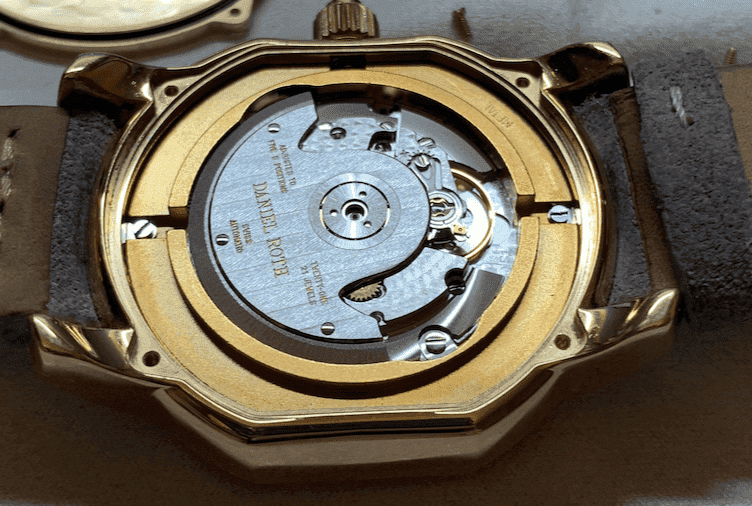
Screen Shot 2020-10-04 at 2.00.41 PM.png
 
Engineering news on Phys.org
  • Informative
Likes   Reactions: berkeman
Lnewqban said:
What has happened to the original female thread?
According to this site, the pitches differ for both diameters:

https://www.sizes.com/tools/thread_unm.htm

thank you. The original .9mm diameter screw has rattled loose and I cannot find a replacement screw anywhere. I suppose another option to replace the screw is paying $2000 to Bvlgari for a full service.

edited: typos
 
This is a $10-40K watch with high resale value. The resale value will be much lower if it is "repaired" by a non-expert, and will be close to zero if it does not survive the repair. I would take it to a repairman.
 
  • Like
Likes   Reactions: berkeman
Lnewqban said:
Tapping for 1.0 mm with different pitch will destroy whatever is remaining of that female thread, in my humble opinion.
Somebody must have the original 0.9 UNM screw.
Some thread lock may do the trick of retaining it in place.

Please, see:
https://www.ebay.com/itm/M-9-90-UNM...645762?hash=item5b760de402:g:aJYAAOSwaS9fRq9J

Best luck!
Vanadium 50 said:
This is a $10-40K watch with high resale value. The resale value will be much lower if it is "repaired" by a non-expert, and will be close to zero if it does not survive the repair. I would take it to a repairman.

My apologies. I meant to say just the screw has been lost. The female thread is 100% intact as far as I can tell. I bought the watch from an online Sothebys auction in march. And no one else placed any bids it so I got a good deal, much less than $10K. I will take your advice and not alter the female thread. (the screw seems to be propriatary to the brand and I still cannot find it for sale anywhere). I will keep searching. thanks
 
  • Like
Likes   Reactions: Lnewqban and berkeman
  • Like
Likes   Reactions: docnet
Replace the screw.

Test the thread pitch by borrowing a similar screw from another location. Notice the thread angle may not be the 60° as expected with UN or ISO thread standards.

You might measure the thread pitch by screwing a soft material into the hole to get a print of the thread. I use a tapered splinter of a match stick, with modelling clay on bigger threads.
 
  • Like
Likes   Reactions: Lnewqban and docnet
The chances of destroying the watch are pretty high. Watches are made to a level of precision rarely ever found in other industries. Many years ago, I worked for Hamilton Watch Co., and old-line American watch company. I was simply astounded at the precision involved in every aspect. I would never try to work on a watch if I wanted it to continue to function.
 
  • Like
Likes   Reactions: jim mcnamara and docnet
  • #10
Baluncore said:
Notice the thread angle may not be the 60° as expected with UN or ISO thread standards.
This would be my concern. Watch makers may use proprietary fasteners, you'd be better off finding an old-time independent watch repair service and see if they can help you. At least they would know the options.
 

Similar threads

Replies
8
Views
11K
Replies
3
Views
2K
  • · Replies 9 ·
Replies
9
Views
4K
  • · Replies 8 ·
Replies
8
Views
4K
  • · Replies 13 ·
Replies
13
Views
2K
  • · Replies 10 ·
Replies
10
Views
2K
  • · Replies 2 ·
Replies
2
Views
6K
  • · Replies 6 ·
Replies
6
Views
2K
  • · Replies 21 ·
Replies
21
Views
9K
  • · Replies 6 ·
Replies
6
Views
2K