SUMMARY
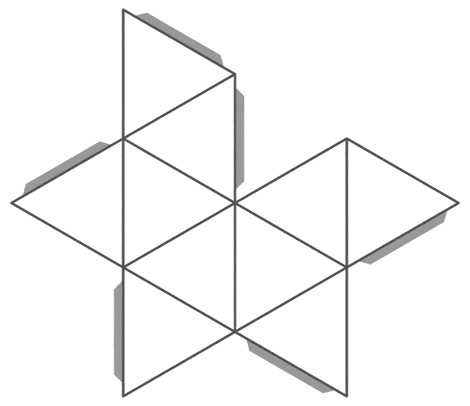
The discussion focuses on creating Wigner-Seitz cells for Body-Centered Cubic (BCC) and Face-Centered Cubic (FCC) structures using paper, akin to origami techniques. Participants emphasize the importance of understanding the geometric shapes of these unit cells as the initial step in the process. The request for development figures or planar representations indicates a need for visual aids to facilitate the construction of these cells. Clear communication and resources are essential for those unfamiliar with the English language in this context.
PREREQUISITES
- Understanding of Wigner-Seitz cell concepts
- Familiarity with Body-Centered Cubic (BCC) and Face-Centered Cubic (FCC) structures
- Basic origami skills for paper modeling
- Ability to interpret geometric figures and diagrams
NEXT STEPS
- Research geometric construction techniques for Wigner-Seitz cells
- Explore origami methods specifically for BCC and FCC structures
- Find or create planar figures for Wigner-Seitz cells
- Study the mathematical principles behind unit cell geometry
USEFUL FOR
This discussion is beneficial for students of materials science, hobbyists interested in origami, and educators looking to teach geometric concepts related to crystallography.