How to Prove an Inverse Function Using Equating Square Roots?

Join the discussion
Ask a follow-up here, or get your own question answered by working scientists, mathematicians and engineers — people, not an autocomplete.
Real named experts · corrections over time · the nuance an AI answer skips
9 replies · 2K views
#neutrino
Messages
51
Reaction score
2
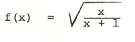
if
upload_2016-1-15_8-59-51.png
then to prove an inverse of this exists the following has been done to show that it is one to one
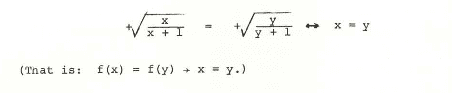
upload_2016-1-15_8-59-8.png


what is the basis of equating the 2 square roots ?
 
Mathematics news on Phys.org
Mark44 said:
What is the definition of a function being one-to-one?
an output can have only one input ,but what i don't understand is the basis of the expression
upload_2016-1-15_15-42-34.png
 
Simon Bridge said:
Can you think of another way to show it is 1-1?
yes i can reach the conclusion if we draw a graph but I'm confused about how to arrive at the conclusion (one to one ) using this data
 
#neutrino said:
yes i can reach the conclusion if we draw a graph but I'm confused about how to arrive at the conclusion (one to one ) using this data
If you graph it, can you think of a specific feature of the graph that you could phrase mathematically?
 
#neutrino said:
an output can have only one input ,but what i don't understand is the basis of the expressionView attachment 94307
That is exactly what you said above: "an output can have only one input". If x and y are the "inputs" for the "outputs", f(x) and f(y), and they are the same, f(x)= f(y), so they are the same output, the inputs must be the same: x= y. Showing that "if f(x)= f(y) then x= y" is exactly the same as showing "an output can have only one input".
 
#neutrino said:
an output can have only one input ,but what i don't understand is the basis of the expressionView attachment 94307
It is the "If" part of an "if-then" statement. It is not proven, it is assumed. So there is no need for a "basis" for the statement.
If (x/(x+1))0.5 = (y/(y+1))0.5
then x=y.

This is all that you need to prove to show that the function has an inverse.
 
HallsofIvy said:
That is exactly what you said above: "an output can have only one input". If x and y are the "inputs" for the "outputs", f(x) and f(y), and they are the same, f(x)= f(y), so they are the same output, the inputs must be the same: x= y. Showing that "if f(x)= f(y) then x= y" is exactly the same as showing "an output can have only one input".
FactChecker said:
It is the "If" part of an "if-then" statement. It is not proven, it is assumed. So there is no need for a "basis" for the statement.
If (x/(x+1))0.5 = (y/(y+1))0.5
then x=y.

This is all that you need to prove to show that the function has an inverse.

so why have you proved an input equals an input ? when what we should prove is that for two particular inputs the OUTPUT will be the same only if those two inputs are equal.
 
Last edited by a moderator:
That is how you prove it. Prove that if the result of the function is the same, then the inputs were the same. That what "or two particular inputs the OUTPUT will be the same only if those two inputs are equal." means. So your question is more about how to phrase the logic rather than about function inverses. This might be a good, simple example of using truth tables to see that the logic is correct.