How to Solve Coulomb's Law Question 1: Calculating Net Force | Physics Problem

  • Thread starter Thread starter Potatochip911
  • Start date Start date
  • Tags Tags
    Coulomb's law Law
Click For Summary

Homework Help Overview

The discussion revolves around a problem related to Coulomb's Law, specifically calculating the net force acting on a charge due to other charges. Participants are exploring the correct application of the law and the necessary components for calculating forces in a two-dimensional context.

Discussion Character

  • Mixed

Approaches and Questions Raised

  • Participants describe multiple attempts to calculate the net force, including using both magnitude and vector components. There is a focus on the relationships between the charges and the distances involved, with some questioning the correctness of their expressions and substitutions.

Discussion Status

Some participants have provided guidance on ensuring the correct charges are used in calculations, while others have pointed out potential errors in reasoning. The discussion reflects a collaborative effort to clarify misunderstandings and refine the approach to the problem.

Contextual Notes

There are indications of confusion regarding the use of absolute values in calculations and the proper identification of variables. Participants also mention the need to consider the derivative for determining maximum force, suggesting that the problem may have multiple layers of complexity.

Potatochip911
Messages
317
Reaction score
3
1. The problem statement, all variables and given/known }data
The picture I drew is quite sad but it's the best I could do lol.
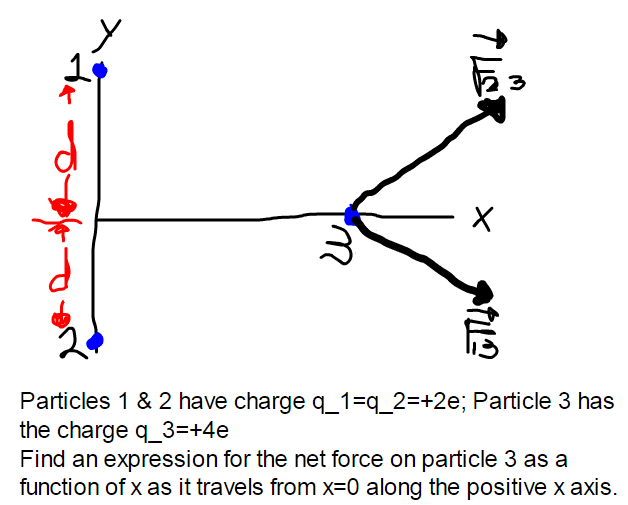
102ti87.png

I forgot to mention in the image that it's the magnitude of the net force we're looking for.

Homework Equations


##|F_{12}|=\frac{1}{4\pi\epsilon_0}\frac{|q_1||q_2|}{(R_{12})^2}##

The Attempt at a Solution


I've tried solving it 2 ways and both have failed. The first method I tried was to ignore directional vectors since the y components cancel out in this example.
##F_{3}=F_{13}+F_{23}=\frac{1}{4\pi\epsilon_0}\frac{|q_1||q_3|}{(R_{13})^2}+\frac{1}{4\pi\epsilon_0}\frac{|q_2||q_3|}{(R_{23})^2}## ; Then since the hypotenuse of both triangles is the same we have ##R_{13}=R_{23}##; ##R_{13}=\sqrt{x^2+d^2}## and since ##q_1=q_2## we have $$F_{3}=\frac{1}{4\pi\epsilon_0}\frac{2|q_1||q_2|}{(R_{13})^2}=\frac{1}{4\pi\epsilon_0}\frac{2|q_1||q_2|}{x^2+d^2}$$
Unfortunately this isn't the correct expression, I also tried solving it with x and y components instead of magnitudes:
##F_3=\frac{1}{4\pi\epsilon_0}[\frac{|q_1||q_2|\cos\theta(+\hat{\imath})}{(R_{13})^2}+\frac{|q_1||q_2|\sin\theta(-\hat{\jmath})}{(R_{13})^2}]+\frac{1}{4\pi\epsilon_0}[\frac{|q_2||q_3|\cos\theta(+\hat{\imath})}{(R_{23})^2}+\frac{|q_2||q_3|\sin\theta(+\hat{\jmath})}{(R_{23})^2}]## which after simplifying leads to the expression $$F_3=\frac{1}{4\pi\epsilon_0}[\frac{2|q_1||q_3|\cos\theta}{(x^2+d^2)}]$$ which also isn't the correct expression even after substituting ##\cos\theta=\frac{x}{\sqrt{x^2+d^2}}##
 
Physics news on Phys.org
Potatochip911 said:
1. The problem statement, all variables and given/known }data
The picture I drew is quite sad but it's the best I could do lol.
102ti87.png

I forgot to mention in the image that it's the magnitude of the net force we're looking for.

Homework Equations


##|F_{12}|=\frac{1}{4\pi\epsilon_0}\frac{|q_1||q_2|}{(R_{12})^2}##

The Attempt at a Solution


I've tried solving it 2 ways and both have failed. The first method I tried was to ignore directional vectors since the y components cancel out in this example.
##F_{3}=F_{13}+F_{23}=\frac{1}{4\pi\epsilon_0}\frac{|q_1||q_3|}{(R_{13})^2}+\frac{1}{4\pi\epsilon_0}\frac{|q_2||q_3|}{(R_{23})^2}## ; Then since the hypotenuse of both triangles is the same we have ##R_{13}=R_{23}##; ##R_{13}=\sqrt{x^2+d^2}## and since ##q_1=q_2## we have $$F_{3}=\frac{1}{4\pi\epsilon_0}\frac{2|q_1||q_2|}{(R_{13})^2}=\frac{1}{4\pi\epsilon_0}\frac{2|q_1||q_2|}{x^2+d^2}$$
That is wrong, naturally.
Potatochip911 said:
Unfortunately this isn't the correct expression, I also tried solving it with x and y components instead of magnitudes:
##F_3=\frac{1}{4\pi\epsilon_0}[\frac{|q_1||q_2|\cos\theta(+\hat{\imath})}{(R_{13})^2}+\frac{|q_1||q_2|\sin\theta(-\hat{\jmath})}{(R_{13})^2}]+\frac{1}{4\pi\epsilon_0}[\frac{|q_2||q_3|\cos\theta(+\hat{\imath})}{(R_{23})^2}+\frac{|q_2||q_3|\sin\theta(+\hat{\jmath})}{(R_{23})^2}]## which after simplifying leads to the expression $$F_3=\frac{1}{4\pi\epsilon_0}[\frac{2|q_1||q_3|\cos\theta}{(x^2+d^2)}]$$ which also isn't the correct expression even after substituting ##\cos\theta=\frac{x}{\sqrt{x^2+d^2}}##
Use the value of the charge when you calculate the Coulomb force, not the absolute value.
You want the force acting on charge 3, but you used q1 q2 in your first two terms.
By the way, where is x=0?
 
  • Like
Likes   Reactions: Potatochip911
ehild said:
That is wrong, naturally.

Use the value of the charge when you calculate the Coulomb force, not the absolute value.
You want the force acting on charge 3, but you used q1 q2 in your first two terms.
By the way, where is x=0?
Okay, I had ##q_1## and ##q_3## on my paper but I accidentally put ##q_2## in LaTeX. So placing the proper variables gives $$\frac{1}{4\pi\epsilon}[\frac{q_1q_3\cos\theta(+\hat{\imath})}{(R_{13})^2}+\frac{q_1q_3\sin\theta(-\hat{\jmath})}{(R_{13})^2}]+\frac{1}{4\pi\epsilon}[\frac{q_2q_3\cos\theta(+\hat{\imath})}{(R_{23})^2}+\frac{q_2q_3\sin\theta(+\hat{\jmath})}{(R_{23})^2}]$$ which after making the substitutions ##q_1=q_2##, ##R_{13}=R_{23}## and ##\cos\theta=\frac{x}{\sqrt{x^2+d^2}}## becomes $$\frac{1}{4\pi\epsilon}\frac{2q_1q_3\cos\theta}{(R_{13})^2}=\frac{1}{4\pi\epsilon}\frac{16e^2x}{(x^2+d^2)^{3/2}}$$ which is pretty much the same expression as before just without the absolute values. x=0 would be where the y-axis intersects the x-axis in the image.
 
How do you know it is wrong? It looks correct, but you can substitute the the numerical values.
 
  • Like
Likes   Reactions: Potatochip911
ehild said:
How do you know it is wrong? It looks correct, but you can substitute the the numerical values.
In the second part of the question it asked to calculate where the force would be at a maximum and I thought the derivative was elementary enough that I wouldn't make a mistake on it so I assumed the original expression was incorrect. After looking over it again it turns out it's actually the derivative that I took incorrectly and the function ##F_3(x)## is correct.
 

Similar threads

Replies
4
Views
2K
Replies
11
Views
2K
  • · Replies 11 ·
Replies
11
Views
2K
Replies
14
Views
3K
  • · Replies 3 ·
Replies
3
Views
2K
Replies
6
Views
2K
  • · Replies 4 ·
Replies
4
Views
1K
  • · Replies 13 ·
Replies
13
Views
4K
  • · Replies 9 ·
Replies
9
Views
2K
Replies
3
Views
2K