Can a 10N Force Overcome Friction to Move a 10kg Block?

  • Thread starter Thread starter Benjamin_harsh
  • Start date Start date
  • Tags Tags
    Block
Click For Summary
A 10kg block on a horizontal floor experiences a gravitational force of 98N and has a static friction coefficient of 0.2, resulting in a maximum static friction force of 19.6N. When a horizontal force of 10N is applied, it is less than the maximum static friction, indicating the block will not move. The discussion emphasizes the importance of correctly formatting the problem statement and including relevant equations and units for clarity. Proper notation and presentation are essential for effective communication in physics problems. Understanding these principles is crucial for solving similar mechanics questions.
Benjamin_harsh
Messages
211
Reaction score
5
Homework Statement
How to solve this block problem?
Relevant Equations
How to solve this block problem?
A block of mass ##10kg## rests on a horizontal floor. The acceleration due to gravity
is ##9.81 m/s^{2}##. The coefficient of static friction between the floor and the block is ##0.2##.
A horizontal force of ##10N## is applied on the block as shown in the figure.
The magnitude force of friction (in N) on the block:
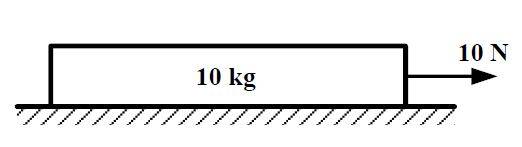
246700


I can able to find ##F_{s}^{max} = 98 * 0.2 = 19.6## (##F_{n} = 9.8 * 10kg = 98##)

After this how to proceed.
 
Physics news on Phys.org
Benjamin_harsh said:
After this how to proceed.
Consider whether the block will move.

By the way, you are not using the template properly. The description of the problem ("a block of mass ...") should appear under "problem statement " and relevant equations are such as "##F_s\leq\mu_sN##".
 
It's also a good idea to put the appropriate units next to any numbers that you write down unless they are dimensionless.
 
The book claims the answer is that all the magnitudes are the same because "the gravitational force on the penguin is the same". I'm having trouble understanding this. I thought the buoyant force was equal to the weight of the fluid displaced. Weight depends on mass which depends on density. Therefore, due to the differing densities the buoyant force will be different in each case? Is this incorrect?

Similar threads

  • · Replies 6 ·
Replies
6
Views
1K
Replies
16
Views
3K
Replies
13
Views
3K
Replies
15
Views
3K
  • · Replies 33 ·
2
Replies
33
Views
1K
Replies
61
Views
3K
  • · Replies 9 ·
Replies
9
Views
4K
Replies
7
Views
1K
  • · Replies 4 ·
Replies
4
Views
8K
  • · Replies 5 ·
Replies
5
Views
4K