How to tell if energy was conserve in a momentum problem?

Click For Summary
SUMMARY

This discussion centers on determining energy conservation in momentum problems, specifically in elastic collisions. The scenario involves a small mass "m" colliding with a larger stationary mass "5m," resulting in different velocities post-impact. Key insights include the necessity of knowing both pre- and post-collision velocities to assess kinetic energy conservation, and the importance of the restitution coefficient in evaluating the elasticity of the collision. The conclusion emphasizes that differing speeds after impact do not inherently indicate energy loss, as energy conservation can still occur in elastic collisions.

PREREQUISITES
  • Understanding of elastic and inelastic collisions
  • Knowledge of kinetic energy and its conservation principles
  • Familiarity with the restitution coefficient and its significance
  • Basic concepts of momentum in physics
NEXT STEPS
  • Research the calculation of the restitution coefficient for various material pairs
  • Study the principles of elastic and inelastic collisions in detail
  • Learn how to calculate kinetic energy before and after collisions
  • Explore advanced momentum conservation problems in two-body collisions
USEFUL FOR

Physics students, educators, and anyone interested in understanding the principles of momentum and energy conservation in collision scenarios.

Blockade
Messages
68
Reaction score
0
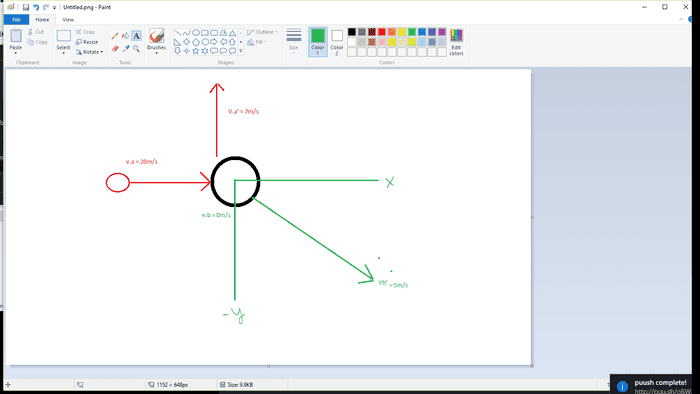
How can you determine if energy was conserve in a momentum problem? Let's say a small mass "m" hits a larger stationary mass "5m" where the smaller mass "m" flies bounces upward and the larger mass "5m" bounces in a negative downward direction.

So from them bouncing off each other I know that it's an elastic type of collision. What I also know is that the initial velocity of both masses are not the same after impact.

Can any of these clues allow me to tell if energy was conserve within the system?

Note: The picture is just something I made up and the values of the different velocities just demonstrate that the smaller ball loses speed after impact.

Does that mean that energy is not conserved since the smaller ball losses speed and therefore it losses kinetic energy? Does this make it an elastic collision instead of a perfectly elastic one?
4a89d4ae6b.png
 
Physics news on Phys.org
No, you cannot tell from the information you present.
If you know both velocities before and after collision, of course you can check if the KE is conserved.
If not, you need to know something about the materials. The quantity that tells "how ellastic" is the collision is called restitution coefficient. You can gind it for various pairs of materials.
 
nasu said:
No, you cannot tell from the information you present.
If you know both velocities before and after collision, of course you can check if the KE is conserved.
If not, you need to know something about the materials. The quantity that tells "how ellastic" is the collision is called restitution coefficient. You can gind it for various pairs of materials.

So if energy is conserved then the speed before impact should equal the speed after impact?
 
No, not at all. Where did you get this from? And what speed are you talking about? There are two speeds after a two-body collision.
And two speeds before collision. What would you mean by "the speed after impact should equal the speed after impact"?
 
nasu said:
No, not at all. Where did you get this from? And what speed are you talking about? There are two speeds after a two-body collision.
And two speeds before collision. What would you mean by "the speed after impact should equal the speed after impact"?

I mean the speed of the smaller ball (red). I thought that if the speed of the smaller ball before the impacted is different from the speed of the smaller ball after the impact are not the same value then the kinetic energy is not constant, therefore it's energy is not conserved. I think that my reasoning and definitions are wrong then.
 

Similar threads

  • · Replies 6 ·
Replies
6
Views
2K
  • · Replies 30 ·
2
Replies
30
Views
3K
  • · Replies 53 ·
2
Replies
53
Views
5K
  • · Replies 3 ·
Replies
3
Views
2K
  • · Replies 1 ·
Replies
1
Views
2K
  • · Replies 4 ·
Replies
4
Views
1K
  • · Replies 2 ·
Replies
2
Views
2K
  • · Replies 5 ·
Replies
5
Views
2K
  • · Replies 9 ·
Replies
9
Views
2K
  • · Replies 30 ·
2
Replies
30
Views
3K