How to write this in Set Theory notation?

Click For Summary
SUMMARY

The discussion focuses on expressing the intersection of two circular areas, denoted as A and B, using Set Theory notation. The intersection is defined as A_intersection = A ∩ B, with the additional condition that the intersection area must be contained within B, leading to the expression A_intersection = min{A ∩ B, B}. Participants clarify that the intersection A ∩ B is inherently a subset of both A and B, and suggest using the notation A ⊂neqq B to indicate that the intersection is a proper subset of B.

PREREQUISITES
  • Understanding of Set Theory notation, specifically intersection and subset concepts.
  • Familiarity with mathematical symbols such as ∩ and ⊂neqq.
  • Basic knowledge of Venn diagrams to visualize set relationships.
  • Concept of circular areas and their intersections in a physical context.
NEXT STEPS
  • Research the properties of intersections in Set Theory, focusing on subsets and proper subsets.
  • Explore advanced Set Theory notation and symbols for expressing conditions on intersections.
  • Study Venn diagrams and their applications in visualizing set relationships.
  • Investigate real-world applications of Set Theory in physics, particularly in fluid dynamics.
USEFUL FOR

Mathematicians, physics students, and anyone interested in applying Set Theory to physical problems involving intersections of areas.

danielFiuza
Messages
4
Reaction score
0
Hello Everyone,

I am trying to write the intersection of a physical problem in the most compact way.
I am not really familiar with Set Theory notation, but I think it has the answer.

It is about the intersection of two circular areas:
- Area 1: A
- Area 2: B
If I want to write this in Set Theory notation:
A_intersection = A ∩ B

Until this point everything is okay. But I have an extra condition
- Extra condition: intersection area always smaller than B (or in other words, the intersection area needs to be contained in B).
A_intersection = min{A ∩ B, B}
(ie. The maximum intersection area can not be larger than B)

How can I write this? Is there any short mathematical symbol for that?

Kind regards,

Daniel

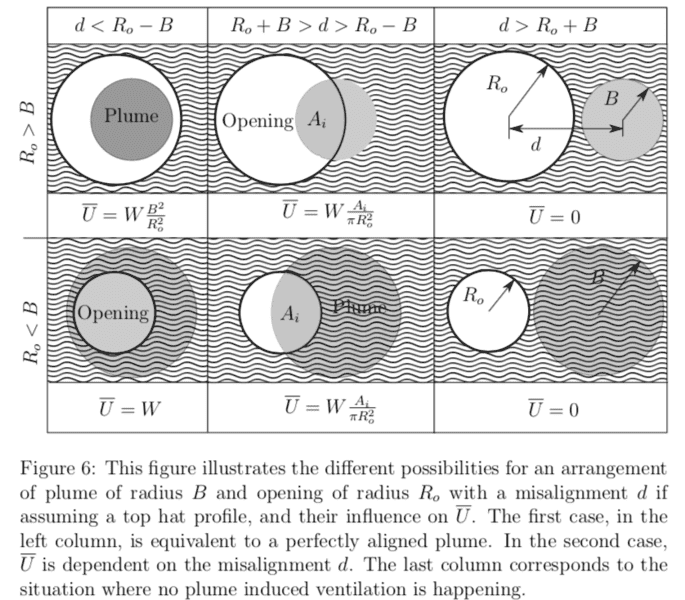
PS: Physically, I am trying to describe a situation as the following one:
' A jet of water of radius R1 impinging against a wall with a hole of radius R2, misaligned from the opening. The water is driven through the intersection area, given that the intersectio area is smaller always that the hole radius R2'
1) For a perfectly aligned jet with the opening:
- If the radius of the jet R1 is smaller than the opening radius R2, all the fluid from the jet goes inside. -> R1
- If the area of the jet R1 is larger than the hole area R2, only the area R2 drives fluids-> R2
2) Then extending this for different misalignments.
Screen Shot 2018-10-22 at 16.18.53.png
 

Attachments

  • Screen Shot 2018-10-22 at 16.18.53.png
    Screen Shot 2018-10-22 at 16.18.53.png
    69 KB · Views: 448
Last edited:
Physics news on Phys.org
danielFiuza said:
Hello Everyone,

I am trying to write the intersection of a physical problem in the most compact way.
I am not really familiar with Set Theory notation, but I think it has the answer.

It is about the intersection of two circular areas:
- Area 1: A
- Area 2: B
If I want to write this in Set Theory notation:
A_intersection = A ∩ B

Until this point everything is okay. But I have an extra condition
- Extra condition: intersection area always smaller than B (or in other words, the intersection area needs to be contained in B).
A_intersection = min{A ∩ B, B}
(ie. The maximum intersection area can not be larger than B)

How can I write this? Is there any short mathematical symbol for that?

The intersection of two sets cannot be larger than either set. We have:

##A \cap B \subseteq A## and ##A \cap B \subseteq B##

This follows because the intersection is only things that are in each set. By definition, therefore, the intersection of two sets is a subset of each set.
 
  • Like
Likes   Reactions: danielFiuza
danielFiuza said:
But I have an extra condition
- Extra condition: intersection area always smaller than B (or in other words, the intersection area needs to be contained in B).
A_intersection = min{A ∩ B, B}

As to containment, it is always true that ##A \cap B \subseteq B##, so you don't need to state this as an additional condition.

If you want to require that ##A \cap B ## be a proper subset of ##B##, it's safest to write this as ##A \subsetneqq B##. (Some people interpret ""##\subset##"" to mean the same things as "##\subseteq##", others interpret it to mean "##\subsetneqq##" ).
 
Thanks Stephen. Just to be clear, is ##A \cap B = B \cap A ##?
Screen Shot 2018-10-22 at 16.18.53.png


PeroK said:
The intersection of two sets cannot be larger than either set. We have:

##A \cap B \subseteq A## and ##A \cap B \subseteq B##

This follows because the intersection is only things that are in each set. By definition, therefore, the intersection of two sets is a subset of each set.
 

Attachments

  • Screen Shot 2018-10-22 at 16.18.53.png
    Screen Shot 2018-10-22 at 16.18.53.png
    69 KB · Views: 936
danielFiuza said:
Thanks Stephen. Just to be clear, is ##A \cap B = B \cap A ##?

If you imagine drawing your sets on a Venn diagram, where ##A \cap B## is the area of overlap between ##A## and ##B##; and, ##B \cap A## is the area of overlap between ##B## and ##A##; then, would you say these represent the same area?
 
Last edited:
danielFiuza said:
Thanks Stephen. Just to be clear, is ##A \cap B = B \cap A ##?
View attachment 232588

Is the set of males over 20 years of age the same as the set of people over 20 years of age who are male?
 
PeroK said:
If you imagine drawing your sets on a Venn diagram, where ##A \cap B## is the area of overlap between ##A## and ##B##; and, ##B \cap A## is the area of overlap between ##B## and ##A##; then, would you say these represent the same area?

Yes, they represent the same area.
I am still confused when the one of the areas is completely contained inside the other (see first column of the diagram attached in the thread). Eg. A belongs to/is contained in B or area B belong to A. Does that still holds? That's were my confusion arises with the notation of ##\cap##.

Thanks again,
 
danielFiuza said:
Yes, they represent the same area.
I am still confused when the one of the areas is completely contained inside the other (see first column of the diagram attached in the thread). Eg. A belongs to/is contained in B or area B belong to A. Does that still holds? That's were my confusion arises with the notation of ##\cap##.

Thanks again,

In the case where ##A \subseteq B##, then the intersection of the two sets is the set ##A##.
 

Similar threads

  • · Replies 7 ·
Replies
7
Views
3K
  • · Replies 10 ·
Replies
10
Views
2K
  • · Replies 2 ·
Replies
2
Views
3K
  • · Replies 1 ·
Replies
1
Views
3K
  • · Replies 2 ·
Replies
2
Views
3K
Replies
5
Views
4K
  • · Replies 2 ·
Replies
2
Views
1K
  • · Replies 18 ·
Replies
18
Views
3K
  • · Replies 33 ·
2
Replies
33
Views
3K
Replies
3
Views
2K