How was Galileo able to observe Venus's phases?

  • Context: Undergrad 
  • Thread starter Thread starter TheExibo
  • Start date Start date
  • Tags Tags
    Galileo Phases
Click For Summary
SUMMARY

Galileo Galilei's observation of Venus's phases provided crucial evidence for the heliocentric model of the solar system. He was able to observe these phases by utilizing clear skies and careful timing, often viewing Venus shortly before sunrise or just after sunset. This method allowed him to see the crescent phase of Venus, demonstrating its proximity to the Sun. The discussion highlights that while a geocentric model could theoretically explain some observations, it fails to account for the actual phases observed by Galileo.

PREREQUISITES
  • Understanding of heliocentric vs. geocentric models
  • Basic knowledge of planetary phases
  • Familiarity with observational astronomy techniques
  • Experience with using binoculars for celestial observations
NEXT STEPS
  • Research the historical context of Galileo's astronomical observations
  • Learn about the phases of Venus and their implications for heliocentrism
  • Explore observational techniques for amateur astronomers
  • Study the differences between heliocentric and geocentric models in detail
USEFUL FOR

Astronomy enthusiasts, educators, and students interested in the historical development of astronomical theories and observational techniques.
TheExibo
Messages
55
Reaction score
1
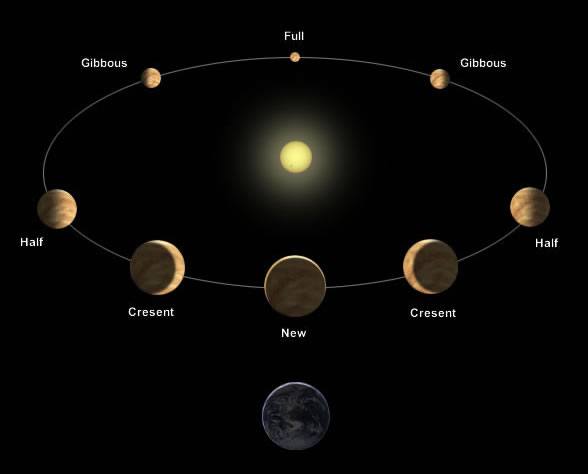
Another piece of compelling evidence of the existence of a heliocentric solar system was the discovery of Venus's phases by Galileo Galilei. How was Galileo able to observe these phases with the Sun in the way? Did he simply view only early waxing and late waning phases? I find it questioning how Sunlight did not prevent him from observing the planet. Venus's phases are as shown in the image below:
phases_of_venus.jpg
 
Astronomy news on Phys.org
TheExibo said:
How was Galileo able to observe these phases with the Sun in the way? Did he simply view only early waxing and late waning phases? ...

That would be the obvious way

I find it questioning how Sunlight did not prevent him from observing the planet.

why ?, it's not too difficult to do, even for an amateur astronomer using just a little bit of careful observing
Venus can be observed till its very close to the sun

Dave
 
davenn said:
Venus can be observed till its very close to the sun

Also, Galileo's sky was probably a lot clearer than it is for most of us nowadays. :oldfrown:
 
  • Like
Likes   Reactions: Vishakha
Venus often appears as a star either in the early morning before sunrise or the early evening just after sunset. Venus is far enough away from the sun to be visible from Earth.
 
He did it the same way you can do it tomorrow morning with a pair of binoculars. Get up an hour before sunrise and aim your binoculars at the brightest object in the eastern sky. That's Venus. It will show a crescent phase.
 
  • Like
Likes   Reactions: Nugatory
Thanks for all the replies!

Wouldn't it be possible for us to see phases of Venus in a geocentric Solar System? Suppose that the Sun is on one side of a stationary Earth, and Venus is on the other. You can see a "full Venus". Now imagine both the Sun and Venus on the same side of the Earth, with Venus in between. Now we can see a "new Venus". Can't such an occurrence be described by a geocentric model?
 
It would, but the phases would look different if both Sun and Venus would have an Earth-centered motion. You need some way to get Venus between Sun and Earth sometimes and behind the Sun at other times.

Also, Venus is never far away from the sun in the sky (certainly not on the opposite side), you would need something additional weird going on preventing your scenario from happening.
 

Similar threads

  • · Replies 4 ·
Replies
4
Views
2K
  • · Replies 7 ·
Replies
7
Views
2K
  • · Replies 1 ·
Replies
1
Views
2K
  • · Replies 4 ·
Replies
4
Views
3K
  • · Replies 2 ·
Replies
2
Views
3K
  • · Replies 10 ·
Replies
10
Views
4K
  • · Replies 7 ·
Replies
7
Views
3K
Replies
17
Views
4K
  • · Replies 12 ·
Replies
12
Views
3K
  • · Replies 15 ·
Replies
15
Views
3K