How was this substitution possible?

  • Context: Undergrad 
  • Thread starter Thread starter InDireNeedOfHelp
  • Start date Start date
InDireNeedOfHelp
Messages
3
Reaction score
0
TL;DR
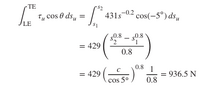
I'm currently going over Fundamentals of Aerodynamics by Anderson and am stuck on this tiny step of an example.
I'm currently going over Fundamentals of Aerodynamics by Anderson and am stuck on this tiny step. It is example 1.1 on page 26.

How is
1744898520535.png
equal to
1744898539567.png
? How was the 0.8 exponent taken out of the equation to make space for c/cos5?

1744898412261.png
?hash=f53d387e6e28ef240be978235c9a2f3f.png

Thank you in advance. Apologies for the formatting if it was confusing as I am new to this.
 

Attachments
  • 1744898429207.png
    1744898429207.png
    3.2 KB · Views: 67
Mathematics news on Phys.org
It looks like the book integrated ##s^{-0.2}## to ##\dfrac{s^{0.8}}{0.8}## using the usual antiderivative rule for exponents: $$\frac{d}{dx}\big (\frac{x^{n+1}}{n+1} \big) = x^n$$
 
PeroK said:
It just look likes the book integrated ##s^{-0.2}## to ##\dfrac{s^{0.8}}{0.8}## using the usual antiderivative rule for exponents: $$\frac{d}{dx}\big (\frac{x^{n+1}}{n+1} \big) = x^n$$
Hi! I understand that bit on how to integrate but I'm confused about this part: if c/cos5 = s
12, & s12= s2- s1, how is it that s20.8 - s10.8 = s120.8 = (c/cos5)0.8

Is my line of reasoning correct? Thanks
 
InDireNeedOfHelp said:
Hi! I understand that bit on how to integrate but I'm confused about this part: if c/cos5 = s
12, & s12= s2- s1, how is it that s20.8 - s10.8 = s120.8 = (c/cos5)0.8

Is my line of reasoning correct? Thanks
Without more context, I don't see it either.
 
##\dfrac{c}{\cos 5°}## is the length of ##\overline{14}=\overline{12}## that is the vector in the picture. Maybe it is the mean value theorem of integration.
 
fresh_42 said:
##\dfrac{c}{\cos 5°}## is the length of ##\overline{14}=\overline{12}## that is the vector in the picture. Maybe it is the mean value theorem of integration.
Hmmmmm. Thank you for replying but after a lot of thinking, I believe the author used s1 to be 0 so it canceled out. This would be the only way that s20.8 = s120.8 = (c/cos5)0.8.
 

Similar threads

  • · Replies 3 ·
Replies
3
Views
1K
Replies
6
Views
3K
  • · Replies 4 ·
Replies
4
Views
842
  • · Replies 4 ·
Replies
4
Views
3K
  • · Replies 1 ·
Replies
1
Views
2K
Replies
2
Views
2K
  • · Replies 3 ·
Replies
3
Views
2K
  • · Replies 19 ·
Replies
19
Views
3K
  • · Replies 0 ·
Replies
0
Views
3K
Replies
6
Views
2K